|
 |
 |
 |
 |
 |
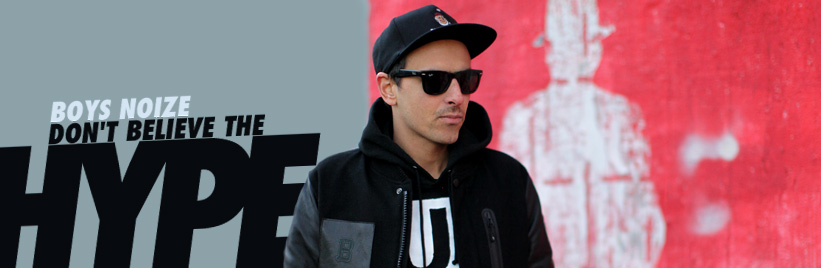
Boys Noize: Don't believe the hype
The Berlin-based DJ/producer talks house, graffiti and how Raster Noton influenced his last album.
Like any artist that has built a strong brand, there's way more to Alexander Ridha's past (and present) than meets the eye. An encyclopedic knowledge of deep house, for instance, borne of early slot gigs at clubs in his hometown of Hamburg. Or a fierce independent streak that led him to create his own label only a year after his first production under the Boys Noize name. Indeed, it's the age-old story of an artist determined to set himself apart that sees Ridha currently riding a wave of success that will see him among the headliners at this year's Sonar festival.
You grew up in Hamburg playing quite a bit of deep house, right?
Yeah, I think I have the full house history. I had an older brother, so when I was a kid at the end of the '80s, he had all the early Trax releases. I didn't know it was house or whatever at the time, but I liked the tempo and the rhythm. So when I turned 13 or 14, I started to buy all those records and started to DJ as well. I also worked in a record shop called Underground Solution in Hamburg, which was probably one of the most influential house records shop in the north of Germany. When I started to work there it was 1997. Around that time, I was listening to a lot of Force Inc records from Ian Pooley and all sorts of US deep house stuff.
Hamburg seems to be a real house city.
Yeah, totally. I think Hamburg, certainly if you compare it to Berlin, had a totally different sound. In Hamburg it was a true house sound, you had all the deeper stuff and the cool stuff and also towards the end of the '90s you had all the diva stuff, which I hated. Berlin had way more access to techno. In Hamburg there was only one club called Tunnel that I went to, but it wasn't really techno, it was more trance.
Why do you think you were initially resistant to techno?
The first techno I got in touch with was schranz, so I thought "oh, that's techno." I didn't know, for instance, the Underground Resistance stuff. In the shop I was working at the techno records we got in were just so fast and instrumental. I didn't like it.
Were there any DJs in particular that inspired you early on?
I didn't often have people like that, but one of them was DJ Hell. Those early days with Gigolo were so good, and he was always the guy who, even though the label became so big, tried to do the next thing. He never played the stuff that everyone else was playing, he was always a step ahead. That was always my idea of a DJ set as well, to play new stuff.
Also, I have to say when I heard 2manyDJs at first. That was a pretty big moment for me because they were just so quick with what they were doing with vinyl and the way they mashed-up stuff. That was something I wanted to do, but I wasn't able to because I didn't have four hands. [laughs]
"It's easy to make everyone go crazy.
It's harder to do something fresh."
You recently said in an interview that you try to educate your fans, but that you find it hard to do so. Could you expand a bit on that?
It might sound strange, but I think what is missing today in the scene is a little bit of culture. You know, just a couple of years ago when I DJ'd, it wasn't like everybody knew the track you were playing. I like that people had to really dig into the music and go to certain record shops to find the music.
You seem very old-school in that way.
Yeah. That's just because for the last 12 years I go and buy records every week. It's a big part of me. I started because I thought it was the coolest thing to do, I loved it. I was the only one of my friends—my friends were listening to hip-hop and rap—that was playing house and they were like, "Are you gay or what?" But it felt great because it was a special thing for me and I thought only I knew the records and no one else. Nowadays, I wish that a lot of DJs at festivals could stop thinking, "OK, I gotta rock the people" and take a step back. It's easy to make everyone go crazy. Scooter can make people go crazy. That's not a tricky thing. It's harder to do something fresh.
You mention being fresh, and I was curious about that. I've seen you talk in other interviews about how you thought people had taken what you were doing a few years ago as far as it can go.
Yeah, to be honest, I thought we came to the limit of that two years ago, and we just continued. It's incredible because back then it was easy to say, "OK, this is done now," because the DJs won't play it anymore, but nowadays it's changed because the music is so accessible for everybody. A lot of DJs aren't DJing the way they used to, where they would stop playing a promo once it came out.
There were always commercial DJs, but I think because of that stuff the style kind of continued and got stronger and stronger. Even though I was thinking that, "Wow. It can't continue like this. You can't play the same record over and over or the same style just from a different producer, but copy it a thousand times." It's the same with all sounds I think.
It's interesting you mention festivals in this context because I've talked to a lot of DJs that say that they almost pack their crate differently when they know they're going to play at a big event. You almost have to play differently when you get to a certain level. I guess no matter how popular you are, if you get to a certain level these expectations come in. It's what you do with that situation that is interesting.
For me, I was pretty radical with this. I remember two or three years ago playing my first gigs in the US at the SXSW Festival. I came with my vinyl records, and the first record I played was an Alva Noto remix from Byetone, and then the second track I played was Soundhack's "Devils Run." If I play a big festival in LA, I'd rather go there thinking, "OK, there's no way I can go there and just play the biggest records because that's what everybody's doing." Of course, I'm a party DJ, and I like to have fun with everyone. I don't want to go there and just do my own thing. I think that's a horrible thing to think as well.
Tell me about your studio. With your acid compilation on the label, I assume you have a few pieces of analogue gear.
It's a lot. I have a big analog studio, I have almost every Roland from the series. I started when I was 16 in the studio, we had a Juno 106 and a Nord Lead and a Virus. Back then it was a mix of digital and analog; I was using a lot of samplers. I was doing filter house, so I didn't need much. But I bought an 808 really early on and as I played more gigs, I got more money and more equipment. I have a lot of old stuff and new stuff as well.
Do you find yourself leaning on one machine more than others?
Well, with the Rolands, there might be a year or two when I don't use it and then after two years, I will use the 101 or the 909. There's a lot of new stuff that I'm into right now like all the Elektrons. I have all of them, even the new one, which is pretty amazing. There are a lot of German brands as well like the MFB. I like the MFB stuff because it sounds really modular. The MFB 503 is a great drum machine. I used that on the Gonzales album. I haven't got into a modular system yet just because I think it's too crazy, but the MFB stuff gets really close to it.
You mentioned the Gonzales album, and I've read that you've also done a collaboration with Spank Rock. Is that something that you're looking towards to get into more often?
Yeah, I'm trying out a lot of stuff right now for myself. I did a couple of tracks recently that are pretty techno, I think there could be something for, I don't know, Robert Hood's label or Ostgut Ton. I'm not sure about calling it Boys Noize or maybe something else.
I think the track on your last album, "Rozz Box," for example, could work at Berghain.
Actually, with that track I was pretty influenced by Raster Noton. I love all that stuff, it's amazing sound-wise. Alva Noto is just amazing.
Have you ever thought about doing a collaboration with him?
Yeah, I've been in touch with him actually. But I'm not sure. I would be up for it. But I'm not sure if he would.
That's interesting. I can totally hear the connection somehow between Alva Noto using, say, sine waves and the noise that someone like Justice creates with their distortion.
I think so too. It's about sounds, you know, whether it's a Justice record or an Alva Noto record. I don't care how they are generated. But if they sound good together in a context where you haven't heard it before…

How did you come up with the name Boys Noize?
I can't remember honestly. I probably stole it from some other stuff, I don't know. I was always doing graffiti and spraying and stuff so I was always thinking about names that are not actual names. When you tag, it's a combination of letters that look good.
You were doing graffiti when you were growing up?
Yeah, I was doing more tags. Tags always. I can look at everything out here and can immediately say, "These are the guys that can do it and these are the shit guys."
Which one were you?
Well I wouldn't call myself one of the shit guys of course [laughs] but I was doing it a lot...
Was it only in Hamburg that you were doing it? I guess you were doing it with all of the friends you mentioned earlier who were into hip-hop and stuff.
Yeah, exactly. It was a culture thing as well. I was always a little bit more extreme than the others in many ways. [I think this is how I] came up with the Boys Noize name. At that time I had a lot of aggression. Not anger really, but I just felt like I was DJing already in Germany for many, many years in every club under a different name and I just wanted to, you know, fuck everyone. Like "This is the way I'm doing it." I think it was a very positive energy actually.
Do you still have that same energy you think?
You get a little bit distracted from it when you work a lot on other stuff, like when I did a lot of label stuff two years ago. I was involved in so much bullshit. Right now, I have a partner, so now I'm only dealing with the creative stuff. But still you're having conversations with your artists every day about new stuff. It wasn't like five or eight years ago where you're just about creating music all the time. But I definitely have very strong feelings about stuff that is going on. My music is always a reaction.
|
|
|
|
|
|
Published / Wednesday, 23 February 2011
18 Comments
Photo credits /
Live at Metropolis, Montreal- Karel Chladek
Header and graffiti - Paul Clement
|
|
|
|
|
 |
 |

Features
|
|
|