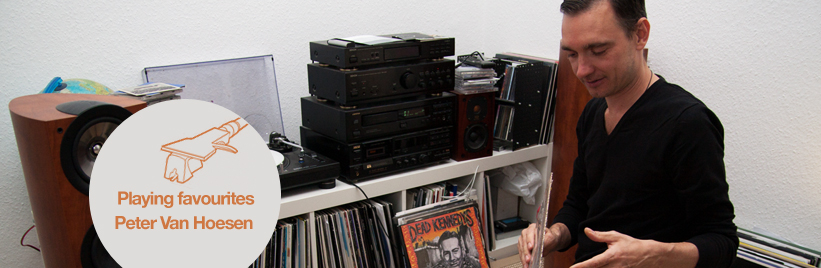
Playing favourites: Peter Van Hoesen
Todd L. Burns kills an afternoon flipping through the Belgian techno artist's record collection.
It seems like everything Peter Van Hoesen does is the distillation of something much bigger. Take his latest album, Perceiver, which was whittled down from a body of work more than twice its length (leaving a wealth of unheard material to fuel his live sets). Then there's his own musical style, which, as well-honed as it is today, comes from a vast and eclectic set of influences: Belgian new wave, '80s post-punk, industrial, and avant-garde all play at least as big a role as techno in Van Hoesen's musical history. This interview, too, was carved out of something big and unruly. When RA's Todd L Burns dropped by Van Hoesen's flat to talk about records, a casual chat somehow engulfed an entire afternoon. What you see below is roughly 15% of the original conversation.
Cocteau Twins
Wax and Wane
1982
The Cocteau Twins track that you picked was interesting to me because you can actually hear what she's singing about, which is a rarity for them.
It's from their first album, Garlands, which is very spaciously produced. They only have a drum machine, a bass guitar, a guitar and a vocalist, but it sounds like nothing else. It's almost because of all the delays on the guitar, it all becomes very blurry and widescreen. I think I picked that up when I was 16 or 17. I've listened to it a thousand times, and it's still one of my favourites.
Were you aware back then of labels? 4AD obviously had a lot of other bands that were interesting.
I had no clue. It was something I picked up at the library I think. Where I lived in Antwerp back then you could go to the library and get records. I was subscribed to three different libraries! So I was constantly going to libraries, getting out music, going to the other, recording everything that I liked. I started listening to the Cocteau Twins later works, and I like those albums as well, But Garlands, and specifically "Wax and Wane," that's where the sound is very pure.
TC Matic
If You Wanna Dance, Dance, If You Don't, Don't
1983
TC Matic was probably one of the most influential Belgian bands in the '80s. They were making some kind of crossover funk nuwave whatever, and they all were very good musicians and what I found interesting in the beginning was that most of their tracks have some kind of really weird time signature. The drummer and the bassist are animals, they're really tight. And then the lyrics: Throughout the album I think you've got five or six different languages and they're constantly changing in one song from French to Flemish to English. They were very Belgian, they mixed up everything. When they broke up, it was news on the national radio. They were huge in Belgium, and it always surprised me they were so big with that sound.
Have you ever seen Front 242 live?
Yes, three or four times.
How was it?
The last show was still one of the best concerts I've ever seen. They sold out one of the main concert venues in Brussels, so it was a hometown gig for them. I think they sold out three nights in a row, and I went to two nights of that.
So you're a super fan?
I'm a huge fanboy.
Do you remember the first time you heard them?
Yeah. Again, going to the library. It was Geography actually because I don't think anything else was out. At the time, I was reading Being There, this strange book about this guy who doesn't really have an identity. He's picked up and given a job as a gardener, and the only thing he's knows is gardening but somehow through his use of language he ends up being a close advisor to the President of the United States because he's always talking in metaphors. Somehow this book is stripped down and very minimal, and Geography is the same thing. It's very cold, made on an eight-track. I was immediately like, "Whoa, what is this?" It was only later I found out they were Belgians.
So it wasn't immediately obvious whether they were Belgian?
I didn't know enough about music back then to make connections you know. It was through them that I started finding out about other electronic bands from Belgium. Then, suddenly when you start digging, there's The Neon Judgement and many, many others. The list is quite long.
Why in Belgium did this stuff emerge?
I think a lot of people were influenced by punk, but not necessarily in sonic terms. Obviously there was no access for any Belgian band to the big rock circus in England or America. We knew as Belgians there was no way. Even if a Belgian band would have the perfect pop song with the perfect English lyrics, executed perfectly, you'd still be dealing with EMI Belgium or some very small piece of the puzzle.
It happened maybe twice, three times in the '80s, but Belgians knew, "This is not for us, we don't have access to that," so immediately you're driven off that path into something slightly more adventurous because, well, that's the only option.
I think it also has to do with this mix of things, Belgians are quite good at mixing things. The Neon Judgement did it with electronic music and a guitar. Front 242 starting to mix up their music with a very distinct graphical approach. Before that I'd never really seen a band that was really conscious about this connection between these two things. Mainly, I think it's because Belgium's a bit of an island.
Mike Parker
Geophone 17
2011
Mike's a university art teacher, so he does his own sleeves. I think they're beautiful, the Geophone label. Just the sleeves. But the music is… there's nothing like Mike Parker.
A lot of people might slot Mike Parker's sound alongside the Prologue crew. He's even released on the imprint. What makes what he does different to that in your mind?
I think Mike's sound is way more stripped. He doesn't really go into those long, hazy drones. Usually it's a kick drum, there might be some other element of percussion, then he goes for just one sound and he squeezes everything he can out of this one sound. He also works quite directly. He told me once that he does a lot of live takes, he just starts the machines and he starts tweaking and that's the record. I remember hearing Donato Dozzy play his remix of "Forward" at Labyrinth. And the original sound, to me back then on the dance floor felt like something electrical was coming out of the sky and just…like… infecting everybody. It was just one kick drum, one sound, that was it. There wasn't even a hi-hat. It was just a kick drum and a noise. That says everything about Mike.
I'm curious about this one because, well, he's a house music producer.
This one is connected to the label night we did in Panorama Bar last year. Most people would expect Time To Express to play in the Berghain, but we were invited to do a label night at Panorama Bar which was an excellent reason for Samuli, Donato and me to play a bit housey. I'm quite content where I am, but one of my small frustrations is that I rarely get to play out all these more house-y vinyls that I have. This track is kind of dreamy, a bit hazy and there's a very nice sensitive feel to it that I find. In a way it's something that I think is not that different from what I like. It's just an extension of my interest in trancey, psychedelic vibes and records.
Dead Kennedys
Holiday in Cambodia
1980
Are you a big punk fan?
I am, yeah. I’m not so well-versed in early punk, I think I started picking up on bands that were more active after '76, '77. I still listen to punk once in a while, and some metal bands even. The power and the directness of the music appeals to me with bands like Dead Kennedys. Also they had a sense of humour. Even when they were talking about dark political things it always had a kind of funny twist to it, sarcasm to the max. That appealed to me.
There’s not a lot of humour in your music. Or maybe it’s all inside jokes?
No, there’s not a lot of humor. It's two different approaches: I’m more into the research of the whole thing, where the Dead Kennedys went for the more immediate result.
How long does it take you to finish a track usually?
Long. Usually I start with something, I work on it for a couple of days then I leave it for four or five weeks just to get a fresh perspective on it, and then I come back to it, and then maybe in the best possible scenario I get it finished after another few days. Sometimes it might take three months, remixes always take a long time. Funnily enough, the track that I think most people know me from, "Axis Mundi" on Ostgut Ton, that was done in five hours on a train from Berlin to Amsterdam in my headphones and then refined in a couple of days, but that’s the exception. Usually it takes a while, and I forget about tracks as well, I make them and I think I’ll come back to them in six weeks, but then I forget about them cause I’m making new stuff. So right now I’ve got two or three hundred tracks in the studio and I don’t even know what they are.
Outer Space
Memory Bomb
2010
I closed Labyrinth with this record last year. I learned about this record through my friends from Tokyo. I was there, and we had a long listening session, and during that session I heard it and then went online and bought the record off Discogs for 30 or 40 euros. It's an amazing tune. The whole record is amazing.
And now he's playing at Labyrinth this year, right? I'm really curious as to how far it's come from its psytrance roots. A couple of years they booked Scuba. Last year they had Atom TM, instead of, say, Tobias DJing. It's definitely more and more abstract as time goes on.
It follows the listening patterns of the people who organise it, but in a way even through all these years I still see the connection with the past. This year there is a very clear connection between Outer Space and Petar Dundov and Labyrinth's past. I think this part of the strength and the uniqueness of the festival that they somehow managed to make it all work. You know, since the first time I DJed there in 2008, I can't remember a single DJ that hasn't fit. I do remember sometimes not being totally into it, but that's a matter of taste. I don't remember thinking a single time that they don't fit here, and that is not something that is easily achieved. That requires an enormous amount of research.
La Muerte
Lucifer Sam
1986
I saw the YouTube video for this, and my defining memory is that the lead singer was wearing a cowboy hat.
Yes, they had a style of their own, and were also a Brussels band. The singer was—or is—a filmmaker, and so from the start they were very concerned with imagery like you know like the cowboy hat. The live performances were unbelievable. I remember they once had a half naked woman on stage dancing, while the band made extreme noise and the singer would constantly roll over the floor and shout into the microphone. There was a whole scene in Brussels around that kind of more punky underground garage sound and it made an everlasting impression that concert. It was just so violent.
When you performed live at Mutek as part of Sendai, you didn't have any lights. Is that something you asked for?
This is a standard requirement for a Sendai concert. No lights.
Why?
There are two reasons. I'm not a big fan of electronic groups being in the spotlight, because there is nothing to see, so I don't think for us we should bother trying to be the focus, because what we do is about the sound, and it's about the visuals that we present. And that's the second reason: the less light, the better the visuals will come out.
For me, a dance floor should be dark. Obviously with Sendai we're not playing dance music, but the same principle applies, the dance floor should be dark because then people will not start looking at each other, they won't become socially aware of where they are, who they're with, who's looking at them, whatever. They become less self-conscious, and this will enhance their experience on the dance floor.
Everybody just looking up at a DJ… I think it makes no sense. You're not doing a rock concert. The raves in Brussels when I was younger, there was maybe a little bit of light on the DJ, but I don't remember people looking at the DJ, you were just on the dance floor dancing. This changed somehow, and now you've got big name DJs who are out there being rock stars. That's fine with me, but that's not dance music. Dance music is not only defined by how it sounds but also defined by where you experience it and how you experience it. I usually end up asking promoters to turn down the lights whenever I play cos the darker it gets, the better the party, it's usually like that, and several people have told me afterwards, "Hey, you were right." It's not rocket science. Give me some light so I can see what I'm doing, but you don't need to put a big spotlight on me. Just focus people's mind on the music and what they're doing on the dance floor which ideally is dancing, not texting.
Photek
Form and Function
1998
Were you ever into drum & bass?
For a short time—maybe eight months or so—I actually DJed drum & bass. I had this whole techno comedown around 1999 or 2000, I was totally bored, so then I started going through all possible genres that I thought were interesting back then. I bought quite a bit of drum & bass, and Photek... He didn't use the format, he made the format. Even now I regularly listen to it, not only to enjoy the music but to try and understand how he gets there, especially the early stuff. There's all this space in the music but there's the most inhuman programming going on, like, he must have like just sat there and programmed every note. He does really syncopated angular grooves, but then you find yourself kind of swaying. I probably understand it a bit better than ten years ago but it still gets to me.
I read an interview with him recently, and he said he got a bunch of money from this label and was able to sit down for a year and simply think about how he wanted the album to sound. I don't know if that type of thing is ever really going to happen again.
I think that would be difficult. I do think a lot about it my music, but to have that much space is probably not a good thing for me I think. I like having set goals to works towards. When I used to do music for dance performances, it was always very clear that in six weeks we have to do the music, and then we do rehearsals for four weeks, etc.
This is my favorite Robert Hood tune. He's done tons of amazing tracks, but that for me is still the one. It's a little bit joyful, the melody line gives the track a personality. There is almost something human in there. But the other tracks on the double pack, they don't really have that. They're really alien sounding, minimal masterpieces, but that one has a bit of funk.
On your new album, is there a song that's kind of an outlier in your mind?
An outlier? No, I don't think so. For this one, the original idea was to have two albums, one with tracks that are vaguely in the line of the first four/five, not conscious of the dance floor. Techno but not really danceable. The second album was going to be eight dance floor tunes. By the time I had them finished, I had them in two iTunes playlists and I was just listening to them and neither made any sense to me, and then I started just dragging tracks from one playlist into the other and there was an "aha!" moment. So I just deleted the idea and went for one album, but vaguely the outline is still there. The first part is kind of more researched...
You use the word research a lot.
Yeah. That was very important for this album. To go a bit deeper, find unusual connections. A lot of the tunes that didn't make it are far more experimental than the ones that made it, but somehow I thought there was something missing with those… I don't know.
So do you have a bunch of stuff that you're going to use elsewhere?
I've actually decided to not release most of the material. Instead, I'm going to work it into the live sets so that the live set really becomes a thing on its own. Obviously I'll play some of the versions of the tunes that I've made before, but the idea is to have at least half of the live set will be material that will never be released.
Population One
Transition
2012
I think Terrence Dixon is really interesting.
He's totally his own man, isn't he? He doesn't take any of the usual formatting into account. It just builds and builds and builds. It's very airy and dreamy. I bought this for Labyrinth. He's just diving deeper and deeper into his sound and with this record that really stands out.
He's obviously in Detroit, and I get the sense that when you say that he doesn't take any of the usual formatting into account that it's because he isn't touched by a lot of what's going on in Europe. I just wonder if someone like him came to Berlin and was at Berghain every week that it would change everything.
I think it depends on where you are in your journey. I think for a lot of people who are still questioning themselves musically, this could be a very interesting city because it could orientate you to so many different sounds. But I got my big inspiration boost at the end of the '90s, and it actually hasn't really changed.
The inspiration for techno lapsed for a bit, you mentioned. What brought you back?
Sitting down and thinking, "OK, electro's out, drum & bass is out, breakbeat is out. What do I do now?" I was making experimental music as Object, but that wasn't getting me anywhere.
Did you literally sit down and think about this?
Yes, because I knew that I had decided already that I wanted to make a living making music. I was making a living, just. And I felt that just there was a drive within me that wanted to have more time to make music, but I thought, "OK, if you want to have more time for making music you should try and find out exactly what it is that you want to do, because when you find that out, you’ll make better music and you'll be able to make a living." And I knew I wanted to make techno. It’s really about being honest with yourself. There was a period where I thought that it would be uncool for me to make techno, I don’t know why, but eventually I got over that.
Was techno uncool around that time?
For me it was, because I was deep into experimental things and it was like "yeah, techno, I did that years ago, whatever." But then I found out that you can actually be quite experimental doing techno.
I had no idea who this guy was, and I listened to the track and I thought, "this is kind of dusteppy, but no not really..." Then I looked into it and was like, "oh, OK."
Most of the tracks that were released on Fuel, the label that he worked for, are just prime examples of what you can do with bass, I mean you have to listen to this on a proper system, it is totally amazing. I first heard him at a festival in Belgium years ago, and I was thinking, "is this guy a drum & bass DJ playing his records at 33?" It had so much impact because there was so much space that he could use, he could really play with the frequencies. On the same release there is a track which is maybe three minutes long, and it’s just this really low 60 hertz bass going "wwwwooooo... wwwwooooo... wwwwooooo..." When you play it on a big PA, everything starts to rattle.
Is there something I could listen to on one of your records that you put in there, knowing that if you’re listening to it on a shitty system, you wouldn’t necessarily get it?
I think most of my music you won’t get on a shitty system to be honest. You really need a proper system to get everything out of my music. And not only my music obviously. I was recently very unhappy with a review on RA of one of the remixes I did where the reviewer wrote that there was very little bass to speak of in my track. I thought, "How did you listen to this? Did you listen to it on laptop speakers or just a really shitty system? Maybe that’s possible, but then that’s not the right way to review it. You have to experience it in the setting for which it was made, and that’s at a proper club, that’s what this music is made for and all the experimental music I did was even more of that.
Obviously this music is not made to be digested just in front of your laptop, and the way we presented it back then was by using big systems and big venues and by bringing people into a space where the sound is set up in four corners, they can sit down or lie down, they can relax, and then you give it to them. We had one band on Foton, Ultraphonist. At the end of their concert there was the sound of a Boeing 747 flying over you, you just had no idea what was happening. They did 40 minute shows, it was just one crescendo, not much happening above 600 hertz, it was mostly bass, you were being just totally flattened by the sound, and after 40 minutes they would just cut it, and this void that you would be thrown into, the sudden silence, was one of the most amazing experiences I ever had. But if you listen to the CD that they made for us, on a normal system, you’re not going to get anything like that. It's that kind of music—it's extreme.
|
|
|