- Audio Damage is developing a growing reputation for building great-sounding and substantially left-of-centre products. The latest is no exception. Phosphor is modelled on the alphaSyntauri, a quirky additive synthesiser released in 1979 which originally required an Apple II to work. Times have changed since then so while half of Phosphor could certainly be classed a homage, there's plenty on offer for the 21st century producer here too.
Phosphor offers its control set via a single pane which is welcome at a time when many synth plug-ins have become riddled with parameters buried in sub-pages and menus. At the top you'll find the two oscillators but these are unusual, as they offer additive synthesis rather than the subtractive approach common to most hard and software synths. Additive synthesis provides a number of partials, which are effectively sine waves offering different frequencies. While each sine wave is pure, as you begin to add additional partials, the produced waveform becomes more complex and the range of sounds you can produce grows exponentially. Phosphor offers 16 partials per oscillator and to make sounds you simply add in the partials you want by turning up their level sliders. Neatly, the resulting waveform appears in the window behind these so you can see the sound develop in real-time.
This is only step one, however, as the two oscillators can interact in various ways. The frequency of Oscillator 1 can be modulated by that produced at Oscillator 2 and, unusually, the same thing can happen in reverse, so that ever-more-complex sounds can be created from cross-modulation. Whereas the majority of oscillator choices within traditional subtractive synths prioritise the volume of harmonics close to the fundamental frequency, Phosphor allows you to work differently. You could establish a low partial, for instance, ignore the next few and then add additional content using just the highest partials, creating weird and wonderful tones. This would be powerful enough with a single Oscillator but with two and their cross-modulation possibilities, Phosphor is already a sound design dream come true.
Also unusually, there's an envelope for each oscillator at the initial waveform stage. Most synths feature envelopes which can be assigned to a range of parameters but Phosphor's do one thing only—amplification change on a per-oscillator basis. Underneath the envelopes, each oscillator then features its cross-modulation slider, another to introduce Noise generation plus Pan and Velocity Amount sliders. Lastly, each Oscillator features Level and Pitch Offset sliders with +/- 10Hz of pitch change available to each sound source. This narrow range represents a rare weakness among Phosphor's capabilities but, to compensate, the Noise options are wonderful. There are two flavours here—either straightforward white noise, or a Vintage option which is crunchier and more lo-fi. Both dramatically increase Phosphor's already impressive sonic potential.
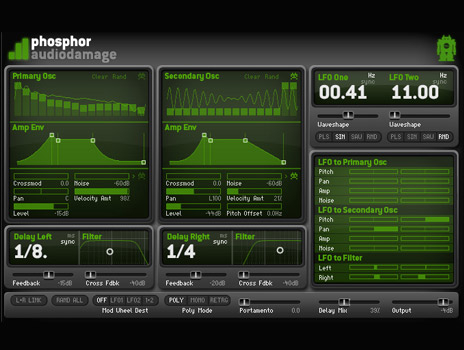 On the right-hand side, twin LFOs lie in wait. These can be sync'd to your host's tempo or left to run free and while only four initial shapes are offered (Pulse, Sine, Saw and Random), a Waveshape slider lets you warp them. Beneath these parameters, a matrix lets you assign each LFO to the targets of your choice with amount dials to offer the LFOs into Pitch, Pan, the Amplifiers or the Noise generator for both oscillators.
At the bottom of the GUI, there are independent delays for the left and right hand channels which, like the LFOs, can be clocked to tempo or set in milliseconds. These effects can be filtered and again, they can cross-modulate from left to right making them more flexible than they first appear. Get used to the delays—they're built into the vast majority of the presets, though a Delay Mix slider in the bottom right-hand corner lets you kill their effect if you want dry sounds.
Alongside this slider at the bottom, you can set up LFO 1, LFO 2 or both as your mod wheel control source, while there are options for mono, re-trigger or polyphonic playback, Portamento amount as well as the option to Randomise all parameters. Anyone who read our Sounding Off piece a few weeks ago might not be surprised to discover that I really like this feature as it can throw up some inspiring results. If you prefer a more localised randomisation, this function can be applied to each oscillator individually, preserving all other parameters.
All in all, Phosphor might not sound as though it offers the most comprehensive set of controls and, for those used to myriad modulation options, it certainly falls some way short of other available plug-in synths. However, this plug-in behaves in a completely different way to any other synth I've come across and so what it lacks in traditional parameters it more than makes up for in terms of raw originality. If you want bell-like sounds, cheesy '80s digital keyboard tones, 8-bit style computer game sounds (complete with lo-fi noise), vintage pads or weird and wonderful one-off effects, Phosphor has it all. For the $59 asking price, this synth is a creative and inspiring bargain.
Ratings /
Cost: 5/5
Versatility: 3.5/5
Sound: 4/5
Ease of use: 4.5/5
On the right-hand side, twin LFOs lie in wait. These can be sync'd to your host's tempo or left to run free and while only four initial shapes are offered (Pulse, Sine, Saw and Random), a Waveshape slider lets you warp them. Beneath these parameters, a matrix lets you assign each LFO to the targets of your choice with amount dials to offer the LFOs into Pitch, Pan, the Amplifiers or the Noise generator for both oscillators.
At the bottom of the GUI, there are independent delays for the left and right hand channels which, like the LFOs, can be clocked to tempo or set in milliseconds. These effects can be filtered and again, they can cross-modulate from left to right making them more flexible than they first appear. Get used to the delays—they're built into the vast majority of the presets, though a Delay Mix slider in the bottom right-hand corner lets you kill their effect if you want dry sounds.
Alongside this slider at the bottom, you can set up LFO 1, LFO 2 or both as your mod wheel control source, while there are options for mono, re-trigger or polyphonic playback, Portamento amount as well as the option to Randomise all parameters. Anyone who read our Sounding Off piece a few weeks ago might not be surprised to discover that I really like this feature as it can throw up some inspiring results. If you prefer a more localised randomisation, this function can be applied to each oscillator individually, preserving all other parameters.
All in all, Phosphor might not sound as though it offers the most comprehensive set of controls and, for those used to myriad modulation options, it certainly falls some way short of other available plug-in synths. However, this plug-in behaves in a completely different way to any other synth I've come across and so what it lacks in traditional parameters it more than makes up for in terms of raw originality. If you want bell-like sounds, cheesy '80s digital keyboard tones, 8-bit style computer game sounds (complete with lo-fi noise), vintage pads or weird and wonderful one-off effects, Phosphor has it all. For the $59 asking price, this synth is a creative and inspiring bargain.
Ratings /
Cost: 5/5
Versatility: 3.5/5
Sound: 4/5
Ease of use: 4.5/5