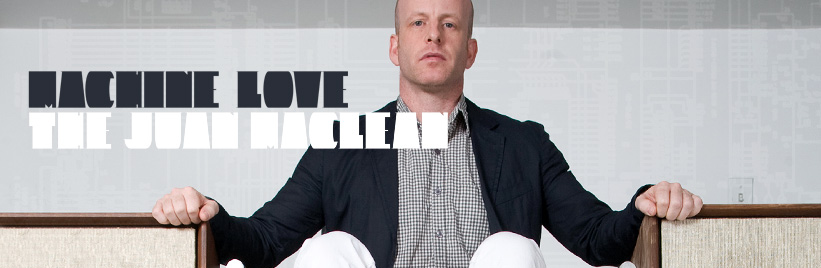
Machine love: The Juan Maclean
RA continues its new feature series, Machine Love, with a look into the working methods of a man devoted to hardware: The Juan Maclean.
The Juan Maclean just released his second full-length album, The Future Will Come, earlier this month. His history goes far beyond the two albums he's released since 2005 under that moniker, however. John Maclean's music career started in earnest in 1992 when Sub Pop signed an up-and-coming post-punk synth rock band from Rhode Island called Six Finger Satellite. Maclean got his start as a guitar player, helping to create a sound which to this day is lauded for its forward-thinking fusion of electronic and post-punk.
Maclean's current endeavors wouldn't be possible without those roots. James Murphy, of LCD Soundsystem and DFA fame, convinced Maclean to get back into music following a lengthy hiatus after the break-up of Six Finger Satellite. And, for that much, we owe him thanks: Since rejoining the music world, Juan has released several big singles, a critically-lauded debut album Less Than Human and amassed an imposing remix resume for artists ranging from Daft Punk to Matthew Dear.
Having caught Juan's live show with LCD Soundsystem recently, it was immediately evident that this was a man who knew what he was doing around his gear. So on the eve of his new album's release, we caught up with him to discuss his recording process and to talk about what went into the making of The Future Will Come.
Can you describe your studio setup for The Future Will Come? What's the breakdown of hardware vs. software?
In general, everything I use in the recording process is in the world of outboard hardware. The only software I use is Logic and Recycle. I am still using Logic 7. For me, when Apple took over Logic it began to look and feel like some sort of consumer video game, so I'll continue to run this version for as long as it is compatible with available hardware.
In terms of hardware, my home studio setup is pretty extensive, mostly in terms of my analog synth collection. I have struggled over the years with finding the perfect small format mixer. I've been through a few, and at this point I am using a 16X4 Mackie Onyx. It's pretty neutral sounding, and the best I can say about it is that it doesn't sound bad. My dream would be for someone to make a 24 channel line mixer with direct outs on every channel and decent op amps (as opposed to horrid IC's). I have a bunch of outboard mic pre's with high impedance direct inputs that I run all my outboard gear through whenever possible. These include Neve 1272's, API 550's, Universal Audio 610, and a bunch of older weird things like a couple of tube amps that were taken from an old Ampex tape machine. Another key component to the sound of my stuff is my use of certain compressors. I am a big fan of the dbx 165a, it is quite gritty in the midrange. I also use the dbx 162 on the mix bus for nearly everything. I use a pair of Purple Audio MC77's on a lot of stuff too, mainly percussion things like claps or congas. And finally, a Urei La2a.
As far as my outboard synths are concerned, there are just too many to list completely. Some key players are: Roland SH101, Moog Voyager and Rogue, Sequential Circuits Prophet 600, Roland Juno 106, Future Retro Revolution, lots of old Casios, Waldorf Q, Wurlitzer, Rhodes, EMS synthi, Arp Axxe and String Ensemble.
Did you record in a traditional studio or on your own?
Generally, with everything I do, I start off in my home studio and end at the DFA studios. For this album, I threw in another studio in the middle.
I start by writing these sort of rough outlines of songs in my home studio. I do this by using either drum machines or old drum samples I've accumulated to program drums sounds, and sequencing most of the keyboards via midi.
For this album, I then went to Flymax studios in Woodstock, NY, with Alex Frankel and Nick Millhiser of Holy Ghost, who have both played in my live band. Engineering this session was Eric Broucek, who was also a member of The Juan MacLean, and the long-time assistant engineer at the DFA studio. At Woodstock, we then started replacing many of my programmed parts that I had done at home with live playing. Nick replaced many of the drum parts with live drumming. Alex would replay keyboard parts by hand, and write new parts like strings or pad type things.
Basically, we just tracked as much stuff as possible, everything from playing pre-written parts to just jamming from nothing. Also, Nick and Alex brought a whole van full of their personal gear, which included even more analog synths and keyboards that I don't have. We just filled this studio with vintage gear. The studio itself was entirely analog as well. It had an old API 550 series console, and we recorded everything on a Studer 2-inch tape machine. Since it was in Woodstock, home of the hippie festival, there were many lost days where people showed up flying on the acid that seemed to be everywhere, and we would jam for hours on end, venturing off into this psychedelic disco freak out type journeys.
"Alex Frankel called me from Australia a few weeks ago....yelling at me about quantizing the hi-hats."
I then took the Woodstock sessions material and brought it back to my home studio. We dumped all the 2" tape down into Logic. At home, I once again went through and edited all the live playing into song structures, do more detailed sound processing, chop up and sequence the drums, stuff like that.
Once I had the structures place again, Nancy Whang and I went back to Flymax to do vocals. We went up there alone, with me engineering. We arrived with our basic vocal ideas, but mostly we sat in the studio and wrote together, often writing lyrics back and forth to each other. Nancy did a bit of engineering as well, when I would be doing vocal takes.
In the final stage, I went to Plantain, the DFA studios in NYC, to do the final mixing, mostly with James Murphy. The control room at Plantain is built around a 48 input Oram console, and it is the place where I am most comfortable mixing.
It seems like part of your signature sound is sequenced live drums. Do you usually pull from the same sample base, or do you record new drums for each individual song?
I never use drum samples. For every song that has live drums, there is a live drummer playing them, either Jerry Fuchs or Nick Millhiser. What you are hearing is a drummer actually playing to that song. I don't use drum samples from other recordings or reuse my own drum samples. Even handclaps are done for each individual song. I do, however, go through and edit the drums. I quantize them, but often just the kick and snare, leaving the hi-hats alone. This can be irritating to DJs. Alex Frankel called me from Australia a few weeks ago, Holy Ghost were DJing at Big Day Out. They were playing "Happy House," and Alex realized that the hi-hats weren't quantized and that's why he could never get them to line up properly. So he called me and yelled at me, I could hear it pumping through the sound system, and he's yelling at me about quantizing the hi-hats.
The 303 / acid synth sound also seems to creep through a lot of this album. Is that a sound you find yourself reaching for often? Do you use the TB-303 or a remake (Future Retro / x0xb0x / software)?
I use both a TB-303 and FutureRetro Revolution. I love acid house, have been enormously influenced by it, but I try to use those acid sounds in a different way. Basically, I try to use acid sounds in a sort of pop music format, or just in a context that you would not normally associate with that sound. It's such an identifiable thing, it's tempting to just immediately fall into a traditional acid house arrangement. But, for example, the sequenced bass line on "The Simple Life" is actually a 303, but it doesn't really sound like one because the cutoff on the filter is pretty closed.
What's your normal technique for recording vocals? How does it differ when you record yourself vs. recording Nancy?
I am mostly singing in a low register that is slightly below my real range, so I rely a lot on proximity effect and microphone selection. For me, I use a grittier condenser mic like a Neumann TLM 193 that I can get right up on it and sort of "play" the proximity effect in terms of how the bass is resonating with my voice. For Nancy, we'll use a bit clearer mic, like a Manley tube mic.
We both prefer to be alone when doing vocals, and it seems like they usually get done in the middle of the night. I record a lot of mine alone in the control room, and I'm sure most of them get done after 2 AM. When Nancy does hers, sometimes we'll just loop the song in Logic while in record mode, and I'll leave the studio for a half-hour or so while she does hers.
The credits for "Tonight" attribute the flugelhorn to you. Did you actually play a flugelhorn?
No! I don't even know what a flugelhorn is. That sound is actually the "flugelhorn" preset in my DX7. Most of us around DFA had grown up viewing the DX7 as a sort of pariah. It was the first big digital synth to be made commercially available, and for a period of time it was heralded as the technology that would make analog synths obsolete and useless. In fact, compared to the analog synths it was looking to replace, it sounded cold and sterile, if not comically unlike the real life sounds it was looking to imitate. However, I had read that Brian Eno was rumored to have used one on Music for Airports, so I went out and bought one. It sat in my studio for years, untouched, until I started making this record. For some reason I dragged it out, and it actually got quite a bit of use, especially the awful presets that are meant to imitate instruments like the saxophone or flute.
How do you deal with the upkeep of vintage / analog gear? I'm guessing NYC probably has some good techs.
There is one place we use, but it has gotten absurdly expensive, no matter where you go. Most of the time you're stuck with having to pay nearly the amount it would cost to replace the thing you're having fixed. I can fix some things myself, but I often don't have the time. Recently I had an SH101 fixed and it cost me almost $400. But everyone at DFA owns a lot of gear that is at the point in its lifespan that it is all breaking down constantly. Gavin Russom used to work at the DFA studio, and he was really good at fixing stuff. We used to call him The Wizard.
The Juan Maclean live
I have a near anxiety attack every night we set up our gear and turn it all on. I'm always somewhat surprised when I turn on my SH101 and it still works. The only thing that is really sequenced or clocked is the Moog Voyager, which is synced to an MPC2500. The Voyager is what produces the basslines. Everything else is played live.
But we do have a mountain of gear on stage, though not as much as LCD, and it is mostly vintage analog type stuff. There are little horror stories, like Jerry's (Jerry Fuchs, drummer) Simmons drum brain dying just before we were about to play a festival in Barcelona. Just standing on stage getting ready to play and realizing that something like that, something that is such an integral part of our sound, is not working.
Probably the most embarrassing scenario occurred in LA last September, at the El Rey. Somehow the Voyager ended up in a different set of sound banks, and we couldn't figure out how to get it back to the original bank where all of our sounds were stored. Unbelievably, me and Nick ended up getting out the manual and reading it, in the middle of the show, while standing there in front of a full crowd, trying to figure it out. I actually asked if there was anyone in the audience who was familiar with them.
One time we were in Bristol, in England, a few years ago, some members of the band had taken a fair amount of drugs before the show, mostly things like ecstasy and cocaine and mushrooms. I was using my older MPC at that point, and during the breakdown part in "Crush the Liberation," somehow I had managed to unknowingly raise the tempo from 120 to 180 BPM. So the song kicks back in and it's blindingly fast, and we all looked at each other and just jumped in and played furiously along.
People went crazy, they thought it was part of the show. I think Jerry threw up after, but he never missed a beat. He is like a machine, the best drummer in the world as far as I'm concerned. I was hoping that you could choose a track off of the new album that you could break down and give us some details around the production.
The song "The Station" is pretty representative of the way a lot of the tracks on the album were done. I had written the basic parts of the song at home, using drum samples and mostly sounds from my Waldorf Q. I took these tracks to the studio in Woodstock, and the first thing we did was have Nick replace the drum parts. I had actually written an entirely different drum pattern, but Nick came up with something with a really nice Kraftwerk style hi-hat pattern. Then Alex replaced my bassline by playing the same line by hand, I think on a Prophet 5. I replaced the little arpeggiated melodies with an SH101, again playing them by hand directly into an Echoplex. Alex also added the string pad, which was a part he wrote in the studio, and I believe it was done with a Roland Juno 106. We recorded all of these parts through Neve 1073's into the API console.
Next, Nancy and I went back to the studio at Woodstock to do the vocals. For this song, we sat on the couch in the control room writing the lines back and forth to each other. When we had the vocals parts fleshed out, I set up two different mic stations, so Nancy and I were singing our parts in the same room, facing each other.
I then took all of this back to my home studio, where I recorded the synth leads, which were done with an SH101 plugged into the UA610 and a 165a compressor.
Finally, I took it to Plantain, and it was mostly done at this point, so it was really just a matter of mixing the song down. James came up with the idea of fading it out at the end.
If you had to strip your studio down to five items (not including recording / monitoring tools)—what would they be?
Akai S6000, FutureRetro Revolution, Korg SQ10 sequencer, Roland SH101, Moog Voyager.
Got any advice for the up-and-coming producers out there?
I'm a big advocate of getting outside your computer, using as much hardware as possible. I made so many tracks with just a few pieces of gear, like my old Akai S1000, Waldorf Q and a Juno 106. Just having stuff like that and a cheap mixer sounds loads better than doing everything in the computer with soft synths.
| | |