|
 |
 |
 |
 |
 |
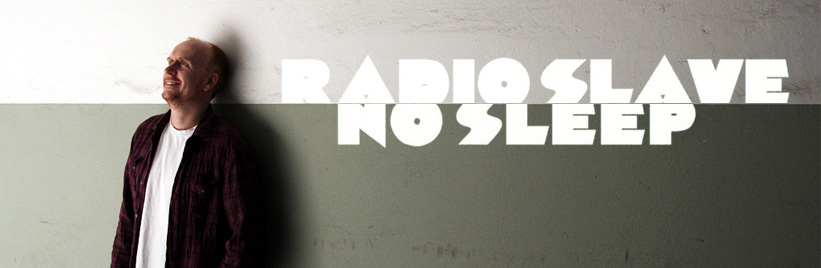
Radio Slave: No sleep
It would be difficult to conjure a name as deeply etched upon the narrative of contemporary electronic music as Radio Slave.
What began as a tongue-in-cheek, remix-based venture, conceived to skim the froth off the outermost layers of pop music has since mutated almost beyond recognition; twisted and transfigured into the snarling, techno-drenched beast that has come to represent the name's current incarnation.
Matt Edwards is, of course, synonymous with the old adage of having a finger in every conceivable pie. The Radio Slave name has seeped a perpetual stream of 'floor ready material in recent years, leading to an upsurge in demand for Edwards' DJ appearances across the globe. His work alongside close friend Joel Martin as Balearic brothers-in-arms Quiet Village dragged the duo in the direction of the sofa-bound mainstream last year, thanks to their exotic debut Silent Movie. Embodying the stereotype of a modern, multi-faceted musician, Edwards has—alongside the London-based James Masters—headed-up the Rekids imprint since its inception in early 2006, steering the ship on a course of worldwide recognition and healthy levels of commercial success.
But is he content? Of course not.
What's clear from an afternoon spent in Edwards' company is that his is a tale of an unquenchable desire for reinvention: Everything—including the continued existence of the Radio Slave project it seems—is open for debate. Far from finding success and receding to a comfort zone, Edwards' responses are littered with probing open questions aimed squarely at himself. Edwards tellingly wears the frown of a music industry veteran; weathered by issues such as imitation, piracy and "selling out," yet remains as amorous and passionate about music as the day he first clapped eyes on his true love: vinyl.
What was your gateway into the music-making process?
I guess from getting really caught up in nightclub culture during the '90s and becoming a DJ. I had my first gig at the Milk Bar in London around 1991. I got so caught up in it that when I met two guys in '93 who had a studio, I got properly into making music. It was purely using hardware. But [I was] in a more background role, saying, "I like this, I like that," so it wasn't really hands-on, which I found really frustrating as I'm a creative person. My background is in graphic design and art, so I always liked to be hands-on. I subsequently lost interest in it after a while although I was still very much a music enthusiast, collector and DJ.
Did you undertake any sort of formal musical training in those early days?
No, none at all. It wasn't until I got back into it in 2000 with Serge Santiago that I realised how accessible making music with a computer was. I hadn't really seen this up until that point. I'd been so detached and caught up in DJing and other aspects of life that I hadn't really thought about doing it. I was actually able to realise a lot of the ideas I had had for many years by using a PC.
It's interesting that such a big deal was made of your use of Fruity Loops back in those early days. Is this something you still use?
Yes, I do still use it a bit, but I don't think that's important, as it's what is in your head and your imagination that matters. I don't think people should get caught up in programs—in a lot of ways they will dictate how you make music.
This is linked to a massive problem I have in life, which is to do with imitation, which goes from fashion to art to music; everything. A lot of people make a living by imitating other people. There are a lot of people who make dance music who are very successful and all they're doing is imitating their peers. To such a degree that I think there are certain DJs and producers who are just copying each other and I just end up thinking, "What's the point?" Perhaps a lot of less creative people look for that when they're making music. I have absolutely nothing against the technician side of music because it does involve being a real craftsman. Some people are great at that, but not at being an artist. They know how to build something, but not design it.
J Dilla essentials
Matt Edwards
Slum Village - "One" (Instrumental)
This what got me obsessed with Dilla: Weird ass 4/4 beats and a crazy piano stab that slowly morph into a slow italo disco groove... Totally inspiring and timeless.
J-Dilla - "Big Booty Express"
Proper Detroit beatdown. This is the real sound of the Motor City. If you don't have this, make sure you buy both versions of the LP for the vocal/instrumental versions.
Common feat. Erykah Badu, Pharell & Q-Tip - "Come Close" (J-Dilla Remix)
The original song was really cool, but Dilla killed it with his remix. Low-slung and super rough production that showed the major labels that his sound could be commercial, but still retain that underground vibe. I really loved that he always kept the soul in his work. I miss him! I wanted to bring up the subject of hip-hop, as I know this played a large part in your early musical development. Is the hip-hop scene something you still draw inspiration from?
Probably not. I'm not really following a lot of hip-hop these days, although I still buy a few albums. J Dilla was one of my heroes and since he died there has just been a steady stream of imitators.
What do you make of the supposedly Dilla-influenced crop of artists who have come through recently such as Flying Lotus and the LuckyMe crew?
I wouldn't actually ever compare what Flying Lotus does to Dilla. I think Dabrye from Ghostly International is really good, and some of the stuff from Amsterdam like Jay Scarlett is interesting, but again I think a lot of it is simply borne out of imitation. I think J Dilla was really unique. It's actually a shame Pharell Williams doesn't make music anymore—or if he does I'm not hearing any of it. Things like "Drop It Like It's Hot" and the last Clipse record were amazing and were really pushing things forward. We [Rekids] are about to release an LP from Atlanta duo Jjak Hogan, which in my biased opinion is the sort of hip-hop I've been waiting for.
Your remix work has in many ways defined you as an artist. At this point in your career how selective are you?
I'm trying to move away from doing remixes of dance tracks; they're the most difficult because people expect you to make something out of perhaps only eight or nine parts. If it's already a techno track, then you can't really do much with it. I much prefer working with vocal tracks which—when I look back—was what I was doing much more of a few years ago when I was living in England: the major label stuff, which I really enjoyed.
You've been quoted in the past as saying the Radio Slave project is centred upon club tracks and wouldn't necessarily lend itself to an album format. Do you still feel this way? And will we ever see a Radio Slave album proper?
We are in fact releasing a Japanese-only album this month with all the "No Sleep" tracks. [But] I'm not even really sure if I will continue with the Radio Slave project beyond this year.
Would you consider another wholesale shift in musical direction such as the one in 2006, rather than ditch the Radio Slave name altogether?
The older I get I'm starting to think that I'd rather just release stuff under my own name. The Radio Slave name was originally just used as a remix vehicle to get jobs. I was working with someone else and I was doing a lot of re-edits of pop tracks so the name obviously worked. And then it became this monster and turned into something else. I always wanted to kill it but a lot of people were saying to me, "You've done this, so why spend another three or four years building a name up again?"
Let's talk about Matt Edwards "the DJ." You've mentioned in the past that you're a fan of the "classic mix," in other words, drawing tracks out and extending mixing. Do you feel that your DJ style has intrinsically impacted upon your production career and vice versa?
I think I will always instinctively go back to where I came from musically with regards to dance music. I was lucky enough to experience some amazing DJs playing in London during a really interesting period of the music's history when people like Larry Levan were playing at Ministry Of Sound. He used to play the same record for half an hour, playing all the different versions and still kept it interesting. You could make comparisons with someone like Ricardo: He can build drama by playing a single record and teasing and stretching it out. But there are only certain people who can do it really well, and Levan was one of them. I actually have a lot of praise for DJs who play a track two or three times during their sets.
Is this something you do yourself?
Sometimes. You don't get many DJs doing it nowadays. I heard Luciano do it once at Panorama Bar where he played Audion's "Mouth To Mouth" three times within the space of five hours. At the time it was a brand new record, and everyone wanted to hear it. If you're at a house party and someone plays a record that you like, you would ask to hear it again so there is no reason it can't work in a club.
At the risk of making it sound like a marketing ploy, do you have a mission statement or something you set out to put across as a DJ?
Not really, but I do think it's difficult for a lot of DJs, including myself, when you're playing a guest spot. To express yourself musically in the space of two hours—sometimes even 90 minutes or less if you are playing at a festival—makes it incredibly difficult to set your stall up and try and sell yourself and present yourself as a DJ. That's why it's so much fun when we do our Rekids parties at Panorama Bar. It's these sorts of parties where you can really get into mixing and playing records that you really want to play.
How long would you personally need to put your message across?
Not a great amount of time. I'm actually enjoying playing with other people a lot more recently. I had the chance to play quite a lot with Marcel Dettmann and Gerd Janson recently who are people I really respect musically so it's a lot of fun. Marcel is really great to play with: he's enthusiastic, really vibey and has a lot of energy. We've played together in Berghain and Panorama Bar.
What destinations are you drawn towards playing internationally?
I have always loved Tokyo and I think Japan in general is the best place in the world to play, although Berlin is always good fun of course. The people are crazy which is always a spectacle and the clubs are really amazing and all run properly by music lovers which I haven't experienced in any other city apart from Tokyo and other places in Japan.
There seems to be a general consensus among traveling international DJs that Japan is one of the premier places to play. What is it about Japan that is so exciting?
I think the whole way that they have digested Western culture, music, fashion, design and the lifestyle. They are also incredibly passionate about other types of music like jazz. I find it's the one country where you don't have to play any hits; you can just play what you want. I played once at a place in Osaka and got it down to 87 BPM in the middle of the night. The slower it got, people were taking their tops off, screaming and totally vibing off it; they are just so into it. They know everything about me and I get the maddest requests. The girls there know all of the tracks and everyone simply dances.
What still inspires you to make music on a day-to-day basis?
Well, at the moment I feel there is this kind of modern sound that I can hear in what Luciano does, and maybe Ricardo. I can hear that there will be this organic, electronic sound coming through, but I'm not sure if it will be a real dance floor kind of thing. Perhaps more of an adult-based electronic music; a listening experience, but at the same time sort of heady. I'm into futuristic sounding music that doesn't sound like anything you've heard before. Ricardo has played me some stuff that he's making at the moment and it is super weird.
In what sense?
It's all very simple, but at the same time very crazy sounding. It's hard to describe. Music for more eclectic dance floors shall we say.
Are there still musical avenues you personally wish to explore under the umbrella of an existing project, or perhaps a new venture?
I've got a lot inside me that I want to get out, and a lot of dreams I would like to make come true, so to speak, and not just in music. I have just started this new project, which we will probably announce at the end of the summer. I've done maybe five tracks and it's going to be an album-based project that is also going to involve film and art. I have different people working on different sides of the project. It's a much more kind of cerebral, dance floor sound; it's downtempo and takes a lot of inspiration from jazz and improvised sounds.
[But] this year will be interesting as in addition to the new project, the Radio Slave Works! album will come out in July, which will be the best of Radio Slave remixes. I guess we're doing a lot of summarizing this year.
One of the new things I will be doing, though, is recording a Quiet Village album that won't be sample-based and will be more inspired by the remixes that we have done; much more electronic. We're recording it in July and a Quiet Village remixes album will come out as well.
Have you considered reviving the Rekid moniker?
I've been saying for the last few years that I would make the next Rekid album but there are a few other things to think about. I would still love to be able to make a living from just making music, but at the moment I am making money by DJing and not really making any money through recording music. All the money we make from releases on Rekids, we put back into the label. Without the success of "Grindhouse" and some of the others, Rekids probably wouldn't exist.
I don't know in the future if it will be possible for artists to sit at home and make music without touring it. Will you be able to put out albums in five years time? I have no problem with saying that five years ago when the Radio Slave thing was really kicking off—with the major label remixes—we could get six or seven thousand pounds per remix. There is no way a major label would pay over two thousand now unless it were someone like Justice. I guess there are probably a handful of names in the pot that can still command huge sums.
You used your MySpace blog recently to vent some of the frustration you were feeling with regards to Rekids releases being subject to piracy. Is there a way to combat the situation?
Ultimately probably not, but obviously it's going to backfire in the faces of the people who do it. Without the labels and the distribution and the music being physically sold, there would be no music.
Do you think that the key to tackling the issue is based in technology or by attempting to instigate a cultural shift in the way people think about consuming music?
I think we're way beyond [a cultural shift] already. I think that it just moved so quickly. Maybe I'm old fashioned, but even when I didn't have any money it would all be saved up to buy records—much to the distress of my previous girlfriends. Even now I don't download music. I still like the whole process of going to the store: I like the social interaction. Music has just become about lists of data to a lot of people, and I think in a way it's sad how things have gone.
|
|
|
|
|
|
Published / Thursday, 14 May 2009
36 Comments
Photo credits /
Radio Slave at Compression, USA - Christopher Soltis
Radio Slave eye - Dan Banda
|
|
|
|
|
 |
 |

Features
|
|
|