RA
RA Japan
Global
Local
Music
Interact
Search RA
Playing favourites: Sound Stream

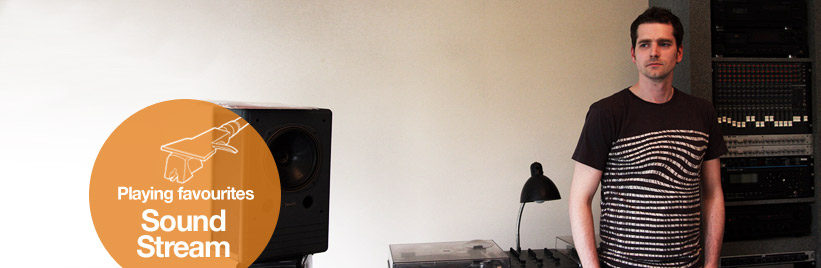
RA catches up with the elusive Berlin-based producer to chat about some of his favourite records.

Since his debut in 1997, Frank Timm's releases under his aliases Sound Stream and Soundhack as well as his collaborations with fellow producer Errorsmith as Smith N Hack have been few and far between, leaving a body of work that many other producers might equal in a year or two. But his quality control can be excused, because whenever something hits the shelves bearing one of his many names, it automatically connects with clubland. Be it the chopped-up tools or disco groove experiments, Timm's signature is always recognizable.

In the past, Timm's public persona has been just as elusive as his releases. But now, with the ever-increasing interest in his work as producer and DJ, he's finally opened up a bit to shed some light on some of the seminal influences in his work to date. RA's Finn Johannsen caught up with Timm in his impressive Berlin studio to talk edits, disco and Ron Hardy.


El Coco
"Cocomotion"
Cocomotion, 1977


This goes right back to your first Sound Stream 12-inch. I found it interesting that you just used a tiny weird loop, instead of its catchy bassline.

Yes, I often just get hooked on single parts and sample them. "Motion" was more like an edit. It's just a loop which then gets chopped up a bit. I like the loop because it holds the tension for so long, it's very trippy.

It's a very special approach to editing. You certainly weren't aiming for authenticity or better DJ use.

It's kind of how it started though. The first re-edits in Chicago, for example, looped bits and extended them until they developed a hypnotic quality. I think Ron Hardy initiated that. He rode a loop for several minutes and after a while it just sucked you in. This repetition also goes back to James Brown. His band played a riff for a while, then a break came on, and then it started all over again.

So you decidedly edit music to achieve a track-like quality?

Yes, definitely. With nearly all my productions I try to last long with little, and it is the same with other music I like. Simple tracks that don't need much to hold attention for quite some time, instead of losing that after half a minute.

What do you think of edits that keep the arrangement of the original and just tweak the beats?

No. Something new has to be created in the process of editing. And as a DJ, I'd rather take a real drummer and fight my way through the timing. It's funkier than a streamlined edit. That makes no sense to me. It's OK if you have a track with a wonderful part in it and then a break follows with guitars or something else you just don't want to have. But an edit ultimately has to lead to something new.

Hamilton Bohannon
"Zulu"
Dance Your Ass Off, 1976

Bohannon is another significant influence on your work.

Yes. His sound was so unusual at the time, very blunt and monotonous. There isn't much happening, but they do it all live and just go on and on. I think the drum arrangements especially were really way ahead. There wasn't much music then where the snare was on the 1 all the time. Dance Mania had a phase where all the claps and snares of the tracks were placed like this.

In the mid '70s it was certainly adventurous to structure music like tracks.

He was a drummer after all. There are so many instruments expected to go all the way in music, to break out in solos and such. I love it that he decided to just stay straight, and not show off. It goes back to James Brown: "Funk is what you DON'T play."

He obviously had no interest in exposing himself that much as a performer. On a lot of his music he isn't singing much, if at all.

Yes, a lot of his stuff has these track characteristics. He also mostly has some cheesy tunes on his albums, where he has a go at ballads for example. Those are funny, too. But the bulk of his work is just tracks like these, in which he doesn't care about refrains. He just raps a bit occasionally and that's it. In any case it's very unusual.

So those characteristics were exactly what interested you for the according work with Smith N Hack?

Yes, we wanted to make a tribute and as we both love his music we were sure very soon that he should be our first candidate.

Who are your other candidates for a tribute?

Well, we're already working on an Italo Disco/Moroder-type project. "Space Warrior" was kind of a taster for that.

First Choice
"Dr. Love"
Dr. Love, 1977

A classic disco tune.

Yes, and one of the most sampled tunes, too. But I always play the original. It has an incredibly long part in the middle which is nearly all break, with sparse instrumentation and no singing, and then follows another peak at the end. As a DJ, I had the most incredible experiences with this.

How did you get into disco?

That goes back to my childhood. My mother had a relationship with an Afro-American guy who was stationed here with the Air Force, and he had a big record collection. It was not that specialized, he had a lot of stuff like Stevie Wonder or George Benson which was already commercial at that time. But the aesthetics of what I like were all over it, and it influenced me very much.

What first got me into house was stuff like Technotronic. I must have been 14 or 15 years old then. I noticed that it really attracted me. Then I had a phase where I was into harder stuff, which was very dominant in early '90s Berlin, but I soon went back and ended up with labels like Strictly Rhythm. That was the time when house got settled in Berlin and the factions of house and techno emerged and separated. A lot of people stayed with the hard stuff but house attracted me more. In clubs like Tresor techno was the main sound but they also had the Globus club, which was predominantly house.

Was that the time when you decided to bring all your influences together?

Well, as a DJ you are crazy about music and you are interested in a lot of different sounds. Then you get to know that a track sampled something and you start to connect the dots. It was like time travelling to my childhood, and I became infatuated with finding out where sounds where originally coming from. And the deeper I got into it, the more I got to know. Sometimes I wondered how someone could possibly produce something and then I found the original and understood how.

So you are interested in timelines, as to who did what first?

Yes, but it was not so much about who did it, it was more about the music. I just got deeper and deeper into the music and travelled back, and then I ended up at the roots. I can't really draw a line between disco and house. For what it does to me it is the same.

Glenn Underground
"Remember the Good Times"
Jaz World, 1995

This is from the heyday of Chicago's cut-up disco sound.

Exactly. It's so rough. This was an incredibly important phase in my development. It is the time when I started out to produce. And it was the time when I ran into the record store every week, and I had to think hard about what to buy with the money I had, because I could have bought everything. It was also the most euphoric time for me as a DJ. There was so much great music I didn't know, which sounded totally fresh. It was a very formative period.

Frank Timm
In what way did this production style in Chicago at that time influence you?

It was very influential for me. As a producer you can try to invent something new, but in the end you are influenced by what you like. Your taste shapes what you do when you start to produce. There are so many who claim to never have been much involved with music before, and that they just went ahead all on their own. I never believe such statements. Music itself is a state of flux where one thing builds on another, and making music is a state of flux, too. I don't think that you can really direct that. You get influenced and you automatically do the things you like.

The approach of the Chicago house producers to sampling disco was often very harsh. The energy level seemed to be very important.

Yes, but they also managed to pin down the essential elements of the tracks they sampled. If you take DJ Sneak for example, by locking certain parts of a disco original in a loop he really tried to boil down a track to the basic essentials of what you need to make people dance. And you can achieve so much with one single loop. You can create something new and hypnotic which goes off on in a club.

That's what interested me most at that time, to find out for myself what I need to make a track work. Especially with a lot of current productions I noticed that I don't like these epic arrangements. I like to keep it simple. I like it when a track is of good use for a DJ, and he does the rest. I see myself as that DJ and I produce music that fits my purposes, and my productions basically end up sounding the way they do because of that. Of course I try to refine and develop the way I produce, and I don't want get stuck with something that already has been there for some time, but ultimately this is what it comes up to. I can't really explain it any other way.

And your own signature then is sort of the byproduct of a continuous process?

I think so, yes. Sneak had a lot of great tracks but he was not my personal favourite. What Sneak did with loops and filters then also led to a total overkill of the sound later on. I found the cut-up tracks Glenn Underground did were really tricky. The sound was really dirty but that was due to the production style. I think that is missing in current music. A lot of it just sounds too clean.

What do you think of minimal then? In principle, its approach to build a track isn't too far off from what you think is necessary.

I certainly like a lot of minimal tracks. I would get in a fit just playing disco loops all the time. I like a combination of different things. A minimal track can be as good as something else, there are no limits. I try to bring different things together. By tendency there is too much minimal being played in the clubs. The flood of according releases is too much. And I come from a time where clubs still had peak hours, so I have my problems with that. Minimal is more the soundtrack to a party than the party itself.

You used to go to the club for the music, and today the music is often just the soundtrack for a social event. You don't get grabbed by the music and dance. You go out and have a little fun, you don't go out to get locked on the floor. Sometimes you don't want to go home and the music fits, but in the end I need some variety, and some ups and downs. I want a night to go off without having to wait for it for three days [laughs], the chance to have a good party and still go home after two or three hours. Then again it's interesting that in the past you got booked to play one or two hours, and now you play three hours or more and you play differently, because you can't play a peak time set for several hours. I think all is valid, but I do miss the variety. There is always too much of one sound.

DJ Rush
"We Play Again"
DJ Rush Presents Knee Deep, 1991

This track goes incredibly well together with disco records. You can play it with any disco record actually.

This is another Chicago tradition, all these tracks that consist of nothing more than rhythmic elements and some weird sounds.

Yeah. It's also based on endless loops that generate a real mind fuck. I absolutely love this record. It really does strange things to my head. All these repetitions and this trickiness, and also its stoicism amaze me. The grooves are totally tenacious, but that's what makes it very interesting.

I think this tradition probably also goes back to Ron Hardy, because he often played some basic rhythm patterns and bonus beats in his sets.

Yes, definitely. But DJ Rush especially made it real punky. I once heard him play a disco set and it was really fantastic. I think he was once seen as the legitimate successor to Ron Hardy, because he played with even more energy. And you can hear it here, it's the same aesthetics. Rush is faster and freakier, but it is a similar feeling.

You also did tracks which you stripped down to some kind of matrix of rhythmic elements, and then you played around with it.

Yes, especially the Soundhack releases are often just tracks. Me plugging away with just a small array of elements, and then break after break. [laughs] Sound Stream sounds different. It's not that it does different things to me. I always wished that you could judge your own music in a neutral way. It is not possible, but I would like to experience that. I can always decide on other music, but I have no objectivity for mine. That is the most difficult thing about making music, you can't look at your work in a normal way.

Was it a conscious decision to develop Soundhack and Sound Stream apart from each other soundwise?

It just came out that way eventually. I had done music for quite some time and then I thought the material which became the first Soundhack release did sound different to what I knew, and so it was the first time I thought some of my music was worth releasing. The Sound Stream tracks were just good party tracks that I enjoyed to play out, and I just made a dubplate at first. But the one project really does not go without the other.

Steve Poindexter
"Whiplash"
Phase II, 1991

I can only call this great. It is so pure. I don't demand music to be pure in general, but I prefer it to be that way. I like it to be simple and direct. I like so many different things but this is what I always come back to. Everything is where it should be, there is no embellishment. I don't need it to sound incredibly well-produced, it should only work in a club context. The same goes with my music. I'm not enough of a sound nerd to work differently. But I noticed that there are tracks I love very much, and they all sound totally trashy. All this Dance Mania stuff sounds terrible for example, but it was always a very important label for me.

Lil' Louis and the World
"Club Lonely"
Club Lonely, 1992

Yet another musical side of Chicago, although this sounds as if it could also be from New York.

Yes, a bit. These organ chords are so great. Lil' Louis was somebody who started so much in Chicago, and not only with "French Kiss." His work got cited on countless other releases, even from the same scene. They tried to nail down the essence of his tracks. He really was groundbreaking.

The musical heritage of certain scenes is so often told apart, but he was somebody who overcame that.

I don't see any sense in these local categorizations. You can hear in a lot of records from either Detroit or Chicago that they influenced each other. I don't think there is a need to separate that. This track has such a warm feeling to it, like his record "How I Feel" on Dance Mania. His sequences are so outstanding, as in "Blackout" for example. He is not the typical DJ/producer, his music reveals some real musicality. He's from a different world.

Do you also play deeper sounds like this in your sets?

Yes, definitely. I'm also interested in that, as you can hear with "Live Goes On." I like a lot of the deeper stuff by Moodymann for example. Or Theo Parrish's "When the Morning Comes." I don't like the deep house tracks so much that use the same pads and string patterns, or that sound too clean. I like deep house to be a bit rough, too. And I don't like it to be too mellow and noodley. The latest by Pépé Bradock is incredibly great. It is the perfect combination of the deep house sounds I like, and it is a bit insane. It really wreaks havoc on the floor, but it is also very beautiful.

It is interesting that you name Lil' Louis, Moodymann, Theo Parrish and Pépé Bradock, who are all more or less considered to be eccentric mavericks and who all have a distinctive signature.

Yeah! I think you can always hear if somebody makes music the way he is, and doesn't try to imitate something else he likes. Music has got to have honesty. I think you can hear that. I tend to like music that is coherent with its producers. Then I have the feeling that everything they do is true, and that they reveal something about themselves.

Published / Monday, 18 May 2009

comment 20 Comments


Share this article


Features


Other features
In advance of his two performances at Mutek 2009, we call up Berlin to chat up Tobias Freund, a 20-year veteran of electronic music, and the man responsible for some of clubland's most idiosyncratic hits of the past few years.
Globe trotting DJ and producer Anders Trentemøller takes listeners on a harbour boat trip through Copenhagen.
Diynamic's boy wonder has crafted one of the year's most idiosyncratic full-lengths. RA's Todd L. Burns calls him up to find out about the story behind each track.


About  
Staff  
Mobile (beta)  
Submit event  
Copyright © 2013 Resident Advisor Ltd.
All rights reserved. Terms & Privacy.