How I Work
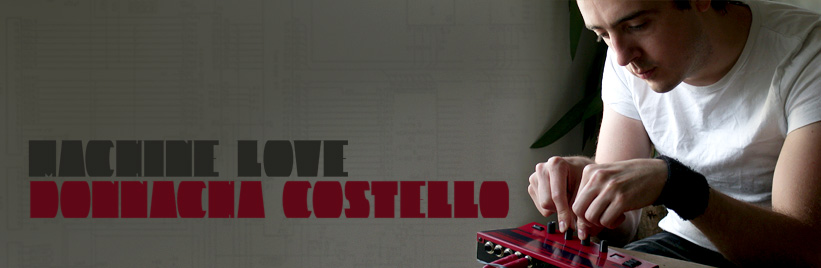
Donnacha Costello
I don't really have a set way of working. Sometimes a sound I'm playing with kicks off an idea, sometimes a rhythm does the same. But it's mostly sounds.
The most recent track I have been working on went like this: When programming new sounds on the Synclavier, I hit on something that I really liked. Once I added some portamento and played it a certain way, it was really Detroit-sounding to me and set off an idea, so I played a line in an unusual time signature played against a regular 4/4 beat. I do that quite a bit these days. I don't have it in front of me right now, but if I remember correctly I think it could be counted something like 4 bars of 3/4 followed by one of 1/4 played over 4/4. I guess that makes it 13/4 over 4/4.
I've always loved odd time signatures since I was a child and clearly remember listening to and loving the pinball number count song on
Sesame Street which is full of stops and starts. (If it's not in a weird time signature, it certainly gives the illusion.) I also like things that are in regular time signatures, but sound like they're not. For example, Pat Metheny Group's "So May It Secretly Begin" on the album
Still Life (Talking). I love things that you have to concentrate on if you want to count or clap along.
I recently released a track called "Waltz for Chet" which was programmed in 15/4. The underpinning 808 rhythm is completely straight 4/4, but it's the element that sounds like it's in a weird time signature because the melody dominates. The melody can also be counted in 3/4 or waltz time, looping over 10 bars. Some people think the drum programming sounds complex as it shifts so much but actually it's a pretty straight rhythm.
Anyhow, back to the track I was talking about... I was playing this melody against a kick and enjoying it so I recorded the line as MIDI and started to work on the rhythm. I used the D16 drumazon plugin running inside plogue bidule rewired into Pro Tools.
I developed a nice rhythm playing through a Moogerfooger Low Pass Filter TDM plugin in Pro Tools. With the envelope follower set the way I like it, certain sounds like the 909 clap or accented hats open the filter up. The rhythm breathes a lot this way.
I overlaid that with some 808 from the D16 Nepheton, and then I added some composite bass/chord sounds from the Nord Modular but the way I was playing them left a lot of empty space in the arrangement. To fill this, I compressed the 909 track to extend the decay of the kick drum and fill the gaps.
I began to work on the effects using the Eventide H3000 factory TDM plugin. Eventide always made great hardware and now they make great TDM plugins. The original code from their hardware now runs on the TDM DSP chips, so it sounds every bit as good as any of their hardware, plus it's totally integrated into my system. Within reasonable limits I can have as many instances as I want. If I had half-a-dozen or more Eventide processors in my studio it would cost a small fortune!
I recorded the Synclavier chords I was playing earlier. Then I selected a bass sound I really like, also made with the Synclavier and doubled the chord line with that.
I sampled a chord from the Synclavier, put it into Battery and made use of its Hi-Pass filter and LFOS to modulate and pan the sound around. These are all the elements of the track. After this I worked on the arrangement.
All in, the track took about a week to finish.
Most of that was done in the first few days, and then I spent about an hour each day tweaking EQ, effects and arrangement.
Production habits are:
-I use EQ to cut frequencies rather than boost them.
-I use delay to widen the stereo field of certain sounds.
-I sometimes use compressors for artistic reasons such as extending the kick drum decay as mentioned above, but not very often and so far only on individual tracks.
-I stay away from compression on the master buss.
A professional mastering engineer can achieve much more than I could if I were to start doing that so I mix the track to the best of my ability and leave the rest to the mastering engineer which, after all, is precisely his job.