Scion presents Breaking Through - Submit an artist today
RA: Resident Advisor Global
News
Features
The Feed
RA Newsletter
Local
Event listingsSubmit an event
Club Tickets
Party photos
Clubs bars and venues
Music
Music reviews
DJ PagesDJ Charts - Top 10s
Record labels
RA Podcast
Interact
My RA
Inbox
RA ForumsLatest forum topics
Competitions
Search RA
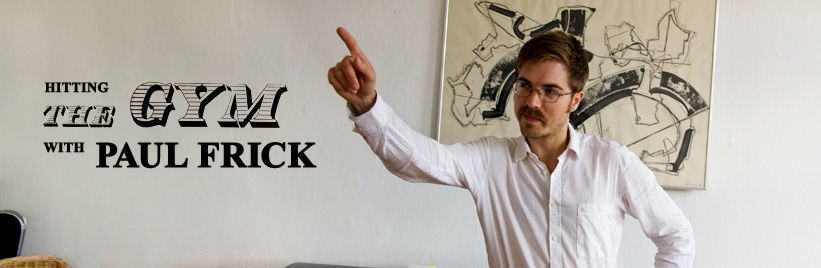
Hitting the gym with Paul Frick

An unlikely techno pin-up? Paul Frick doesn't think so. And with a host of releases on the way and a new label to his name, he might just be right. RA's Todd L. Burns catches up with the classically trained producer.

Brandt Brauer Frick. Add an "and," and you have yourself a law firm. Paul Frick prefers boy band, though. "Just look at us!" he exclaims, with a glint in his eye.

All I can see at the moment is one of them. Frick. But he's right. When I check the MySpace page of the aforementioned avant-garde techno trio later that day, I see a beautiful drawing, the group positioned like a pastel Kraftwerk, serious, handsome and maybe, just maybe boy band-esque. Frick is the oldest of the trio—five years removed from Daniel Brandt and Jan Brauer—yet he sounds as enthusiastic as a child unwrapping Christmas presents when describing the project at his apartment in Berlin. "We haven't sampled a single bass drum. We record everything acoustically and sometimes add an analogue synthesizer. We have tons of tracks without hi-hats! The percussion is usually prepared piano, knocking on the piano or even just sticks."

The excitement is palpable, his thick German accented English coming faster and faster. "We've only existed since January or so, but we've played some festivals and at Berghain. That gig was part of Club Contemporary Classical. It went super well. Until then we had played really techno concerts with a screaming and dancing crowd, but the people there were actually sitting on the floor when we started and only slowly stood up. Even the organizers didn't expect us to play techno. We were a lot more nervous than usual because there was this feeling in the air that you didn't know how people would perceive it. I really love these kinds of situations because it has the adrenaline of a real concert."

An illustration of Frick and his Piano
It's hard to imagine a guy who looks less like he craves the adrenaline of a live show. But Paul Frick is a man of many surprises. And it's what makes his music so distinctive. Despite only having a few production credits, you can already begin to discern a "Frick sound." It's one that has much to do with his dual life as classical composer and techno producer. In nearly every track that bears his name, there's a piano that guides the way—even if it's lying in tatters, expertly cut up by Frick's sure hand.

"I had piano lessons from the age of seven. I actually begged my parents to get piano lessons," he says, smiling at my quizzical look—knowing that it's usually the other way around. "I had a very good piano teacher, she focused me on the really creative aspects like the simple rules of improvising or saying things like 'play only the black keys.' Very quickly I started to imagine pieces. And, by the age of 11 or 12, I was going to composition classes. Then a bit later I began participating in a competition for composing pupils. I was selected three times. The prize was a trip to southern Germany to a castle with other students who had been selected. Professional musicians would play the stuff we had composed. These three experiences were really important for me. I never would have studied composition if it hadn't been for these because I finally found other people my own age doing all this weird stuff which none of my friends [back home] ever did."


On the piano

Frick playing his Piano

Despite his rigorous classical training, the lessons that he learned from his first piano teacher were the ones that left the most important mark: Frick's listening habits would often drift from the approved classical titans like Bach and Mozart to things like heavy metal. By the time he got to University, the two were intimately intertwined: "When I had to present myself to the other students, I transcribed a song from this Scandinavian death metal band called Meshuggah. It had ultra-complex rhythms, but there was this pulse that—for avant-garde composers in Germany after 1945—was a bit of a no-go area."

Philip Glass and Steve Reich's minimalist classical music never took hold in German academic circles. It was instead a place where the serialists and Stockhausen ruled. Even so, Frick once again found hope in a teacher, Friedrich Goldmann. The father of Macro boss Stefan Goldmann, Friedrich "was great. The classes with him actually had a lot of talking about life in general, about philosophy and sometimes after an hour we would finally come to music. I have never met such an incredibly intellectual person, he recommended me so many books...he could connect thoughts incredibly well. I also showed him a lot of dance music I did, and he was always very open to it but he couldn’t like it and he told me 'Hey, you are so much better with what you do with a classical point of view'."

Goldmann may have never warmed to the instrumental hip-hop or techno that Frick was presenting to him, but clearly the open-minded approach of the professor has informed his work since. Even so, it took a while before Frick was able to engineer that sort of connection between thoughts that came so easily to his teacher, largely due to Frick's very real fear of being labeled a crossover act or a gimmick. "Crossover is a word that I can't identify with at all. Usually it's this phenomenon when someone combines an artistic side that he is very firm with and another artistic side that is foreign to him or he doesn't have so much experience with. A lot of times you can hear it immediately. There's no real communication between the material."

Of course, before communication comes interest. And, for a long time, it was severely lacking. Growing up near where the Love Parade was held each year, Frick associated dance music with "the freak show" outside his door. It wasn't until he heard Akufen's My Way, in fact, that he truly heard the possibilities inherent in the genre and began to experiment with crafting beats in a 4/4 time signature. "I was shocked, as I found it so interesting and such a good combination of experiments and elements that make you happy and make you move your body. From then on, when I started to make my first attempts, it was in that direction."

It's a tale as old as the genre itself, surely, but Frick was already a full-time musician. So things didn't seem that far out of reach. The key was making the music sound distinctive, and making it sound like it didn't belong in the crossover arena. His first releases for Kalk Pets did just that, even if he garnered a great deal of interest for the one track that was a gimmick of sorts, "Steal My Heart," in which he identified every single sample for the listener. And even told us how he transformed them.

It was meta-techno at its finest. (And, crucially, catchy as hell.) Frick has continued on with this theme in the new video for Brandt Brauer Frick's "Bop," which unmasks how each element of the group's acoustically-created minimal techno is played live in the studio. Frick, in a short essay at Modyfier about "Steal My Heart" explains why he's so intent on giving people a window into his work and its construction: "A lot of artists (and the critics even more) are obsessed with their uniqueness and individuality, which in most cases is simply ridiculous. This is a long-term consequence of the genius cult that emerged in 19th century and that still holds the strongest cliché of 'the artist' nowadays."

Deconstructing the process: It's a popular meme these days among artists, whether it be Speedy J and his Open Collabs project, Kevin Gorman making all of the elements of his tracks available or Richie Hawtin posting every single track he plays on Twitter. In fact, the perfect embodiment of techno futurism in 2009 is exactly the opposite of what made the shadowy, alien sounds that came from the originators of the genre so compelling. Much of what makes Frick's music so interesting is the limitations that he puts on himself. Playing live with a Korg ESX instead of Ableton? Going into the studio to create minimal techno with acoustic instruments?

They put lie to the idea that you need the newest gear, or be hip to the newest sub-genre. Instead, twisting what already exists is often good enough, as evidenced by the solid first offering from his new Gym label—a project he's undertaking with Brandt and Brauer. Frick's solo track and Brandt and Brauer's collaboration as Scott are nothing special on the face of it, but have enough to offer in its grooves to sustain massive repeated listening.

But how did they come up with that name? "We actually found the art first, and immediately knew we had to start a label after we saw it." That buff guy in the center of the debut 12-inch is appealing, I tell him. But he's a bit at odds with the way that the three..."Yes, of course. Just look at us!" he exclaims, finishing my thought.

Published / Fri, 06 Nov 2009

comment 12 Comments

Photo credits /
Illustration - Danae Diaz
Video directed by Daniel Brandt & Julian Schleef


Features


Other recent features
Label of the month: MathematicsBreaking through: Ghosts on TapeDJ Bone: True to da roots

About  
RSS feeds  
Get involved  
Submit event  
Copyright © 2009 Resident Advisor Ltd.
All rights reserved. Terms & Privacy.