RA: Resident Advisor Global
News
Features
The Feed
RA Newsletter
Local
Event listingsSubmit an eventMiami WMC
Club Tickets
Party photos
Clubs bars and venues
Music
Music reviews
DJ PagesDJ Charts
Record labels
RA Podcast
Interact
My RA
Inbox
ForumsLatest forum topics
Competitions
Search RA
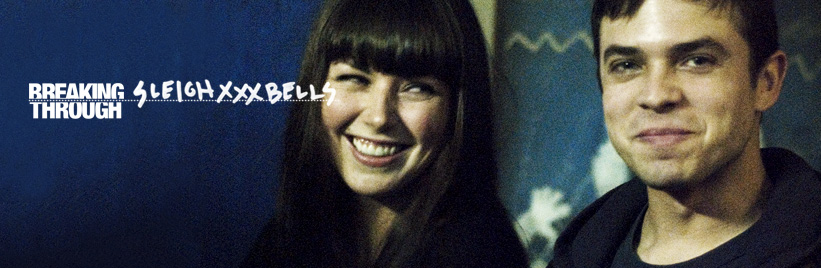
Breaking through: Sleigh Bells

The New York duo was the darling of the CMJ Festival this year. RA's Nick Sylvester charts how and why they've recently broken through.

Located in an east Brooklyn neighborhood called Bushwick, The Market Hotel is a low-key all-ages loft venue where the New York-based duo Sleigh Bells are playing the last of three shows in four days. They have had a good week so far. Writers and industry people had traveled to New York for the CMJ Music Festival, looking for something to be excited about, and the unknown band had delivered: concise hip-hop inflected pop songs that matched overdriven guitar riffs with sugary female vocal melodies.

As the locus of Brooklyn's current infatuation with scuzzy lo-fi music, The Market Hotel is an appropriate venue. An unmarked door outside opens to a steep and rickety wooden staircase, lit just enough to see that the walls are unfinished too, anxious to splinter. The main performance space is shaped something like a squished pentagon, with a modest elevated stage at the room's focus. Squiggly line drawings and curious animal figures are painted on the walls, and red metal support poles compromise the view lines. On the ceilings and walls are holes of odd shapes that give little hint to their cause. As one of the city's only all-ages venues, The Hotel has the thrilling, illicit vibe of an '80s video game arcade.

The 28-year-old Derek Miller and 24-year-old Alexis Krauss take the stage at one in the morning—the headlining act for the QuietColor.com showcase. Miller, the guitarist and beatmaker, is clean-shaven and dark-haired, and wears an unzipped hooded sweatshirt. Krauss has changed into shiny black leggings and a loose-fitting yellow tanktop that gives partial view to the former schoolteacher's upper-arm tattoos. She has straight black hair and a pretty cherubic face marked by blue almond-shaped eyes. On stage, the only pieces of equipment are Miller's Marshall Stack amplifier, their two microphones, a few effects pedals and Miller's iPod, which houses all of the band's beats. There is no soundcheck except Miller's deafening guitar strums, proof that his instrument is in tune.

Sleigh Bells

The band's set is short, only about twenty-five minutes long. Neither Miller nor Krauss speak much between songs, and during "Ring Ring," a breezy pop number that samples the riff from Funkadelic's "Can You Get To That," Miller leaves the stage completely. This could have been another hip-pop karaoke act, but there was something very off and ferocious about Sleigh Bells's set. Everything seems to occur with or in the context of its exact opposite: the music's siren-like swells and huge synthesizer horn stabs are so loud they break up ("A/B Machines"); Krauss sings sweet, ditty-like melodies but with the swagger of a writhing Joan Jett ("Crown On the Ground"); Miller, the lone instrumentalist on stage, jumps and kicks around stage so much you forget that there's no band behind him. The music is immediate and chaotic at once—catchy melodies couched in noisy riffs.

"After shows at Le Poisson Rouge and Public Assembly, I knew they were my favorite band in New York," wrote the New Yorker pop critic Sasha Frere-Jones, teasing Sleigh Bells' CMJ performances a week earlier. Stereogum's Amrit Singh dubbed them a "Band To Watch" after seeing Miller and Krauss perform at a Hype Machine event at Santos Party House. After several other blogs had notarized the band, the website Pitchfork Media felt confident enough to forkcast the band's "A/B Machines" then give their "Crown On The Ground" a Best New Tracks recommendation a week later, along with a short "Rising" feature. That Friday, the pop singer M.I.A. lurked along the sides of the Market Hotel, waiting for Sleigh Bells to begin playing.

To anyone not on the ground, it must have read like some elaborate New York-based conspiracy, seeing these identical reports come in, watching Sleigh Bells become an It Band in a matter of hours. By the end of the week, Miller had offers from both major and independent record labels and connected with management groups. Sleigh Bells had, as it were, broken through.

The lie of "Breaking Through", of course, is that it implies an act was meant to break through all along—that there was nothing ever getting in the way of them being discovered. In actuality, hundreds of songs are written and discarded before the ten that we end up hearing. The artist loses his job to play some show that turns out not as opportune as he thought it would; he moves across the country looking for like-minded musicians, only to run out of money and move back in with his parents. He passes on a college education to live in a tour van for four years, unsure of whether the band will make that critical leap. Most bands never reach the point of being a "New Band"; they're simply never heard in the first place.

"I hear half-assed songwriting, a half-assed MIA clone on vocals and instrumentation that bridges karaoke with a Casio keyboard demo," wrote one Stereogum commenter, unimpressed by Sleigh Bells. But the fact that he even heard the band—and call this the Devil's Advocate Take on Hype Bands—is remarkable.

"As a music fan, I felt like there was
this small gap for what I wanted to do."


Miller and I meet a few days later at a Thai restaurant in Greenpoint. The place is equidistant between Tommy's Tavern, a venue that played home to Brooklyn's noise scene for a little in the mid '00s, and Studio B, a recently closed dance club. We sit in the corner of the restaurant, where the wind rattles a thin glass door, frightening a young child at a nearby table. Earlier in the summer, we had met at a concert in Williamsburg, and there he described Sleigh Bells to me as a harsh marriage between noise and pop—something at once very male and aggressive but melodic and "female" too, he said. The songs he sent me afterwards—"the shit I was working on with a lady vocalist," he wrote in an email—were "A/B Machines" and "Crown on the Ground." They were loud and rough—compressed in such a way that the tracks pinched and warped with every kick drum sound. But that aside, here were two blisteringly high-energy pop songs that were somehow exactly what Miller said they were: a violent marriage of extreme opposites.

There are some basic similarities to Ed Banger acts like Justice or M.I.A.. But if anything Sleigh Bells reminds me first of bands like My Bloody Valentine and The Pixies—beauty taken to its absolute pummeling extreme—or Output Records acts like Mu, who typify for me what pop music might sound as putrid, like if we let it sit out and fester for a few years and decompose.

A band that approached that formula was Poison the Well, a South Florida post-hardcore band for whom Miller was a guitarist and songwriter. In the genre, songs often have fierce riff-driven verses with screamed vocals, with relief coming in the form of a soaring, schmaltzy chorus. Miller played in the band for four years, from 2000 to 2004, then quit when the band was at the height of its popularity. This was more or less when the Sleigh Bells project began: trying to do both parts of the hardcore equation at once.

"As a music fan, I felt like there was this small gap for what I wanted to do," he explains. "I was obsessed with [the Deerhoof album] The Runners Four. I thought they got really close...But then live, all the ferocious elements on the album were wimpy and childlike. The drummer didn't even have a crash cymbal!"

Miller moved back home to Jupiter, Florida, and worked with his friends J.P. Pitts and T.J. Schwarz, who later went on to form the band Surfer Blood, using Schwarz's 16-year-old sister as the vocalist. He moved to California in 2007 and tried a configuration that was two guitars and a drummer. In these earlier incarnations there were similarities to Peaches ("she's an influence obviously") and Glass Candy's "Geto Boys" cover. "That struck a nerve," he says. "It was lo-fi and crusty." As for Ed Banger, Miller dug "their aesthetic focus. From a production standpoint I'm a huge Justice fan, and really admire their self-reliance," he said.

But in those artists' songs, Miller thought the balance was off in one way or another—either it was too fierce and not melodic enough, or the opposite. His own songs weren't there yet. "I wanted ideas that were good enough to go for three minutes," he explained. He still hadn't found his vocalist either. Eventually he moved back to South Florida, where he operated under the pressure of his family. "They couldn't believe I had quit Poison the Well. I was supporting myself making music. They thought I was a rock star," he said. In four years since he had left Poison the Well, he had nothing to show for himself.


"We'll find you your fucking vocalist."

Miller's childhood friend Will Hubbard, who lived in New York City, encouraged Miller to come north. Miller moved to the city in May 2008 into an apartment in Greenpoint, Brooklyn, and found work at Miss Favela, a Brazilian restaurant that had just opened underneath the Williamsburg Bridge. Miller talked his way into a waitstaff position, despite never waiting before—quite a feat in New York City, where even low-key restaurants paradoxically can require two years in-city experience.

In his free time, he searched for his female vocalist. Miller said he asked every woman he met if she was a singer. "That's the only reason I came," he said. "Most girls thought I was hitting on them."

One evening in early July, a woman and her daughter sat at a two-top table in Miller's domain at the restaurant. They were throwing back drinks, and arguing about whether or not he was Brazilian, Miller remembers. He wasn't, they learned, and when the mother asked Miller why he was in New York, he told her about his search. The mother pointed at her daughter behind her back. Miller assured them both that it wasn't a come-on, and later that night, he received an email from Alexis Krauss, a fourth-grade bilingual school teacher working in the Bronx for Teach for America. They set up a date to meet in Greenpoint's McGorlick Park, and Miller played her early Sleigh Bells demos he had cut in the band's former incarnation in Florida.

Krauss, a Scottish-Italian woman born and raised in Manasquan, a town on the New Jersey shore, began singing professionally for television, theater, and film when she was ten. At 12, she was working on songs with Jeff Coplan and the Berman Brothers, the producer-songwriter siblings who famously wrote Baha Men's "Who Let the Dogs Out." For a short time, she was the vocalist and bassist in the teen-pop group Rubyblue, and in college she paid her bills as a session singer and a company singer for Hank Lane Music, a prestigious entertainment company that books bands for lavish Manhattan weddings and bar mitzvahs. "The wedding gig was great for stamina," Krauss says. "You have to be really versatile—lots of going out into the crowd and dancing with drunk happy people."

"I was trying to get her
to scream abstract lyrics
about infinity guitars."


Miller lucked out: Krauss was perfect. He attempts to describe the serendipity: "It's probably like whoever invented the fucking Snuggie." The two worked through the rest of the summer on the songs, meeting whenever they could find breaks in her difficult school schedule—long commutes to the Bronx, a 5:30 AM wakeup, days with difficult students. "And I was trying to get her to scream abstract lyrics about infinity guitars after working for 15 hours," Miller said. Krauss often had to cancel because her nerves were so fried from school. This fall, she quit her schoolteacher position to concentrate full-time on Sleigh Bells.

Miller composed all the beats in his bedroom using an Akai XR20 Beatstation and Alesis SR18—shoestring budget machines that he pushed to their absolute end. "The main song ideas are always an accident," he explains. He followed the kick drum beat and often found the rhythm for his riffs there. "The second I'm about to go to sleep, that's when I start to arrange." All guitar sounds come direct through a Korg amp simulator, which contributes to their zero-headspace in-the-red feel. He recorded most of Krauss's vocals on a Shure KSM27 condenser microphone, though for "Infinity Guitars" he had Krauss scream directly into the computer's internal microphone.

In this case, lo-fi has been a necessity. Miller has done an admirable job overcoming his limitations by embracing them—overdriving his equipment. But the goal is to re-record everything in a nice studio, with significant low-end and gloss. Miller describes his goal as "a David Lynch thing. Like Blue Velvet. Everything is glossy but something is very off."

The sound quality hasn't deterred many; some like how lo-fi it sounds. These early demos attracted the attention of the film director Spike Jonze, after a friend of Miller's posted two of his songs on the blog for the movie Where the Wild Things Are. Jonze used both songs for "some short film about robots—crazy shit," and played them for the pop singer M.I.A., which is how she and Miller met.

It's no wonder M.I.A. was interested in Miller's sound; his music is a logical next step after 2007's Kala, and one suspects she might have been in town on a recruiting mission. It certainly wouldn't be the first South Floridian she's tapped for production—funny enough, because Miller once drove all the way down to Diplo's Mad Decent label offices in Philadelphia, only to be turned away at the door. "They're probably using my CD as a coaster," he laughs. "I guess that's karma though. We got plenty of promos with Poison the Well and it was always..."—he mimes tossing a frisbee.

The business of the week leading up to CMJ and CMJ week itself forced Miller to lose his waiter job at Miss Favela, so things are lean until he signs with a label. Plenty are interested, but many labels are pushing for all-rights "360" deals, which means they would take cuts of tour and merchandising profits, along with complete publishing rights. Miller is hesitant to give all that away.

"This is all I have, you know?" Miller says. "I'm not educated. I can't do anything else."
Published / Mon, 16 Nov 2009

comment 5 Comments

Photo credits /
All - Rob Dubbin


Features


Scion Audio Visual
Scion Radio 17
Scion Radio 17
Other recent features
Label of the month: NonPlus+Joris Voorn: A dedicated mindPlaying favourites: DJ Sprinkles

About  
RSS feeds  
Get involved  
Submit event  
Copyright © 2010 Resident Advisor Ltd.
All rights reserved. Terms & Privacy.