|
 |
 |
 |
 |
 |
 |
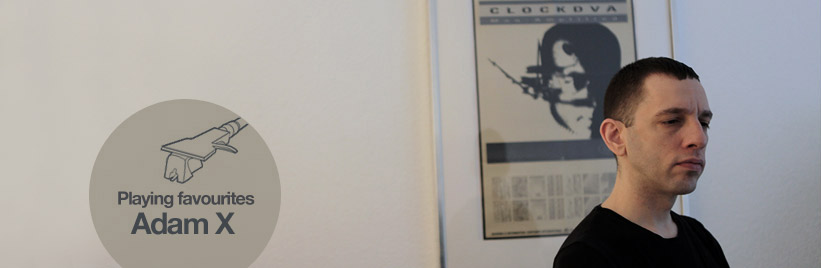
Playing favourites: Adam X
Music to tag to, music for weddings, music we call techno: RA's Finn Johannsen plays the Brooklyn DJ/producer some of his favourite records.
In the accepted history of electronic music in the United States, it seems like there are but two cities worth mentioning: Detroit and Chicago. Somewhere along the way, all the others have been forgotten. That's a shame. Because there are countless stories of DJs and producers offering up music just as original, just as fascinating and just as important to the story of how house and techno took hold in America.
One of the keys to this story are two brothers, Frankie Bones and Adam X, Brooklynites whose productions helped soundtrack their own epic Storm Rave parties throughout the early '90s, and whose keen ears helped make their Sonic Groove record store one of the essential stops in Gotham for any visiting DJ. Bones was the older of the two and had huge early successes in his career, but it's been X that has been perhaps more fascinating of late.
His move in the early '00s to a more industrial sound has been well-documented, but his relocation to (where else?) Berlin reinvigorated his love of techno and has resulted in some of the finest work of his career under a very surprising moniker. RA's Finn Johannsen caught up recently with the techno legend in his Mitte apartment to talk about some of his favourite records. -- Todd L. Burns
Strafe
"Set It Off"
Jus Born, 1984
I grew up in New York in the '70s and '80s with my parents and my brother. My brother had been a DJ since 1980, so there were was a lot of musical roots in my household. I was always around music.
My parents were really big on disco. I was hearing everything from "Ten Percent" by Double Exposure to so many underground disco records, like from 76, Jimmy and the Vagabonds or Crown Heights Affair. Old school disco. I always had roots in the family. My father also had a pretty big rock collection from the late '60s—Sabbath, Zeppelin, psychedelic rock. That was played probably when I was really younger, but by '74 or '75 my parents were already getting into disco.
I would also buy records on occasion. I remember buying Fatback Band's "King Tim III" which was pretty much the first rap record, Michael Jackson's "Don't Stop 'Til You Get Enough," "Let's All Chant," stuff like that. I was like 7 or 8 years old buying this stuff, but I was never really into DJing at this time. My brother was the DJ. He was the one buying the records and DJing. He knew what was going on musically.
I would say when I really first started to pay attention to music a lot, I still was not DJing, that was around '83 or '84. I was 12 years old, and I was getting into graffiti which I was actually documenting on subway trains by photographs. I was travelling from Brooklyn to the Bronx. I was going everywhere with a camera—all four boroughs that had a subway system.
What were the records that you were listening to then?
The records at that time were a lot of electro stuff that was being played. A lot of freestyle like C-Bank's "One More Shot" or "Al-Naafiysh" by Hashim. I still didn't really know who the artists were and stuff like that, but I knew the records and heard them all the time on the radio. Around '84 I went to a break dancing club at a roller skating rink to watch a bunch of people battling, and I heard "Set It Off" for the first time.
I don't know what it was with that record but it fit all the movies I liked at that time: New York movies like The Warriors, Death Wish. It was just this dark record that was kind of like the soundtrack of New York City at the time, when New York City was just like in urban decay.
I have such a vivid memory of being on the Pelham subway line going to see one of the most famous Graffiti writers in New York called Seen, who was in the documentary Style Wars. He used to airbrush t-shirts in a flea market. I don't know why music always has a place in a moment that you can remember a certain situation. I can remember being in that flea market and then playing that track. It was just like the track of tracks. It was the soundtrack of graffiti, of New York, the rawness.
Clock DVA
"The Act"
Interfisch, 1988
This is the song that got me into EBM and industrial music. When I first heard this track it was over for me with techno, for a while. What happened was in 1998 or 1999, I was getting really bored with the loop techno thing. Around the same time I had this friend, Reade Truth, that recorded for Planet E. He comes from an industrial background, and he used to always try to turn me onto it, and I just was like "nah, it's too stiff, it's too rigid." I always had this take that industrial music or Electronic Body Music was like electronic music with guitars in it because stuff that I had heard was like late Ministry stuff from like 1991, and Nine Inch Nails and stuff like that.
I remember some records coming into the shop in like early 1990 on New Zone, like Bigod 20, which was actually Markus Nikolai and Zip from Perlon, and those records were really good because they were kind of instrumental and they were EBM but there were no vocals in them, or very subtle vocals. But I just never paid this genre of music any mind. So one day around 1999 a person came in with a collection of records and they had a lot of cool '80s stuff in it and had a lot of Wax Trax records in it. Reade was in the shop and I told him that he should deal with it because he knew what was in there. And he was like "You have to take this record by Clock DVA. Just take it, because you will fucking love it when you play it." And when I put that record on, and I was playing the instrumental mix, that record really changed Adam X.
I am back into techno now, but that record had a huge, huge inspiration on me. After I heard that record I went out and bought "Buried Dreams," "Transitional Voices," "Man Amplified," I went after every Clock DVA album that was electronic. Then I went after everything else. Reade was like, "If you like that you have to check out Front 242, Skinny Puppy, Klinik. All the New Zone and Zoth Ommog stuff like Leather Strip."
What did you think?
When I heard all this, I was like "How the fuck did I sleep on all this music?" because when we were buying records for Sonic Groove in the '90s they had all these records, and I used to see them all the time but I just never paid it any mind, I was shut down. In fact there was one time when I was with Reade Truth, T-1000 and Denard Henry, hanging out with the white boy of the bunch, and they were playing all this industrial music. I actually turned to these guys, it was around 1995, and said "Why would a bunch of brothers listen to some white-boy music that is so unfunky?" [laughs] T-1000 was later really going out on that one. "Oh, so the music is unfunky and now you're really into it you're making that kind of stuff now?" And I'm like, "Ah, shit!" [laughs]
A lot of the music you play and produce is pretty dark. Where does this fascination with the dark side of electronic music come from?
Well, what is actually dark? Is it really dark, or is it making-you-think music? I always think when you think of something that's happy, happy doesn't make you think. I find lot of music I like is more self-reflective in the sense that it makes you think about life and the future and where everything is heading with technology, as opposed to being really dark.
I do like dark stuff because I used to watch a lot of sci-fi and horror movies and my favourite band of all time was Black Sabbath, outside of electronic music. I never really liked or was into rock or acoustic music that much. But Black Sabbath, when you listen to it, it was so dark but actually if you actually listen to the vocals it's not really that dark, it's just the way people perceive Black Sabbath. Maybe because they had 666 on the "Sabbath Bloody Sabbath" album. But the vocals are about marijuana on "Sweet Leaf" or about war on "War Pigs." They're talking about different things but they never talk about Satan. It's a misconception. Black Sabbath definitely had a big influence on me. As a young kid from when I was 9 or 10 years old, I was buying all their albums, when I was still listening to disco.
Lil' Louis & The World
"Blackout"
FFRR, 1989
This is a special one. I used to work in a messenger company when I was like 16 years old, in a summer break from school. I was trying to make a little bit of extra money in between my graffiti expeditions through train tunnels. I worked in a company where there were Afro-Americans working there and they were always playing house records—Marshall Jefferson's "Move Your Body," Adonis "No Way Back." So I always knew a little about house music to a degree.
My brother was out DJing and he was already into this stuff from that time period, but he didn't live with me so I wasn't really being schooled in music too much. Around '88 I was able to get into clubs and I started to hear more house. I was actually listening to a lot of hip-hop around that time. A lot of old school stuff like Big Daddy Kane, EPMD, Kool G Rap & DJ Polo, Biz Markie or Public Enemy. I used to listen to Mr. Magic, who just passed away recently, a very famous New York radio DJ, Red Alert, Chuck Chillout. Red Alert used to do a show and then after his show was over Tony Humphries would come on. There were two radio shows always running consecutively in New York, on Kiss FM and WBLS.
I don't remember who played "French Kiss" for the first time, but I heard that on the radio and was like "What the fuck is that?" Then I heard it again out in a club. I was in New York in a club I was working at and I heard it again. So one day I ran into Lenny Dee who lived down the street from me, and I asked him "Lenny, what is that record that breaks down and there is this girl moaning on it?" and he said it was "French Kiss" by Lil' Louis, and I asked "Can I borrow that record?" So he gave me the original on Dance Mania, white label with purple text on it.
And when did you first hear "Blackout"?
Well, I hadn't gone out and bought the album yet, but one night I was out on an expedition with a friend to paint some graffiti on trains and we were listening to this mix on WBLS in his car and "Blackout" came on. I get goose bumps just thinking about it. When I heard that I was like "what the fuck is this?" if I didn't find out what it was on the radio, I found out through my brother, and I went to this huge mega store that sold house, hip-hop and disco and asked then if they had Lil' Louis on cassette [laughs], because I had a walkman at the time.
I would go around listening to that album. The whole album was just incredible. From the jazz tracks to "Insecure"—what a beautiful track. I even played it at my wedding. I had a dance with my ex-wife in 2000 and we had "Insecure," it's just such a beautiful, emotional jazz track. I never really smoked weed too much, but when I was young I used to smoke with my friends. We were kind of bad kids, and I hung out with a pretty bad crowd in New York. We used to smoke, and I remember sitting on the train lines listening to that Lil' Louis album and that "Blackout" was just the track. When I did a track with Drop Bass Network when I was making hard acid stuff in '93/'94, it had the vocal sample: "We will dwell in the house of the lord, forever."
Open Mind
"The Trance"
Easy Street, 1990
This is probably one of the best stories of all. Joey Beltram was writing as Poes. When I was painting graffiti I used to know writers from all over the city. I befriended a guy who was friends with Joey, and he invited me out to Queens to a place where they parked trains and they were painting a lot of them.
I got to be friends with Joey and once, when we were painting there in the daytime, Joey asked me if my brother was Frankie Bones and he started to talk to me about music to see if I knew anything, but I really didn't. Apart from disco and electro I didn't know much, I wasn't well versed and I wasn't a DJ so I didn't really have that much to converse with him about—our friendship was really over graffiti.
Around 1990, when Bones opened the record shop and I started working there, he asked me if I knew somebody by the name of Joey Beltram, a writer, and I said I didn't know who he was talking about. Bones said he knows you, but Bones didn't know exactly where from. I said I didn't know any Joeys. I knew him by the name of Poes, because in graffiti we were always calling each other by our tag names. Then one day Joey finally came into the store and I thought "Oh shit, you're fucking Poes!" [laughs]
Do you remember when you first heard this record?
Well, Bones was already talking of getting an apartment with Joey, they were going to share a house and studio in Brooklyn. It was this time period when Open Mind came out and I identified who Joey Beltram was and put a face to his music. This was really some dark futuristic stuff. To me, this is probably my favourite record he's ever done. There are elements on the one side where he uses the break beat from DJ Mink's "Hey! Hey! Can U Relate" on Warp, which is a really rare record and one of my favourite records of that time, and Joey just took that beat from the "Sunshine Dub" and made it something else that was even more mind blowing. I always told Joey to re-release this stuff so I could remix it [laughs] because it's got these Casio freestyle drum rhythms in it. He had a very unique sound at that time, definitely, and he's had a unique sound after that as well.
Project 86
"Industrial Bass"
Nu Groove, 1990
While we are on the subject of this sound we should talk about "Industrial Bass." A break beat anthem out of New York.
That was another really good one. Those guys How & Little used to live in the housing projects behind the record shop. I used to go in to the projects a little—even though it was pretty segregated between the Italians and the housing projects in that neighborhood—because there was a famous graffiti crew called RTW, Rock the World, and a friend of mine used to live there. How used to be a Graffiti tagger, not an artist, he was more of a bomber, he tagged inside the trains, and Bones had befriended them in the shop because they were making music and would come and hang out.
I remember being in a club and I wanted to start DJing but my brother would not tell me how to DJ, my brother would not give me any advice. But How actually sat me down and explained DJing mathematically to me—like the bar and beat structure. So I got to give How a lot of credit for that conversation. I'll never forget that. I was practicing in the shop but soon I got my own decks and a mixer—this was in the early '90s. They were releasing all these records like "Industrial Bass" and Def Con 5 on City Limits, or "Jam to It Again." Bones used to play at this club in Manhattan, and when he played "Industrial Bass" people would just freak out to that record. Another one that is on the freestyle tip, like Beltram. They were really good friends, too. Joey and How, and Carlos Little. There was something bubbling, there was a sound out of Brooklyn and it wasn't Detroit and it wasn't Chicago. It was definitely a New York sound at that time period.
And Bones was championing this sound from a very early stage, incorporating break beats into his music.
Yeah, sure. In the beginning he did Break Boys, "The Beat Goes On" in 1988. I don't think my brother even heard Detroit techno until he went to England in late '88 or early '89. I forgot when he first went. That's when he did "Call It Techno," and he was hearing a lot of Juan Atkins, Derrick May and all that stuff. So you've got to almost question where this Brooklyn sound is from. It's techno, but I don't really believe that it's based on Detroit stuff. I don't think that when these guys were making all this stuff that they were looking to Detroit. They were getting influences probably more from house music and mixing it up with this freestyle thing, which became techno because the music had more of a techno feel than 4/4 house. New York definitely has a special sound. When people talk about American electronic music they don't really talk about New York. It's always Chicago and Detroit, Chicago and Detroit, Detroit and Chicago. Sometimes it gets overlooked.
Frankie Bones
"Call It Techno"
Breaking Bones, 1989
OK, there is still one more of that era we have to talk about. "Call It Techno," by your brother.
Yeah, for me this was an important track. I had him booked at Maria in June last year, and I said to him, "Bones, you have to play this track live, this is a Berlin anthem from the Love Parade. They made a documentary called 'We Call it Techno,' that is the theme of your track. You have to play this." It's actually one of Bones' most original records. And Tommy Musto was an engineering genius. If you listen to that record, the production for that time period was a lot tighter than a lot of other house or techno records coming out. Just the impact of the vocals—it's just Brooklyn, man. It doesn't get more Brooklyn than that. It's like Brooklyn just found techno. Bones brought it to us. [laughs]
It didn't really sound like most of the other hip-house tracks that were done at that time. I thought it was a different statement.
Yeah, it was techno. It was more like hip-techno [laughs], and the lyrics were just spot on because they were really his feeling of what he was experiencing in London, and what he was bringing back to America for us to experience. There wasn't really a focus on techno in the rave scene in LA at the time and what Bones was experiencing in London wasn't as influential in LA as it was in New York, but I think what we did in America with the shop was pushing just techno music on everybody and with knowledge on the music, whereas if you went to LA people were playing techno but there wasn't really a scene based around it. I think Bones seeing what he was seeing in London wanted to make a scene in New York based around what he was experiencing, and we did that. For me, "Call It Techno" is a soundtrack for that.
Kevin Saunderson
"Power Bass"
Sonic Groove, 2000
You brought this one out on your own label, Sonic Groove.
This is a record I happened to put out and I saw a really nasty review/comment on discogs about how it seemed like the record was only being put out to make money off something that had already been put out before, but that was not the case.
I never saw that record with any distributor. I could never find it in the shop and never saw it anywhere. I didn't know about it, never heard about it. And one day I went into a house store in Manhattan, it was probably out a few months at the time, and I saw it in there. They had like 25 copies, so I actually bought ten copies of it for retail price and sold it in my shop for a bit more money to customers into Detroit stuff who normally wouldn't go there, and I never saw the record ever again after we sold out of them.
I had two more copies, and it was always a favourite record of mine. I loved that female kind of whispering thing over the top. I had known Kevin for many years and I had decided I wanted to release that and asked Kevin if he would let me put it out. He gave me the rights to put it out on vinyl. For me, it was a fucking honour. Kevin Saunderson, when it comes to techno, is probably my all-time favourite producer. When it comes to this self-reflective, deeper, darker electronic music it is Saunderson.
Why is it Saunderson? Is it the dark basslines for example?
Yeah, it's those dark basslines. [laughs] But then it's the 909s. The 909's would have been a cleaner sound than Derrick's stuff, and I love Derrick May as well, but he just had a more pronounced sound with that 909. It kind of sounds more like a Chicago style drum rhythm he was using with these techno sounds, while Derrick May had this really unique kind of drum rhythm style and Juan Atkins had more of an electro bass drum style.
Anyway, I put "Power Bass" record out because I didn't think I was going to get a new one from Kevin, and I really had to put a Kevin record out. I had to because it was such an honour to do that so I said "Let me pick something out that no-one really knows, that if you didn't buy records that week you probably don't have it and you probably don't know about it because it wasn't talked about"—there was no internet back then.
Fabrice Lig
"The Track"
Versatile, 2008
This one is a rather recent track, a Detroit update from Europe.
While everything was going minimal [laughs], and I was playing my harder edged stuff in the last few years, I was always looking for and wanting to play newer Detroit music but there is nothing out there, or not enough to make a full set. Things are getting better in the last year or two and that's why I have fallen back into playing more techno-oriented stuff because I am finding good records now.
"The Track" is definitely one of those tracks that I'd expect to hear Kenny Larkin do. It is something that if I didn't know who it was, if I heard it for the first time without checking it out online, I would swear it would be something from Detroit. And that was exactly the type of music and records that I'd been looking for, for a while now. I'm really hoping that there is more techno stuff coming out. I ran into Fabrice while he was here in Berlin a few months ago, and I said "Please do some more stuff like this", because techno needs more of this Detroit feeling again.
This newer sound is emanating and I don't really know what to call it, but it's this hybrid of deeper Berghain morning sounds. I really love what Ben Klock is doing and his whole thing, but I also think there could be more stuff coming out with some more Detroit bass sounds like this one. It's this kind of really melodic but pumping Detroit flavour that's been lacking in the music the last ten years.
So that is your main criticism with minimal, that it got rid of all the textures of techno? It needs to be more complex again?
It's funny to say this, but I was making minimal when no one was listening to minimal. Me and Neil Landstrumm, were doing this on Scandinavia in '97/'98, when everybody in the techno scene was really into the whole harder-edged Surgeon, Adam Beyer, Oliver Ho thing. Me and Neil were taking some roots from the early Warp records which I thought to be minimal records, like "Testone." These records that had really deep basslines and were slow and we were trying to recreate the sound but it wasn't really catching on with people. It was weird because when I had the shop in the earlier part of the decade, when minimal was happening, people were starting to come in asking me for this record on Scandinavia and were saying how awesome it was because it fit in with the minimal thing. And I was like "Hmmmm, really?"
Monolake
"Atlas"
Monolake / Imbalance Computer Music, 2009
In my honest opinion Robert Henke is the best producer of the decade. His music, his albums—Momentum, Gravity, Polygon_Cities—these are just brilliant pieces of music. You can hear in his music how advanced he is with his mindset, with what he's doing musically. And he doesn't try to fit into any sort of genre. His stuff can be dubby or it can have industrial bass rhythms. It's all over. I know people from the industrial scene to house that love his music. He spans all barriers with what he's doing.
Would you say that Monolake is a big influence on your work?
Currently, right now, yeah, my music is influenced by him. I have this ADMX-71 out, a more downtempo project on Hands, and that definitely was a major influence. Him and I guess Biosphere and Mika Vainio. They were a big influence for that and obviously also for the Traversable Wormhole stuff that I do. I wanted to do more dance floor-oriented techno, but I don't like to sample or copy people so it's more of an inspiration in mood than trying to copy any sounds or particular drum rhythms they're doing. But I would say that Monolake is the biggest influence on me for the last couple of years.
Would you say you would have developed something like Traversable Wormhole if you would have stayed in New York?
I think Berghain really shaped that. I have to thank Ben Klock. I sat and listened to Ben for hours as well as Dettmann. Berghain definitely has been a big inspiration for me. It reminds me of being in a warehouse party in New York in the early '90s, the room and all. Not with the sound. [laughs] We didn't have sound like that at the parties back then. But it's also the environment and that headspace you can get into, listening to this deeper stuff at this time in the morning.
I really would love to hear Monolake play live in that room, in a morning set. That would just throw me over the top actually. It would throw me off the building. But it's not just that. The parties and the energy here definitely had a big influence on the Traversable Wormhole sound, on what I am trying to convey with this music. The feeling that I'm laying out.
So that's your own personal Berlin period?
Yeah, this has been two-and-a-half years of just development. I got bored of the EBM thing quite a bit. I did what I wanted to do with it and it was time to move on. Techno to me is always about future music and moving to the next thing and it feels good to be back doing the techno thing again and getting appreciated for doing what I am doing with it.
| | | | | |
Published / Fri, 08 Jan 2010
33 Comments
| | |
|
|
 |
 |

Features
|
|
|