RA
RA Japan
Global
Local
Music
Interact
Search RA
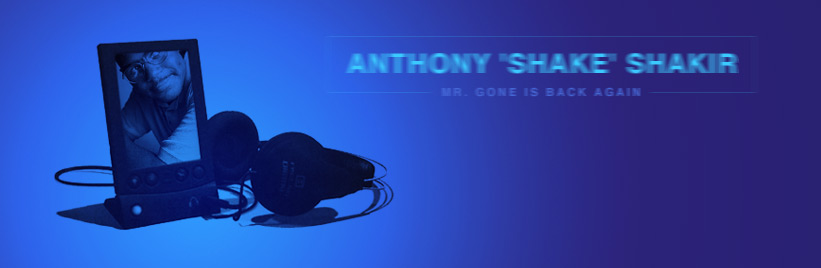
Anthony 'Shake' Shakir: Mr. Gone Is Back Again

Rush Hour has just reissued his work and he'll be among headliners at Unsound Festival New York early next month. Detroit's Mr. Gone is back again, hopefully this time for good.

To even begin to describe his place in music, it must be noted that Anthony 'Shake' Shakir is one of the producers who invented techno. While he never went on to mainstream fame like Juan Atkins, Octave One, Derrick May or Kevin Saunderson, his track "Sequence 10" sits amongst the seminal Techno! The New Dance Sound of Detroit compilation. Nonetheless, Shakir has gone on to record for plenty of respected labels in techno, electro, and house: Tresor, Peacefrog, Metroplex, International Deejay Gigolos, 7th City, Klang Elektronik, Puzzlebox, Track Mode, Moods & Grooves. He also recorded on Mo Wax as part of the first Urban Tribe project alongside Kenny Dixon Jr, Carl Craig and Sherard Ingram.

Shakir isn't a major superstar, though, largely due to two facts: His genre-bending and genre-jumping makes it almost impossible to guess what each release might bring. Sometimes he's sampling Giorgio Moroder, other times he is making instrumental hip-hop. That, and his best work has almost all been released on his own Frictional Recordings label, whose limited vinyl runs have been impossible to find for years.

2010, however, looks to be the moment that Shake will finally find his way into the hearts (and record collections) of dance music lovers around the world: Rush Hour has come to the rescue with a forthcoming Frictional retrospective compilation which will finally make the tracks showcasing his complex arrangements and drum machine science widely available. And Shake is relaunching Frictional with more new material. With the full release of his already classic Levitate Venice EP on Morphine Records dropping in 2009 to critical acclaim, it's obvious that the world is finally catching up to Shake's futuristic vision.

Portrait
Shake at DEMF 2007
You've been making music since the mid-'80s. How does an artist like you age in dance music?

I like doing it! It came from my interest in electronic music, which is just another music form to me. That's just how I look at it. It's not an issue of aging.

Is there pressure to be jumping around onstage like The Rolling Stones are doing?

Some people will think there is a pressure. But me, nah, I don't look at it that way. I like records, so for me it's based on records anyway. A good song is what trumps it all. I don't look at the age thing, I play the records. The records do all the work.

Do you think it will be possible for techno musicians to age like jazz musicians, where they are still able to innovate even as the music changes wildly?

I think it is easy for techno and electronic artists to do that since it is based on machinery. You just gotta get the upgrade.

You started out on the original classic techno hardware, but now you use computers as well. What has allowed you to maintain your sound through the upgrades in machinery?

Well, I had a drum set as a kid. But I never had a hi-hat, so I never learned how to play correctly. I didn't know how to invest in myself as a kid. Machines allowed me to continue to think I could actually make music. With acoustic instruments, I would TRY but I didn't have the discipline to keep practicing to get better. Then when I started (with electronic music), I was surrounded by people who had their own style. I knew that working with them and around them, I didn't want to be a copycat. I had to find a way to do my thing and stand out. I think I was able to accomplish that, at least I THINK I was because I worked at it. I added a hip-hoppish element to electronic music. That was always my approach.

So hip-hop was an influence in your production style?

When I started, in Detroit there was always this line. When this thing started, it wasn't called "techno," it was just guys wanting to do their own thing. But there were two distinct camps, you had the people who just didn't wanna hear radio music anymore. At that time they called it "progressive" music. That tended to be the New York tracks in the early '80s, kinda R&Bish dance club tracks. They weren't disco records, but they were dance records.

"Detroit never liked techno. They STILL don't like techno."


You mean like Prelude and West End records?

Perfect example. Some European artists' tracks fit into that mold and were played in those clubs too. Hip-hop was also coming to the fore at that time. As far as my approach, it came from hip-hop because I like that music too. I liked a little bit of everything, I never got tired of radio music. I would hear some new wave records I liked because of the synthesizers. I was a fan of Thomas Dolby, Heaven 17, some of those British bands from that time. After disco died down, dance music went back home, which was to streets parties, gay clubs, black people and stuff. At that point, black radio was playing some of those records. We liked them because we were always looking for new sounds. Hip-hop came along too, and I liked it because I liked drum machines and the scratching. I would try to figure out "What is that drum machine they're using, and how do you scratch?" I wanted to learn how to scratch.

How would you describe your DJing style?

A little bit of everything. I don't scratch so much anymore, I just play good records. Good songs, good music.

Including pop songs, right?

Yeah, I like a good song. Nobody walks in a record store and says what's the record that goes "wikka wikka bzzzz," they go in there and say "what's the record that says this, says that," or like talking about how his girl left him. They sing it or hum it. Songs were here before we got here, they'll be here long after we're gone. When I play, I play certain records I never stopped liking. I still like 'em. I tell people all the time, black people we never turn away from our folks. We never do that. If we like you once, we always like you. It's like family. The thing about dance music is, with black people this is natural. Especially in Detroit.

But I always tell people, DEMF is one time a year when people act like they like this techno shit. But Detroit never liked techno. They STILL don't like techno. The first festival was not expected to happen, but it happened. It was just a free party, people were walking down the street like "What's going on?" Nobody expected the outcome that came from it. I didn't think it would happen at all. I was hating on it. Carl [Craig] told me about it, and I told him I didn't think people would show up or whatever. I look back and laugh about it now. But the whole thing with the black community, it comes from the civil rights struggles that I was not a part of. I was born in the middle of the end of it. If we like you, we wit' you.

Playing at DEMF


Are you still using vinyl in your sets?

Yes. I have not bought Serato yet. I just like records. I been listening to records all my life. I know the digital way is easier, but I'm like "Ehhh." I'll get to it eventually.

What artists have you been digging?

I like what Micron Audio are doing. Peven Everett from Chicago. I like the music he's making. It's housey and soulful, that's why I like it.

Would you consider techno to be soul music?

I always did, from day one. In the early years of Detroit it was always soul music. What it became when it grew in other places, it was something totally different. If you take "Pacific State" by 808 State, that's Gerald Simpson's record, that's his take on dance music. That's soul. You had to be there to know that was a hot record. Like now, records from that era I know I can work it in my set and when I play it people will get into it. But when I play it outside of my set, they don't understand.

Cover
Your recent EP on Morphine has been a big record for you.

"Space Probes" to me makes that 12-inch. It was mixed by Sherard Ingram, he did the mix because I just had the pieces. I gave him the parts I had and he did what he did with it.

You've got a bunch of things coming out now. What was up with the long hiatus?

I've been working on the main project, a compilation of the Frictional releases for Rush Hour out of Amsterdam. Everything I did, I've been putting it together. It's not like I stopped for a specific reason. I was trying to upgrade my equipment.

Years ago this record came out by Farben. The guy who did it was named Jan Jelinek. He had this series of records where basically the cover was the word "Farben" and just a color and a picture. Those four EPs in a straight shot, I liked them when I heard them. I was like "I gotta figure out how to get this sound," so I could do something vocally with it. I never could figure it out, but I think I know how I could do it now. I don't know if I wanna do it now anyway. My thing was I had to get some new equipment so I could keep up, not get left behind. I looked up five or six years later and realized I didn't need to stop. My Multiple Sclerosis also slowed me down, thought-wise.

How will your MS affect you going into the future?

I look at life like, "I'm here till I'm not here." I've got no complaints, no arguments and no surprises. I'm thankful for the day God gave me, because somebody else didn't get that day. So I have no complaints. I was scared when I first got it. I told my friend when I was first diagnosed, "They say I might have MS." He said, "You ain't gonna die." I said, "OK," and so far that has proven to be true.

Is this your first time working with Rush Hour?

Well I've bought stuff from them, and sold them some, but this is the first time working on a record project. I went to them for this because I wanted to get an album deal in Europe and then try to bounce it back over here in the States. It will work better that way because the market is over there. Period. I had to edit all those 12 and 15-minute long tracks down so they will fit on the CD. There's also two or three new tracks that were done at the same time as the older stuff. There's one that I just like a whole fuckin' lot, it's kind of a housey track. To me, house and techno are all the same. I never made a distinction. That was always my angle, even back then.

"To me, house and techno are all
the same. I never made a distinction."


What is the status of the album that has been slated for Frictional for a number of years?

Well, some of those tracks are on the 12-inch (forthcoming on Frictional). "Frenchy" is on there. I liked Daft Punk's Homework album. When that album came out, I watched how it was being promoted. It was kind of cool to me to watch, when they used to pay attention to this stuff over here, the American media always jumped on the foreign artists like they invented this shit. I used to get pissed off about it. I don't anymore. The thing that always irks me about the press is that they always look to England like dance is an English thing. No, it's not! It never was. They did buy it in bulk, early.

Anyway, this 12-inch is called "Thought Processes." I sampled a Derrick May record on it. I haven't told him yet. I don't think he'll mind. It's like a collaboration. That's how I look at sample records, it's like a bastardized collaboration. It's a new Derrick May record that he don't know shit about. I got into sampling through hip-hop. If I sample somebody's stuff, I wanna sample it so when it's done, it's me. How can I take somebody else's stuff and make it mine. I found out how to do that, and now I do it all the time.

You were around at the very beginning for the Techno! compilation, even though most of your material was done concurrently with the second wave artists like Daniel Bell and Claude Young. Where do you place yourself in the lineage of techno?

In the very beginning. But, I had no confidence. I had no equipment. I had no idea I was in the eye of the hurricane with this shit. I was there, and not there at the same time. That was just my personality. When I think about it, sometimes I feel like I fluked my way into this whole thing altogether. At the same time, even if I fluked my way into it, I feel like I brought something to the table.

Published / Friday, 15 January 2010

comment 33 Comments

Photo credits /
Shake live photos - Matt Cohen


Share this article


Features


Other features
After a year of exciting new takes on bass-heavy styles, RA's Richard Carnes heads to fabric to speak to a number of people behind this month's <i>Elevator Music</i> compilation about the recent developments in the scene and the future of bass.
After a year of exciting new takes on bass-heavy styles, RA's Richard Carnes heads to fabric to speak to a number of people behind this month's Elevator Music compilation about the recent developments in the scene and the future of bass.
We catch up with the Leftroom boss to take a look inside his record bag.
Indian producers, promoters and audiences say the country is primed for an electronic boom. RA tags along with Andy Vaz, Murat Tepeli, Glitterbug and Ronni Shendar to see if, at the very least, they're ready for Cologne.


About  
Staff  
Mobile (beta)  
Submit event  
Copyright © 2013 Resident Advisor Ltd.
All rights reserved. Terms & Privacy.