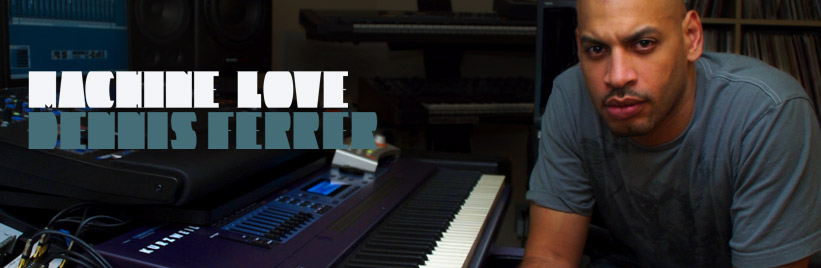
Machine love: Dennis Ferrer
RA talks to New York house master Dennis Ferrer about the machines that line his studio walls, and what it took to get them there.
As paths into the world of production go, it doesn't get much more humble than salivating over a TR-909 through a shop window. He may only have been a penniless, gear-less teenager at the time, but even at this embryonic stage of his career, the adolescent Dennis Ferrer knew exactly what he wanted to do. Working on the basis that Ferrer enjoyed his "breakthrough" via his and Jerome Sydenham's majestic "Sandcastles" single back in 2003, you could very reasonably conclude that this drooling over drum machines was a tale of ten years ago, when in fact, you'd have to go back a further ten years just to chart the initial entries in his discography. Under his lesser known Aurasfere, Jax, Hippie Culture and Morph aliases, Ferrer could be found dabbling in ambient and techno textures through New York imprints such as Experimental, C & S Records and Synewave.
The Dennis Ferrer of 2010, however, cuts a very different figure. From a headline perspective, his recent Grammy nomination for remixing the Dido single "Don't Believe in Love" would seem like his most noteworthy achievement. But even those with merely a casual relationship with electronic music are likely to have crossed paths with his undeniable versions of Blaze ("Most Precious Love"), Fish Go Deep ("The Cure and the Cause") and Télépopmusik ("Love Can Damage Your Health"). In a scene in which commercial success is often seen as something to actively shun, Ferrer has been able to balance gigs at venues like Panorama Bar, Trouw and Movement Festival with an ongoing mainstream presence, as exemplified by last year's "Hey Hey"—online music store Beatport's most charted track of 2009. Rather than play down this modus operandi, however, Ferrer is only too happy to emphasize his inherent love for hooks, melodies and songs as I call up his New Jersey studio.
What first drew you towards production?
I was exposed to a lot of music early on, especially in New York there was a big dance music culture here. At that time it was hip-hop and R&B. It was actually hip-hop and some dance music. It was all meshed up. So I think one of my first experiences with it was actually when we walked by the record shop and we saw a [Roland] 909 in the store front window. I always wanted to mess with it, you know? Some guys would be in there playing with it and I got the bug. I cut school, spending hours in the store and getting kicked out.
I remember putting on the headphones and dreaming about owning an Ensoniq SQ-80. I was like maybe thirteen at the time and I mean, an Ensoniq SQ-80 at that time was costing $2000. That's a lot of moolah, you know, for a kid. And especially for me; I came from the inner-city and it was just not an affordable thing for us, for my family. I messed around with some friend's keyboards and stuff like that for a while until I was able to afford an Ensoniq EPS 16. At that time I was doing hip-hop, though.
Then somewhere along the line, I think I might have been like seventeen, and electronic music was becoming really huge in New York. Frankie Bones and and Adam X and all these guys were kinda heading a movement of techno here.
What year are we talking roughly?
Back in '94. It was around '92 to '94 [working] with Damon [Wild, partner in their Morph project]. It wasn't one person that I learned my productions from, though, it was several people; several really good guys. I think the final chapter was Kerri [Chandler]. Kerri was the one who said "This is where you're at right now but you know what? This is how it's supposed to sound."
Was there anything in particular that Kerri imparted on you that you felt was important for your development?
I think it was a matter of the kick and the bass relationship.
This is a very difficult thing to get right, of course.
It is, it's a very difficult thing to get right but it was always... I think his biggest thing was "It's always about the foot." It's always about that thump; it's got be about the thump and about the feeling. You can get as pretty as you want, but at the end of the day, a good record has to thump. And that was his thing... After I showed him a track I was working on, I always dreaded hearing the words "You sure you wanna do that?" He wouldn't tell me not to do anything. He wouldn't tell me "Do this, do that." [laughs]
How did you two meet initially?
I got kind of disenchanted with the way dance music was. Well my particular genre—the kinda techy genre—at that time wasn't working out. You were getting like 750 to 1000 bucks a record. I mean, you'd have to make freakin' 18 records a year just to eat. And there were no royalty checks. You can't depend on royalties from a small independent label. I went back to school to learn applications programming and I went to go work at a music store—part-time. During my time working and going to school, I met Kerri. Kerri would come down to the music store and since I already knew all the gear by heart, he would come in and always get my recommendations for certain pieces of gear.
I found out he lived around the block from me, but I didn't really know who he was. I really didn't even care. I thought he was some cool cat that I got along with, who lived around the block from me. So I mean, he's the one who basically taught me in a second that you don't need that much. Just get a keyboard and a [Kurzweil] K2000. The first ten records I did, that's all it was. It was a MIDI controller and a K2000 and a small Mackie mixer. And Cubase with 8 tracks: That's all it did back then. [laughs]
So you've been using Cubase since the beginning then?
I've been using Nuendo and Cubase from Steinberg [for] I think it's now 18 years?
Have you ever thought about switching to another DAW?
Well, I tried Pro Tools but for me it's a glorified tape-machine and that's fine, but that's not what I do. I kind of work exclusively with a lot of VSTI now. I had tons of regular keyboards—hardware—but it's gotten to the point where I use certain methods to get my sounds to sound like hardware. I know what they sound like and I know what it's supposed to sound like. There are different ways of doing things: Maybe sending it out to a pre-amp to warm it up, or to a tape-sync. You just find a good synth, send it out to a pre and then back in again...
Are there any particular plug-ins you are utilizing a lot right now on the soft synth front?
Oh, there are tons... It's like record hunting you know? You gotta go find out what somebody doesn't have. My biggest thing is to find synths that other cats don't have. I really don't like the commercialized ones too much.
Was there a point where you just decided to move away from the hardware?
Well, as soon as I found out that I can get close. Everybody says that you can't get close; everybody says "You can't, you can't, you can't." Well, I'm here to tell you that it's bullshit. Because if you can tell me what synth I used on the last ten records I did I will pay you a thousand bucks. But it's not going to happen. Nobody can tell what mic-pre I used. Nobody can tell what microphones I used. I mean, it's ridiculous. You can't tell I recorded "Hey Hey" with a U-47 [Neumann].
Would you say it was a case of snobbery on behalf of a lot of producers?
It's massive, yeah. It's a matter of snobbery. That's what it is. But I will say this: The principle still applies: garbage in, garbage out. You still need a quality, quality AD/DA converter, there is no... There's no getting around that. That's where you gonna get hurt. But, I mean, shit, you can find ways to make something sound wider. Just send it out to a pre, warm it up you know, send it up to tape and bring it back in and you can get close. It's all about your ears.
Are you using Abelton for anything right now?
Yes and no. You don't use Ableton, you play Ableton. I don't mean that in a bad way, but Ableton is an all-in-one kind of synthesizer in my mind. That's why I say you play Ableton. It's almost a self-contained synth. It's an amazing piece of software. Though, I still prefer Nuendo as Nuendo still has more of the classic kinda feel to it: a mixing-board and that's where I come from. So my tendency is most of the time to rewire Ableton to Nuendo. I still think Nuendo sounds better. That's just my personal view. I can't judge it whether it does sound better or not—it's just to my ears. And to tell you the truth, software's sound is totally subjective.
"Everybody's in a rush to do
the hottest, greatest thing.
And you know what? Nine times
out of ten it's garbage."
What about [Akai] MPCs: Are you still using them nowadays?
No, I don't use them so much, they're more museum pieces right now. I found, like I said, virtual ways of doing things. It has been like that for two years now. They're here, and I still sometimes go back to them. But now it's [FXpansion's] Guru; Guru through a big reducer and then out to my tape-machine and back again and it sounds just like an MPC. The thing about the MP was the swing: It was the feel of the sequencer and the filters.
Do you still have many of the old drum machines lying around? Did you ever get yourself a 909?
The funny thing was, yeah, I did and I sold it. [laughs] I got rid of it when I got my MPC. Because they were going for such ridiculous money at one point: $2500. I was like "Get rid of it!" I just sampled the crap out of it on my MPC.
Let's move on to the production process in general. Do you have any set methods or ways of doing things when it comes to starting work on a track?
Every record is kinda different. Sometimes I've hummed out a line in my head, a melody which I'd put down to give me the kinda generic frame to go around. Sometimes that melody in my head then gets lyrics put to it. I go "OK, what if I said this, what if these lyrics said this" and then I kinda put myself into that position. That's what I think a lot of people tend to not do in our music, in our genre. They let the singer kinda song-write and not every singer can write songs, you know? I mean, it's just singers do what they do—they sing. Like, you don't have a trombone player playing a violin.
Do you have any formal musical training?
Well, I taught myself how to play keys; a ton of instructional DVDs, contemporary gospel DVDs, playing DVDs, contemporary jazz DVDs, 1200 chords for the jazz musician kinda thing. So it's a constant process. You're continuously looking for an edge, continuously looking for new chords. To me chords are like buying a new synth: you figure out a new chord that makes sense and you go "wow." It's almost like a revelation. The best education you can get as far as learning to play and learning to make records is by listening to different genres of music.
Do you tend to use many samples?
Early on, yeah, later on, no. If I can play it then I'll play it. Sometimes the sample has a certain kind of grit and dirt that you just can't get [otherwise]. I think it's a tool; sampling is a tool and you can over-use that tool. It's really simple. I mean if you're jackin' everybody for their beats and for every kind of thing... I can't. I mean, I don't necessarily agree with it, but there have been some amazing records like that, you know?
The low-end theory
When it comes to EQing before the mixdown stage I prefer to rely on the "less-is-more" aspect. If you've tailored/sculpted your sound correctly, then very little is needed at the end of the mix. In fact, EQing tends to be a while-you-go affair. If, for example, you're using a sub bass you've just created then immediately what comes to my mind is that I'm going to have to either A) roll off some of the extreme lows so that it doesn't interfere with the kick (if the sub is not an integral piece of the tune) or B) roll off the extreme bottom of your kick. It's an artistic choice as to which one is going to be dominant. You have to choose one. Otherwise a clash occurs, and it's a mess when you hear it in the club.
This is where cheap huge speakers come into play: I mean like 12-inch drivers and above. You don't need expensive large monitors for this as you want to hear the record in where you presume it's going to be in its element. Now near-field and mid-field monitors are a whole different story altogether. As Kerri Chandler once put it to me "You want a Picasso, D? Then expect to pay Picasso prices!" Engineering is an art form that the majority of producers tend to overlook. It's not enough to compose your songs. If you can't translate everything correctly, then what's the point if it only sounds good in your studio? Are you the sort of guy who tends to start from scratch in all respects? Do you work with things like loops?
I don't, no, I never really worked with... I mean that's not true because I've played a record and I hear a percussion loop and I go "Oh, let me sample that." You see, there's no set, standard way of starting on a record. I can be looking through a record bin and sometimes we go record shopping for old records at the basement bin, 99 cents a record, and you say "You know what? Fill up this little crate full of records. I don't give a shit what I'm picking up, I'm not looking for a specific record, I'm looking for surprises." So, I buy two little crates of records, come back to the house and start listening to them, listening for chord progressions, listening for samples that I can take, or an idea.
On the flip side of this, do you have periods of time in which you don't feel inspired?
Of course. That happens all the time. I get times when there's like one or two months where I've got writer's block. At that point what you do is maintenance in the studio. You're basically just jerkin' off, but... You get your mind off making records and sooner or later it just hits you and then you're back to normal again.
Have you ever been able to establish the circumstances in which this happens?
I've always tried to figure it out and half the time when I've tried to work through it, it's just a disaster. You can make a record when you got that block and it's hard; usually it's a bad record. But you just wait until the moment. I mean, after some time you're sitting on the toilet bowl lettin' one loose and boom! The idea comes to you.
Do you have any particular methods for cultivating inspiration?
Inspiration comes from anywhere. As long as you're open to it; as long as you make yourself available to it... It's basically a lottery. The problem is having enough lottery tickets to give you enough of a chance.
Do you tend to sit on ideas?
Of course. There's hundreds of songs on my hard drive which you guys won't ever hear because they're so bad. The problem is nowadays, everybody is putting out everything they make. Nobody sits back and puts it away for a minute. No, everybody's in a rush to do the hottest, greatest thing. And you know what? Nine times out of ten it's garbage.
How much attention do you pay towards what's going on in the scene at any given time?
You have to—it makes no sense not to. I'm a dance music producer. That's what I do. You better pay attention to what's happening. But I don't pay attention to what I think is happening now. I pay attention to what I think is gonna happen. That's the difference. That's what I'm trying to do. I'm not trying to beat you at your game now. I'm trying to beat you before you can get to that game.
What happens is this: You look for what's missing. What's happening in the scene, and what's missing? What do people need, what do people crave? You have to understand that every record that's come out already, these cats have finished it at least a year ago. Whatever record you're listening to, they didn't finish it last month—that record has been an idea and a concept for at least a year. Six months minimum. So everybody, every cat who's a producer is up to something new. That idea is to beat somebody at the game.
"Don't do what you've heard,
do what you think you gonna hear."
With this in mind, is there any advice you'd like to pass on to aspiring producers?
I just said it. That's the key to this. That's the key to being current. Don't do what you've heard, do what you think you gonna hear. Do what you think is lacking, what's missing. When you go to the club, what are people dancing to? Well somebody played that old-school record, what was the element that made everybody go crazy that night? So why did everybody go crazy and why are they going crazy to the new things somebody just released? You just gotta know how to play the game.
Do you actually feel like there is enough competitiveness on the scene?
I don't think there is enough. I think there needs to be. I think... that's what I do. I'm sorry, when I'm hearing somebody's record, do I say "Oh my god, I love this"? No! My first feeling is "Oh my god, that's incredible—I gotta bust his ass on the next record."
I wanted to ask you about your working relationship with The Martinez Brothers: Did you see something in them in perhaps the same way Kerri saw something in you?
Yes, I did. That was the whole reason behind it. Everybody thinks that was a money thing and everybody is misconstruing it and getting it all wrong. See, people always come up with bullshit excuses because they're bitter... That was the issue. I saw somebody who was worth giving a shot. Kerri gave me a shot. He didn't ask for anything. He just gave me the shot. He was there, he was supportive, he said "Look, do your thing, here you go, I'll help you out."
Why keep things secret? You can't take your money with you when you die, so what's the point in keeping up any kind of industry secrets? Look, if you're a bad motherfucker, you're a bad motherfucker. You shouldn't have to worry about some other kids stepping up to the plate.
| | |