RA
RA Japan
Global
Local
Music
Interact
Search RA
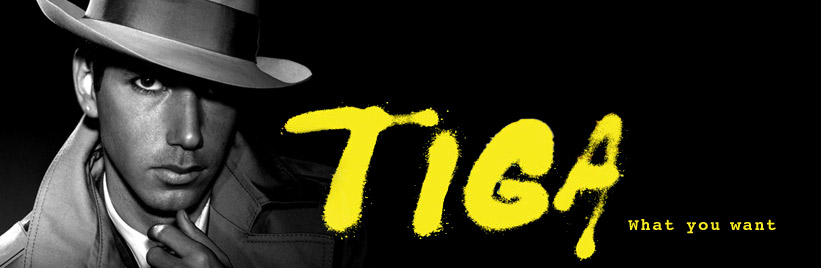
Tiga: What you want
Tiga: What you want

Techno evangelist or synth pop heartthrob? Being both has created plenty of confusion for those who follow Tiga, but the Montreal DJ/producer couldn't imagine it any other way.

There's an old saying that you never get a second chance to make a first impression. (I'm pretty sure that it comes from an anti-dandruff shampoo commercial.) Musicians have it harder than most. My first contact with Tiga was via his take on Nelly's "Hot in Herre." I'd somehow missed his more famous cover song, "Sunglasses at Night," but after hearing both, I was more than content to write him off.

Over time, though, I kept bumping into his name in the most interesting of places. The founders of Mutek told me he was instrumental in bringing techno to Montreal. His Turbo label somehow found room in the past two years to release records by Cari Lekebusch, Roman Flugel, Mike Mind, Brodinski and remixes of Fever Ray. Ciao!, his new album, has Soulwax and James Murphy all over it. And he has a wicked sense of humor about it all. Whatever you might want him to be, he can probably provide it.

Clearly, it all depends on what you (want to) pay attention to. With Tiga, I'd focused on one thing to the exclusion of all others. Having learned my lesson, I called up Montreal recently to make amends.

Goa India in the late 70's
Goa, India in the '70s.
Maybe it's just the interviews I've read in the past, but everything I read seems to be based around your upcoming albums or something similar. You have a very interesting history, though, which I'd like to chat about. You spent quite a bit of time in Goa growing up. How did that come about?

My parents were late '60s, early '70s travelers, and they dragged their kid along with them. In the mid-'70s, they fell in love with Goa, a place that had its beginnings as a hippie paradise. Now, it's more of an Ibiza-type place I guess. Like most kids, I tagged along for the ride. Up until the age of 12, I spent about half the year there. (To avoid the Canadian winters.) That was obviously a long time ago now, but it was an exciting childhood.

You said on your Twitter recently that you went back out there for a while. You said something about DJing with your father.

I spent about two months out there, January and February of this year. It's a pretty funny story. My father used to DJ out there. Starting in the late '70s, there was quite a party scene. In the '80s especially, in a lot of ways—I don't want to say it was ahead of the curve, because it was obviously following places like New York—but it was a fledgling rave scene. People would bring soundsystems to the beach, bring music from Europe or America and play all night hippie drug parties. Which, as we moved into the '90s, became a mainstream concept. In the beginning, though, it was quite an avant-garde idea. My dad was one of the guys on that scene, and that was my introduction to the world of DJing.

They had what amounted to a high school reunion for travelers recently, and as part of the whole thing my dad got up to DJ, 20 years after the fact. He was actually pretty clueless as to how to operate a modern CD player, let alone an actual mixing desk. My brother and I were there, and we toyed with the idea of watching him drown in public. It was a rare case of my dad pleading with me for help. I kind of ducked down, and helped him mix—letting him receive the adulation. It was a bizarre, surreal family event.

What were some of the highlights of the set?

He was playing good music. He always had good taste. He played the Patrick Cowley mix of "I Feel Love," a Blancmange record called "Blind Vision" that I always liked. He was always into early '80s stuff like Fad Gadget and Nitzer Ebb, the stuff that was slightly more politically charged.

When you were starting out in Montreal, were you playing politically charged material?

No, not at all. Like most kids are with their parents, you take a few influences and throw out the rest. When I was a kid, I was always into the cleaner stuff like Duran Duran or Depeche Mode. When I started DJing, it was purely techno, hardcore and early rave music. That was the connection for DJing, it was a techno thing. Not a pop thing.

"I was a preacher, and—looking back
on it—I was quite one-dimensional."


It seems like you can perhaps draw a line between what you were doing in Montreal in throwing these early raves and what people were doing in Goa. It's the same sort of DIY aethestic of starting a scene where there was none.

Sure. Now, when I talk about my past, it's so long ago. It's almost like I'm talking about another person. The main influence that I got from the India experience was that I was exposed to this idea of more extreme partying. The drug culture, the freedom, the dancing. All of the things that became so ubiquitous, things that we all take for granted now. I saw all of this very young, so I was very comfortable and familiar with it.

When I first started to see a little bit of what was happening in Europe in the early '90s via TV or compilations, I really wanted to bring that home to Montreal. I had always wanted to do the same when I returned from India. I could never understand when I'd come home for the summer that kids would be dressed as preps, wanting to be Billy Idol. There was a disconnect. When techno came along, I felt like, 'here's my chance to build something here.' The basic thing in India or the early '90s here, anywhere really, is that there's a basic entrepreneurship, a basic do-it-yourself effect, not to sit around and wait for someone else to do it.

Along with the raves, the record shop that you owned in Montreal seemed to also be a way for you to evangelize about the music that you loved.

That's a good term for it. I was a preacher, and—looking back on it—I was quite one-dimensional. I was really, really, really into my techno music and electronic culture. I was probably a little bit annoying actually.

What changed?

How did I get less annoying?

How did you get less one-dimensional? OK...less annoying.

A lot of that is the age. I was 18 and finishing school, and I had this passion. At that age, you want to be identified with the things you love. It also felt like we were riding the wave of something quite revolutionary. It could be my perspective, but it definitely didn't feel like now, where things are more spread out and there isn't this same kind of singularity of a movement. Or, for that matter, a drug that sweeps a nation.

I also became much more interested in the craft, the artistic side of making things and less the more social and business side of pushing and preaching it. The other thing was, at a certain point, the battle was won. It became a case of preaching to the converted. When everyone I knew was either a DJ or at the record store, what was I going to do? Going around whining that techno was the future?

Tiga


Was that when you started Turbo?

Yes. When I started out, I really just wanted to have fun, I really wanted to be a DJ. That was my number one thing. In the early to mid-'90s, I owned this DNA, a record store, and Sona, a nightclub, and I found myself in an administrative role of running these organizations. It started to make me a little crazy. I did most of the bookings at the club, so I had a bunch of contacts with artists. And I wanted to work more directly with them in a creative environment. The record label at that time was my ticket out of the club business, and of course a platform for myself too.

Your day-to-day interaction with the label over the years has seemed to ebb and flow, depending on what you're working on elsewhere. Where are you now?

Now I'm entering into a more hands-on phase. Originally, it was all me. All the minutiae. I was making rubber stamps, running to the post office, doing royalty reports. But I was lucky, as my younger brother came along and he's been managing the label for the past couple of years. Between him and my career going great—especially with traveling in Europe—it was easy to take a hands-off approach for a while. But now I'm getting back into it, being more involved with the artists, more involved with the release schedules.

It's really a bizarre time to be running a record label. There's no business model. It's just a weird soup. The past two years have been so depressing. I've been spared because my own personal career has been on the up, but the model of an independent record label has become murder. It's such a challenge now, though, that I'm getting really interested. You're really problem solving. Not figuring out how to get people to like your music, because we've had great response. But more how do you actually earn money for the artist? How do you transfer Facebook action into something concrete for the label? It's not easy, but it's a super exciting time.

One of the things that I enjoy about the label right now is we've removed the expectation of profitability. On one hand, it's mega-depressing because you might go broke and starve. But on the other, you should be able to move quickly and have a lot of freedom because no one is expecting to get rich. In that sense, it reminds me a lot of when I started in the early '90s. No one ever thought about making money, it was purely about, "Hey, colored vinyl looks amazing."

Producer vs DJ

To someone who might only know you from your album work some of the remix choices from your last few singles might be surprising—Motor City Drum Ensemble, Matias Aguayo, Adam Beyer, Seth Troxler, Mathew Jonson—but for those who see you DJ or read your charts it's obvious that you're a Ben Klock fan, for example...I don't know if there's a question in there actually.

I know what you mean. As a DJ, it's always been techno for me. I love techno. I'm hopeless. I love acid. I love hard techno. Even a lot of the minimal stuff. I just like it. In the '90s, it wasn't as sectarian. It was pretty normal that you could love an Underground Resistance record and also love a chill-out record. It was all kind of the same. That's the way that I saw it, and that's still the way I see it.

I admit I've created a lot of confusion. And sometimes that's been harmful. I've made some records that have been really pop and had some vocals that have some personality to them. For sure, a lot of people that come to my gigs want to hear "You Gonna Want Me," which is miles away from Ben Klock. It's the same thing with the label. A lot of the labels that explode, like Ed Banger for example, are the ones that get a style, nail it down and expand on it. Turbo has always been a little bit all over the place. That said, the only argument I really need is that we're still going. It's the same for me. I've had a long career. If you have wide tastes, and you're honest about it, you can keep going.

I don't know. I can't really explain it myself. I just know that I've always loved techno, but a lot of the records that I've made haven't been quite as stripped down. I mean, you don't always make the music you love. A lot of times you can't. I make the best music I can. But when I sit down in the studio, it just doesn't come out like a Ben Klock record. Even if I wanted it to. That's the thing: If I could make stuff like Aphex Twin, I probably would. So far I haven't been able to, so it comes out like it comes out.

Published / Tuesday, 13 April 2010

comment 30 Comments

Photo credits /
Goa India - Tarotray


Share this article
Facebook
Twitter
Google Plus
Pinterest


Features


Other features
Sunday night will never be the same again. As the legendary Glasgow party draws to a close, RA gathers up testimonials from artists, clubbers and staff of some of the best nights had at Optimo (Espacio).
As the boss of Deep Medi Musik and co-founder of DMZ, Mark Lawrence is one of the most respected men in the dubstep scene. In advance of his appearance at the Off Centre festival in Amsterdam, RA calls him up to chat 808s, dubplates and soundclashes.
Quality over quantity has been the guiding principle for this London techno label over the past decade, and it has been better than ever since its relaunch in 2009. RA delves into the history of James Ruskin's Blueprint.


About  
Staff  
Mobile (beta)  
Submit event  
Copyright © 2013 Resident Advisor Ltd.
All rights reserved. Terms & Privacy.