|
 |
 |
 |
 |
 |
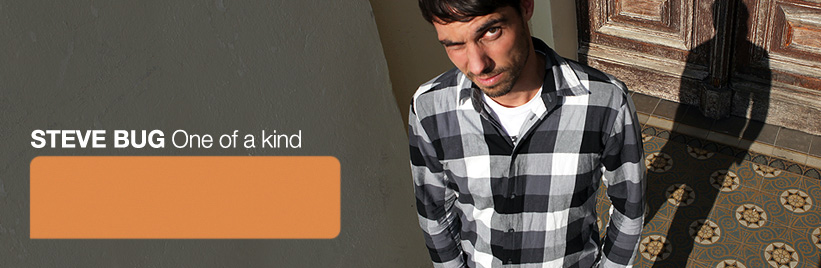
Steve Bug: One of a kind
In advance of his set at RA's ADE night at Trouw in October, we do a little Bugnology 101 with the Poker Flat boss.
Listen to Steve Bug, and he starts to sound a bit like that famous LCD Soundsystem song. But, then again, it's true. He was there at the beginning of dance music in Germany. He's been there ever since as well, whether it's on the dance floor, behind the decks, in the studio or as a label A&R. Forget the many trends, the hypes, the whatevers: Bug has seen them all.
For almost a decade now, he's seen them through the lens of his Poker Flat family of labels, which includes (among others) the deep house-orientated Dessous and the techier Audiomatique, as well as the almost clockwork release of a mix CD. Through it all, Bug has become among the most in-demand DJs in the world, playing gigs around the globe. RA's Todd L. Burns caught him on a rare day off earlier this month to talk about what got him to this point in advance of Bug's headlining spot at the Resident Advisor night at Trouw in October.
Front club in Hamburg. One of Germany's most influential house music havens in the '80s and '90s. Tell me about growing up in Bremen. Was there much of a music scene?
When I started going out, clubs were playing everything. Commercial music, but maybe we didn't know better. Then we went to more funk and black music clubs after that. But the [big club for me was] Hamburg's Front club where Klaus Stockhausen and later on Boris Dlugosch use to DJ. After my first night at the Front club, I started DJing at home and making tapes and stuff.
Klaus seems to be a touchstone for a lot of German DJs. What was it about his DJing that was such an inspiration?
To be honest, I don't even remember the way he was playing. For me, it was more the music and the fact that the music wasn't stopping. At all the other nights I had been to before, there was one track. And then it stopped. And then the other track. Maybe there were one track mixes, but then a break for sure because of the tempo changes.
It was a very special club as well. Front was, I'd say, 95% gay. I was probably one of the only straight guys in there apart from Martin Landsky, who was also going to Front at the time. (We didn't meet until later, though.) It was quite an experience, the whole way they did the music and the lights was completely different from everything I knew before. It was like if you'd only been to more commercial clubs and then you suddenly walk into Berghain.
There was a door policy too right? How did you get in?
I don't know. They seemed to like me. Actually we were always wearing crazy outfits anyway, so after a while they know you. Sometimes we would drive with random people from Bremen, and they wouldn't get in because they were too normal looking. I was quite selfish. I left them outside. I had to go in. I wouldn't do the same anymore, but back then I was so in love with the music that I really had to be there.
You said you went home and started making tapes for yourself after that first time at Front. How long was it before you DJed in public?
Three or four years, but I started buying records even before I went to Front. People had told me that there was going to be house music at Front. So I started to look for those records even before I went.
Were there stores in Bremen that were selling it?
Yeah, there were like funk and soul stores that had been picking up some of the house stuff. Already in 1987 there were already the first big compilations promoted by big companies so it was quite easy to find it. Then I found out about Container in Hamburg where I used to go a lot to buy records afterwards. They had all this stuff from Chicago and Detroit, really underground records that you wouldn't find in any store we had in Bremen. We went there pretty much every week to buy vinyl.
You said you were a hair dresser earlier. Were you doing that at the same time as you were DJing?
Yeah, I was. I think after three years of DJing, I finally quit. I did one day per week less every year. By the end, I was only doing three days. Every summer I took off for a couple of months to go to Ibiza to go party there, and so I would lose all my customers because they would be coming every month. When I came back, they were with other people in the shop. I was sitting in the back room waiting for people to come, so I was doing colours or even washing hair. I got bored sitting around, I'm a person who doesn't mind working a 16 hour day, but I can't sit around doing nothing and feel not needed or unused. I soon after decided to live in Hamburg
Why did you decide on Hamburg?
My choice was between Hamburg and Berlin. I knew there were a lot of good parties in Berlin, but I also knew there were a lot of DJs so it would be harder to get a job somewhere working regularly as a DJ.
Even then there were a lot of DJs?
Yeah, already. It was only people from Berlin, Berliners, but there were a lot of good DJs. Then I got a job offer as well, so I decided it was a better choice to go to Hamburg. I bought my first equipment at the time that I moved, and I immediately figured out that working at an office and doing bookings for other DJs was not really what I wanted to do so I quit my job after Tobias [Lampe, co-founder of Superstition Records] took the first tracks I produced. I decided to concentrate more on music. After a while we founded the first label together and it all slowly developed from there.
What was the idea behind Raw Elements at the beginning. Why did you think, "I need to have an outlet"?
It was more [that] I didn't really feel comfortable releasing my music on Superstition. In the beginning, I was happy to be releasing my music on a label at all, but they had always been treated like special releases. I wanted to be surrounded by people that think the same way that I do and I wanted to give other people the chance to release music that I think is great.
Who around you at that time were you thinking of specifically?
I wasn't really thinking of anyone specific, it was more just anyone. I just felt I was in the wrong surrounding for myself, so I thought it would be better to start something completely new. I asked people around me if they wanted to do tracks for the label, and I was already doing stuff with friends of mine like Acid Maria and Sören Schnakenberg did some tracks for us under the alias Stereo Jack and very soon we got demos from Vincenzo as well. But I had a really big output back then. I was doing a lot of projects which I was not putting my name on because I just had so much time.
What was the reason behind so many different names? Was the sound so varied for each track that you thought they needed new aliases?
It was because if I had released it under the same name nobody would have bought it. [laughs] I don't understand that even now. A lot of people flood the market, and then they become popular so they can play everywhere. But after that no one cares about their records anymore. It's like, "Oh there's another one." People sell out so fast. I never wanted to sell out. I was more trying to find a niche to release something that maybe people didn't even know.
I still think about releasing something without putting my name on it just to see how it goes, but it seems quite depressing these days because unfortunately no one finds out and no one buys it. But it's not about making money at this point. It's still interesting, and it's good to see how it could be for someone who is just starting out and bringing up a label. I was never a person that had to take all the credit for the work they have done.
Why did you finally choose to move to Berlin? Was Hamburg too small for you?
I actually met a girl back then, and she was from Chemnitz. I didn't want her to move to Hamburg, and I didn't want to move to Chemnitz. I think it's better to start somewhere new than have someone come to your city, and you have all your friends and the other has nothing. It's always a bit complicated. So we both loved Berlin, and decided to meet there.

You started Poker Flat basically around the same time as you moved?
Yeah, the last track on the first EP was the last track I wrote in Hamburg. "Loverboy."
Did it feel like a new beginning? New label? New city?
The funny thing is it was released before I moved but then the release stopped because of some distribution issues. I think for about three or four months the record was out, but it wasn't available.
It didn't simply increase the demand?
I wouldn't say so, looking at the way it sold or became popular it was never this one big push. It slowly developed. It was never like, "Wow, it's a big track." It was never an instant hit, like some things we've had on the label. Some people had to take some time with it.
I think that's indicative of the labels as well. Dessous, for example, is deep house all the time. That'll go out of fashion and then come into fashion, but you'll always be there pursuing this idea and it'll probably sell about the same for the most part. Is that your experience?
With deep house I can say that it's kind of tough times, especially with vinyl. It works quite well with the digital, but vinyl for deep house... It seems like there's not enough people. We sell, but it's not like you can really make a living out of it as a label or as an artist.
I think the problem for a while [though, was that] we couldn't really find people who were doing the music we wanted. We were going a little bit more electronic, and you can really see we signed people more from Nordic countries. The house groove got lost for a bit, it got a little bit more emotional from the musical side. The turning point came with "Rej," and suddenly deep house was back. We got people sending us demos again, but for awhile we were thinking of almost stopping the label honestly. We were like, "OK, deep house is gone."

Are you getting the right music for the labels now?
Right now it's better than ever. Sometimes I had the impression, I mean we've been so big since four or five years ago with the Trentemoller stuff, the Argy release with the Luciano remix and John Tejada's "Sweat (On the Walls)."
I think a lot of people in the scene think that maybe anything established can't be good, so after you've had a really big hype they probably won't listen to your label ever again. But, of course, there are always new people coming into the scene, new people following the label and you still have the people that were always following the label.
What do you do to combat that?
To be honest, at a certain point I was focusing on signing tracks that were not big just to get a bit away from it. That's not to say I didn't like the music, I loved it. But you could already see that it's a very difficult thing after something gets hyped if it's a label or if it's a certain sound or something. It's very difficult to get out of it afterwards if you've been a part of it.
You felt like you'd been a part of it?
No, but I felt the label was really big—even though we never really got as huge a hype as other labels in the press. I always thought we were...not underrated... but maybe for what we'd been doing—and for how long we'd been doing it... Maybe it's our personality. Because we weren't outgoing. But sometimes you think it's a bit funny why some labels after two years become a cover story and be like "The Label" or whatever. In a way I think it's good not to be this kind of label. Like, it's another way of saying it's over for a lot of people.
I've always wanted to be, not different, but I also don't want to be part of big movement. When I see there is something coming up like the minimal hype or something like this, even though I pick up some of the records, I never understood why people only focus on this one new thing. I always try to go around it, and do something different.
What do you think the unifying idea behind Poker Flat is?
I think in a way it is a love for the sounds of early Detroit and Chicago house. It has a certain funk to it and, in a way, it's a type of reduced track-based music, sometimes more, sometimes less. But I think for me it's more of a feeling, tracks need to have a soul. For me it's more important to feel the music than to know it's going to be the best-selling or best-working track on the dance floor.
In reading other interviews and your Twitter, it seems like you've played special gigs recently in Berlin at Watergate and in London where you played for the entire night.
I have. At Watergate I think after three hours I was still under 120 BPM, but the dance floor was still full-on partying. It was crazy.
Do you find yourself playing slower on average these days or is that just special occasions?
Special occasions. I love this stuff, but sometimes it's hard to play.
Why is that? Is it because the crowd doesn't respond?
No, I think the problem is there is no good way to do it yet. If you come from a 4/4 beat at 125, and then go down to 110 or 115, it sounds so slow. Everyone would leave the dance floor; it's almost impossible. You would have to slowly lower the tempo and go slower and slower without people noticing. But more and more people are buying only slow stuff. There has always been stuff that has been produced, but it has never been as popular as it is now.
Why do you think that is?
I don't know, maybe it's just because everyone is bored of everything that is around right now. But I don't think it'll ever become a really big thing like minimal or percussive house because I don't think it works for the masses. On bigger dance floors you always need more energy to get people moving. For smaller clubs and for smaller crowds, though, I think it's quite a new interesting part of house and techno.
"I just enjoyed being on the
dance floor so much I
didn't want to become a DJ."
What do you have coming up?
We have the 8 Years Poker Flat compilation, I've been doing a mix for Cocoon for the Green & Blue festival and also I've been doing a new Ovum which is going to be released in October. Josh [Wink, Ovum label boss] and I have been inviting each other back and forth to play label nights, so we thought it would be a good idea.
You've been friends for quite a while?
Yeah, a long time. It's funny. People don't notice it, but after a while suddenly you're a part of it. And it feels so normal. I was always thinking when I started doing my own music that it was stupid that I had never started DJing in clubs or producing music earlier. If I had started in '88, then that would have been like three years of producing. I've been around for a long time now, but in the beginning looking around at the others who'd been around...
Were you just scared in the beginning?
No, I wasn't scared. In a way, I was there from the beginning in Germany. I loved it from the beginning, and I'd been a part of it. I just enjoyed being on the dance floor so much I didn't want to become a DJ.
What was the moment that made you change?
It was definitely the summer of '91 in Ibiza, I had three months off and I suddenly thought, "Yeah, we should do our own parties." I think it was really important to have that time, to make yourself free from everything. I think if I had just continued my work back then, just going to the salon every week and maybe taking a week of vacation, I would never come to the point where I would say, "I'm going to do this." Sometimes I think about this with music too, that I've been doing it for so many years that maybe I already want to do something else without knowing about it because I don't have the time.
Is music still quite natural to you? Does it feel obvious that this is what you want to do?
Yeah, working in music, working in the studio or playing sets somewhere, even the label work is quite natural and it feels right. It never feels like work. The only thing that feels like work is travelling. It's sometimes really hard to just sit around in hotel rooms when you could be with your friends. That's the part that feels like work. Someone once said, I don't know who, "I've decided to get paid for the travel. I play for free." [laughs] And, in a way, it's true. I think all of us would be playing if we were asked to play on a beach or on the river in Berlin; probably everyone would do it if wasn't your proper job and you're just happy to have a few days off.
|
|
|
|
|
|
Published / Monday, 30 August 2010
26 Comments
Photo credits /
Header and portraits - Paul Clement
Front clubnight - Wolfgang Tillmans
|
|
|
|
|
 |
 |

Features
|
|
|