RA
RA Japan
Global
Local
Music
Interact
Search RA
Ata: Come into his kitchen

The recipe to success for a Frankfurt veteran? DJ, club owner, bar owner, chef.


When Atanasios Christos Macias, better known as Ata, opened a new club named after legendary Blues musician Robert Johnson between Frankfurt and its neighboring city Offenbach in 1999, he had already established himself as a vital part of the local music scene. In 1992, he founded Delirium, which quickly became one of Germany's most popular records stores. The store eventually served as a hub for Ongaku Music, whose better known sub labels Klang Elektronik and Playhouse are still around some 18 years after their first releases.

The electronic music scene in Frankfurt, once considered the birthplace of German techno, on the other hand, was in a bad state at the turn of the century. The legendary Omen club had shut down a year before and Dorian Gray was just about to join it. It did not seem like an entirely reasonable idea to open a new club that focused on house rather than techno at that time.

But Ata had a vision, and 12 years later, Robert Johnson has become a household name for international club goers, being regularly voted amongst the best clubs in the world. Its story is as simple as its philosophy: With its amazingly small size, its beautiful location overlooking the river Main, a complete lack of fancy lights and extras, and a line-up that features friends rather than popular names, Robert Johnson had unwittingly defined minimalism before the term took over the electronic music scene.

Despite the recent success of his club, Ata was never one to rest on his laurels. Known for his eclectic and slow-burning DJ sets, he remains a sought-after DJ. And if he is not behind the decks, he indulges in his second passion—cooking—by hosting a weekly dinner party called "Club Michel," or by serving drinks for his friends in his recently opened bar. We caught up with Macias last month to discuss all of this and more in advance of the release of his mix CD for Live at Robert Johnson.

Robert Johnson is entering its 12th year. At the time you opened the club, did you ever think that it would go on for such a long time?

I'm not a pessimist. If I want to do something, I do it and don't think about how long it will last or how much it will cost. It was just like that when we opened the club in 1999. Sure, when I look back now and consider the average half-life of a techno club these days, then I'm thinking: "Wow, 12 years—not bad!"

How do you explain this continuity?

One of the reasons for our success is the fact that we've maintained the Robert Johnson as pure as possible and have tried to keep it all about the sound system and the venue itself. A lot of clubs have a great design, which may wear itself out in a couple of years. Robert Johnson really has no design at all. It's as clean as an operating room. It's only about the music and the people that come to dance every week. And of course there's the rather special location, with the river, the balcony and the door policy, which many people don't like. I consider our club as a micro-organism that doesn't like to be disturbed. And so far it hasn't.


Drink tickets at Robert Johnson read: "Alcohol and nicotine takes out half of humanity, but the other half dies off without Schnapps and a smoke."


Why don't people like your door policy?

Our door policy is rather special since it's completely done by women. Of course there's criticism—some people write angry emails and are pissed off because they didn't get in. The door policy is important, though, in order to have the right balance in the club. In the past it was the same and it still is the same in other clubs. You simply can't let every person in. Period. As a guest, you got to have the feeling that going to a club is something special. Perhaps you lose a couple of people over the years, but the benefit to the atmosphere is much bigger.

It's almost exclusively women that work at the bar and at the cloakroom. Is there a reason for this?

I've been mostly working with women for many years, simply because I find the work environment more comfortable. There's always people that say, "But the girls at the bar are shit!" and I say, "Of course they're shit, because you've been hitting on them for years!" Personally, I find it more interesting when female bartenders don't smile the same way at everyone all the time. There's really an allure to crack them, to get a smile out of them… [laughs] But seriously, we simply try to work with people we know and love.

Truth be told, the club is fairly small. Have you ever thought of moving to another location?

I've learned one thing over the years. There's an attitude toward life in which you don't force things to happen, but instead let them come up on their own. It worked that way with the Robert Johnson and it still works like that now. I would move the club, if the opportunity showed itself. But it would have to be better than it already is—I won't move into a basement anymore! And because our location is already pretty fantastic, it's difficult. Many friends have asked me whether I would open a Robert Johnson in Berlin. There have been discussions over and over with friends and DJs in Berlin, but I think we're all too chaotic to get it done. [laughs] But yeah, if it happens, then it happens. But I'm not going to go out and frantically try to get that done. Even though I do think that Berlin could do with a Robert Johnson...

How so?

Berlin is very diverse in its club scene, which is great, but it is far from perfect as far as I'm concerned. I'm not really satisfied with any club [in Berlin] and I would perhaps go out and do some things differently. That would of course mean to raise the bar, but I'd be happy to try…


"I think that Robert Johnson
is a stoner club if anything."


Many clubs in and around Frankfurt have run into problems with the authorities. How did you evade this?

The biggest problems we've had have actually been through police searches. Those started once MTW, our neighboring club that is a bit more mainstream began playing more techno. So the police came around and saw three things: Techno—kids—drugs—bad! It's idiotic, really. But of course, as it happened, during one of their searches they found kids high on all sorts of shit. And that caused a lot of problems for a while. However, I think that Robert Johnson is, in any case, a stoner club if anything. It is fine with us if someone wants to smoke some weed or wants to get drunk. After all, there's no such thing as a techno club without drugs.

For many years, Robert Johnson has appeared in lists as one of the world's best clubs. How do you handle this popularity? You once tried to post the line-ups as audio files only...

The decision not to print any flyers and only have mixes would have worked if people hadn't posted wild speculations [of the lineups] online. Suddenly I was thought to be Tiefschwarz and Chloé was thought to be Magda. That was no use, so we went back to announcing the line-up again.

Even so, it is unfortunate that on some evenings, when well-known names play, the club is crammed and on other evenings it's not nearly half-full.

In the past, the club was the reason why people came. Then what happened is what I like to refer to as "Rock 'n Roll Business": Instead of the club, it was the DJ that people wanted to hear. In the past you would go to a club because the music was constantly good and you liked the sound and the people. Nowadays most people do not go out not because of the club, but because they want to hear a specific DJ. One reason behind this is the flood of information that you can get at the click of a mouse; you can see which DJ on which night plays where and people search for their favorites. So unfortunately it happens that on certain days less people come because maybe the DJ is not as well-known. But that's the way it is. You don't you have to like it, but you have to accept, just as much as this entire vinyl/mp3 story.

Over the years, Robert Johnson has always promoted DJs that weren't seen that much in other clubs. Is that part of your philosophy as well?

It was always important for us to believe in something. If I book a DJ, then I believe in him and I like his music. Take, for example, Thomas Hammann and Gerd Janson—two awesome lads that have been our residents for many years without being absolute superstars. Still, Gerd has gathered an enormous respect in the scene for his label, his style, and also his sets. And we're happy to be part of this development.

You know, Robert Johnson is not based on a classic business model. We do not book any big names just to see whether they work out or not. If a DJ comes and plays great, then he can come again. Good music, good vibes—those last. I don't give a shit how many people come. And, of course, we also try to boost the people we book—when Magda started out playing here, she didn't fill up any halls. If some DJs like Ricardo [Villalobos] calls me up years later and ask if they can play at our club again, even though they could play in a much bigger space for more money by now, that is, I think, the best example that our system works.


Is the label, Live at Robert Johnson, also meant to keep boosting these people?

Absolutely. Live at Robert Johnson is primarily a platform for our residents and artists. However, there's only one final release from Dixon that's scheduled for the mix series and then it will be finished. We only want to do compilations from then on.

Why is that?

There are so many podcasts and live mixes on every corner on the web, and this cramped DJ mix thing on CD is crazy. Me personally, I find compilations more exciting. I can arrange something with, for example, Ricardo. We can search out tracks that are totally out there, without feeling the pressure to make a coherent mix out of them. I also think that CD lengths don't work at all for Ricardo and neither for me. We only begin to establish a groove after 45 minutes or so, and then the mix is almost over…

Let's talk about your other "club." Club Michel. How did that come about?

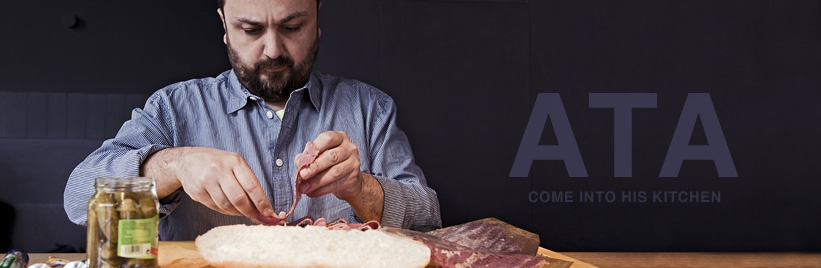
I think it started about seven years ago. I always had a passion to cook. Music, fashion, art and cooking is all part of the same whole. There is a point at which you don't see your friends regularly in the club anymore—they've got kids, family, new jobs, etc. So I asked myself: What can I do to bring them altogether? And funnily enough, they always come to dinner...

...and that's when you decided to throw regular dinner nights?

Yeah, at the beginning I essentially re-arranged the club every Thursday in order to cook there. And guess what: everyone came! The whole thing developed a dynamic on its own. Tobias Rehberger, an artist and friend of mine, has his studio in the same building where we have our office. He talked to me and said that there was a free loft upstairs. I looked at it and thought: "Awesome, that's it!" Then we developed it together and Club Michel was born—in reference to Michel Piccoli, the actor in The Grande Bouffe.

Do you always cook yourself?

Not always. I rather try to have a "special guest" chef each time. Laurent Garnier was once a guest and wanted to throw a cooking session right afterwards. Miucci Prada also offered to cook, but she's really busy. Charlotte Mies, the best cook in Köln as far as I'm concerned, who also cooks for the guys at Kompakt, is now a regular chef. We're in the process of setting up a second Club Michel in Helsinki and I think there are similar events happening in Berlin and London. We also cook for the Frankfurt Museum of Modern art or for the Städel Museum. I would say Club Michel is now a sort of small temple for open-minded people who want to experience an exciting menu.

Would you say that a good menu is similar to a good mix?

Absolutely! Good cooking alone can really get to you—in a positive sense! The combination of tastes, drinks, smells can literally get you high. Food and music are aimed at the same feeling: you notice when you've eaten well, and you feel the same if the music's good, when you're dancing your ass off. Or when you visit an awesome art exhibition. Cooking is art, too.


Conny Plank's drum set at Bar Plank
Club Michel is not your only foray into gastronomy. You have also opened a bar in Frankfurt.

Yeah, Bar Plank. In memory of Conny Plank. Conny is somebody that opened the door to electronic music for me. For me, he has produced some of the most important records ever. When it was made public after his death that his studio was being sold, I bought his original drum kit. I had it standing around my bedroom for years and I had no clue where I should put it...and now it's in the bar. But of course the idea behind the bar, first and foremost, is again to see my friends more often. So we try to keep it personal with self-made cakes and alcohol only sold after 6 PM.

A few years ago you once said that you can essentially forget Frankfurt as being a party city. Do you still think it is?

Nothing has changed, really: Frankfurt is still Frankfurt, a small banking, hotel and convention city. You notice that in terms of culture. The restaurants aren't great and you can't really go out. Admittedly, you can't really go out in Paris or London anymore either, but those cities have much more to offer in general. In any case, my friends and my family are located here, so I stick around. And it has one small advantage: you always have your friends close by. Everyone lives in their Kiez [neighborhood] in Berlin. Frankfurt is just one big Kiez.

How have the projects we just talked about affected your DJ career?

I definitely play less these days. Not because I don't have any time, but rather because I don't want to end up in a club. Once I'm 50 years of age, I definitely won't be standing in a club, just grinding through a set. I like playing records, but I've reached a point where I simply feel too old to go as intensely at it as I did before. Being a DJ is hard work. You've got to prepare, there's the traveling, having no time for your family, pacing through the weekend in order to be back in the office on a Monday morning. I'm happy to have other things around that bring me as much joy without being as stressful.

What do you plan for the future?

At the moment we're planning an illustrated book that covers the past 12 years. We're including not only the club's history, but also the shirts we designed, the posters, buttons, exhibitions, records and concerts. The material has been sorted and catalogued for almost a year by two friends of mine, and is now being packed into a book that will be published early next year. We didn't realize how much we have actually done over this period of time, so it is also great for ourselves to see what the Robert Johnson cosmos is all about. At first the volume was supposed to be called "Halbzeit" (half time), but I quickly did away with that name... [laughs]

So what's it called now?

"Come into My Kitchen," just like the song by Robert Johnson. That title has always stuck around with us. Back in the days, Robert Johnson sang about the kitchen as a place where you'd meet with people, drink whiskey and dance. If you read his story and the story of the blues, you will see that what they did back then wasn't too different from what we do now.

Words / Eike Kühl
Published / Monday, 11 April 2011

comment 47 Comments

Photo credits /
Julia Katharina Ziegler


Share this article


Features


Other features
Denmark's purveyor of dub techno stayed in Copenhagen, and it made all the difference in the world.
Awe-inspiring line-ups, wild locations and an unmatched influence on an entire generation of British electronic musicians: RA's Lee Smith profiles Lost, the 20 year old institution that brought techno to London.
The veteran duo has nothing to sell, as RA's Todd L. Burns found out late last month. But they still have plenty to say.


About  
Staff  
Mobile (beta)  
Submit event  
Copyright © 2013 Resident Advisor Ltd.
All rights reserved. Terms & Privacy.