|
 |
 |
 |
 |
 |
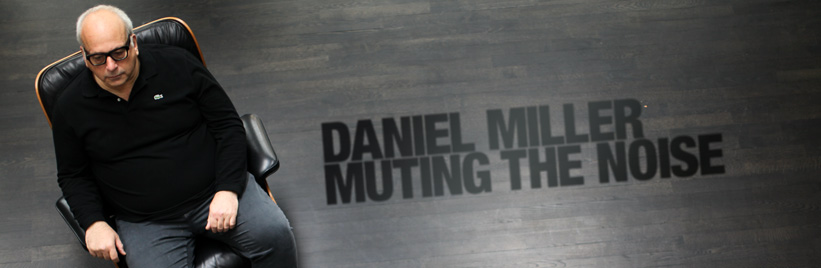
Daniel Miller: Muting the noise
The revolutionary label head talks about his imprint.
It's hard to imagine a large swathe of electronic music without the help of Daniel Miller. As The Normal, "Warm Leatherette," his debut single on his own Mute Records, was among the first wave of electronic pop experiments that emerged from the UK in the wake of the punk explosion. As a label head, he's had a hand in the careers of countless acts. (Depeche Mode, Fad Gadget, Yazoo, Goldfrapp, Moby, Richie Hawtin and Speedy J are just a few.) As he gets set to celebrate the diversity of his imprint at The Roundhouse in London next week, we started our conversation by touching on what it means to be independent again after recently cutting ties with EMI.
I wanted to start by asking you about taking Mute independent once again. It seems like an interesting time to be taking that risk. Or, in your mind, is it a risk at all?
It's always been a bit of a risk, but I never think of it that way apart from the beginning when it was just an experiment. If I thought of it as a risk, I probably wouldn't do it. I just think of it as something I really like to do.
Has it given you the freedom to do things that you wouldn't have when you were with EMI?
When we started with EMI, the first few years went really well. Then EMI had their own problems, the industry had its own problems. So we all had to look at how we were going to restructure things. Being independent again, though, means that we can make our own decisions on how to work things internationally. I feel more confident in signing stuff again, I really feel that I can talk to an artist and say, "We can give you a really great service internationally." EMI never said anything like, "You can't sign that." I had the freedom to sign anything I wanted. I just didn't sign a few things because I felt like they wouldn't fit into the system [we had with them].
You were self-selecting.
Yes. And you always do that. Sometimes there are years and years where you don't want to sign anything. And sometimes there are more bands that you want than you can possibly handle. You're always self-selecting. I remember the Britpop era was pretty disastrous for us. [laughs] There was the techno thing going on in parallel to it, but in terms of signing bands and full-time artists, it felt like there were about a million years there where if you weren't four skinny white kids with guitar, bass and drums there was nowhere for you to go in terms of radio press and people's general interest.
What did you sign in that period?
We were working with some of those post-rock, Kraut-influenced bands from Germany and America like To Rococo Rot, Kreidler, Appliance, Echoboy. We were looking. We're always looking, but we'd say "What are we going to do with this, even if we sign it?"
You started Novamute way before that, right?
We started in the mid-'80s with a label called Rhythm King. There were two English guys I knew. I remember seeing one of them walking down the street one day with a bunch of 12-inches. "Where are you going with all of those records?" "Oh, I've got a label and we're trying to do a deal. This house music thing is just about to explode." "House music? What's that?" He explained what it was, came back to the office and played me some records, and I said that it sounded quite interesting. I didn't quite get it. It sounded like disco to me...but it sounded quite good. But it seemed like he had a passion for it, and he really knew it, so I had him start the label that became Rhythm King. And then came Bomb the Bass, S-Express, the early Warp stuff. (We worked with the Warp guys at the very beginning.) It was a brilliant time. Eventually Rhythm King fell apart, but I wanted to stay in that world. And I was visiting Berlin quite a bit.
"I've never been a big record
collector... That side of music has
never interested me very much."
Do you remember when you first visited Berlin?
We came there quite a bit in the '80s. From about 1983 to 1986, I was living here half the time with Depeche and other artists. It was before the Euro, and the Deutsch Mark was very weak against the pound, so we could record here in great studios that you could never afford in London. After that, I used to go to Berlin Independence Days, and that's where I met the guys from Plus 8. There was a lot of music there that I was getting excited about. I didn't know the name of it, but it was all over the place.
What was it about the music that was so appealing to you?
It felt very much like the things that excited me 15 years before, when I first heard electronic music from people like Kraftwerk. It felt like people were really exploring and experimenting again. And the kids were getting off on these weird sounds. I found that really interesting, and thought, "Well, let's see how far we can go with it."
It's only recently, though, that it seems like you've been interested in DJing yourself more and more. Why do you think that is?
I don't know actually. In the very early days of Mute, I played live. I quite enjoyed it too. And there is a sense of performance with DJing when you're doing it. Looping things, building up layers.
What are you playing these days?
Techno music basically. Pretty much new stuff from the last three or four years I guess.
You're not nostalgic with your sets?
Not really. Maybe when I get better. I'll perhaps become more adventurous, and bring things in. I played a bit of Laibach and Depeche at Berghain, but just a loop, as a bit of color. Don't ask me, though. I'm really bad at remembering names. I hear it, I download it, I put it in a list, you know? I've never been a big record collector. I've never known who played tambourine on the B-side of whatever. That side of music has never interested me very much.
Why do you think that is?
Well, I know why I don't have a very big record collection. It's because I don't like a lot of music. [laughs] I've always been focused on a small amount of stuff. I'm not a collector. I'm a bit of an accumulator.
What's the difference?
One is a conscious thing. The other just happens. You have piles of stuff, and you just don't throw any of it away. One of our bands played in Berlin recently, and they went to the flea markets and got all of these weird Turkish 7-inches from the '60s. They were so excited about it. These kids know so much more about music than I do. It's amazing.
Do you think all of that knowledge, in some way, is unhelpful? I imagine that when you were starting to do things back in the '70s, you were just trying to throw everything you had learned out the window. I wonder how hard that must be nowadays.
It's all in what you do with it. The whole "wanting to change the musical world" in 1976... it was a different thing, really. I was born at a really good time for a music fan. I'm old enough to remember just Elvis Presley when he was good. I was lucky enough to have a mate that had an older sister that was really into music. And I was just becoming a teenager when The Beatles came around. Imagine listening to a record that was made in 1962 and a record that was made in 1967.
I read in an interview with you where you said something to the effect of being alive during those five years gave you pretty high expectations when it came to music.
Exactly. And if you were into music, you really wanted it to continue. But it stopped.
When did it stop?
Around 1967? When I say it stopped, I mean that all of the bands that had been a part of that wave of innovation had taken too many drugs, or had become really conservative and fallen in love with their own technique. And the whole singer-songwriter thing happened. It went from being pop to rock. Of course there were some good bands at the time. Looking back, Led Zeppelin were a pretty good group. At the time, I thought it was the most appalling thing that had ever happened. Well...maybe not the most appalling thing...there were more appalling things like Emerson, Lake and Palmer. [laughs] I couldn't understand why people were so into Led Zeppelin, though. I mean, I loved the blues. That's the one music that's never left me. But I wanted to move on.
Around that time, I first started hearing things like Amon Düül and Can. I realized that it had moved to Germany, basically. I heard Can for the first time, I think, on John Peel in 1968. I was going to college in a place called Guilford, which was a pretty horrible stockbroker belt town, but they had a Woolworths there which had one of the most bizarre buying policies of any record store I've ever seen. They had all of these records for 50 p, like Amon Düül.
Do you remember why you bought it? Did you listen to it in the shop?
I didn't. The sleeve was really great, very psychedelic, it was German, there were lots of umlauts all over the place and it was...it wasn't that great. But it was different to anything I had heard before.
The way your bio puts it, it seems like you spent time in Europe around then simply because the music scene in the UK was dissatisfying.
Well, it wasn't just that. But music was my first love, and I wasn't a very good musician. I had no interest in working in the music business. I worked in film for a couple of years—my second love—and saved up some money and decided to travel. I loved the mountains, and wanted to work in a mountain resort. I ended up getting a job as a holiday resort DJ in Europe as part of my travels. This was 1974 or so.
It was lucky at the time, because [Kraftwerk's] "Autobahn" was a hit, so I could play that. I'd play some Neu. But really it was a business, and I was employed. There were two dance floors in the hotel, and it was very competitive. It was all about getting the punters to spend as much money as possible, so I'd play ABBA, Status Quo, Deep Purple. It was fun...for a while. I really got off on people enjoying it. But it drove me nuts later on. Then punk started, and that's why I wanted to come back to the UK.
You've also said how important it was at that moment that the price of synthesizers came down to a point where it was affordable to buy for an average musician.
Yes, that's right. There were a lot of things that came together around 1978, which is when a lot of electronic singles were released. My single, Human League's single, Cabaret Voltaire, even Throbbing Gristle. That could have only really happened in that year because people had grown up liking some electronic music like Kraftwerk, and then everyone was also encouraging DIY records. There was an article in the music press showing you how to make your own record, how to get it pressed and distributed. There was a famous article by a band called Desperate Bicycles that outlined the process. All of a sudden, it all seemed possible if you put a little bit of imagination into it.
It's obviously easier now.
Easier and more difficult.
What's more difficult?
Well, it's not more difficult to do it. There's just so much more of it. In those early days of DIY, when I started my label, maybe two or three records would come in over a week. Every single one of them was an event. And everyone would listen to every single one. "Who is this? It's from Manchester?" By the end of that same year, there were 30 or 40 new releases a week, because everyone was doing it. That's great in one way. But you don't have time to listen to it all anymore. And if it was 30 or 40 a week back then, just think what it is now. To get someone to listen to something properly was much easier back then than it is now.
I guess in this environment, something like Mute—where you know generally what it might stand for—becomes more important than ever, to get people to listen to something properly.
That's always been a plus or a minus in Mute's case. I wish as many people liked Mute as didn't like it. Especially in those early days, though, with labels like Factory, 4AD, Beggar's Banquet and Mute. More so than now, there was a real sound to those labels because they reflected an individual's taste.
What was the sound to Mute early on in comparison to those?
More electronic in the early days. Maybe more experimental? We had Boyd Rice, early DAF which was quite radical at the time. I don't know. It wasn't so much a sound as it was an aesthetic. Factory was very specifically Manchester. 4AD had this gloomy, droney, lots of reverb on everything. Mute was a bit spikier.
It seemed to me like everything on Factory was filtered through Factory, while every release on Mute seemed to be a different entity.
That was a very different approach, yeah. I wanted the label to be in the background. I wanted it to be all about the artist. Factory's artwork was all done by the same person, the same with 4AD. That was more like the traditional way of doing things. If you bought singles in the '60s from a label, they all looked the same. If an artist on my label wanted a picture of a skull or a picture of flowers, I didn't really care. As long as it worked with the music, it was fine.
What would you say the sound of Mute is now?
I don't think there is one. I just want to work with artists that are original, whether it's a techno record or something else. For me, rock was dead in 1978. Then I saw The Birthday Party. By that point, I thought we had made our point about electronic music being potentially a big part of the future of pop music. When I saw The Birthday Party, I thought, "OK, maybe there is life left in this beast." I realized then that it didn't have to be electronic. It had to be electronic for the first few years, because it had to be apart from what had come before. At that moment, I realized if it's great, it's original and it doesn't sound like anything else—and I like it—then that's good enough for me too. That's what Mute is today.
|
|
|
|
|
|
Published / Thursday, 05 May 2011
16 Comments
Photo credits /
Paul Clement
|
|
|
|
|
 |
 |

Features
|
|
|