RA
RA Japan
Global
Local
Music
Interact
Search RA
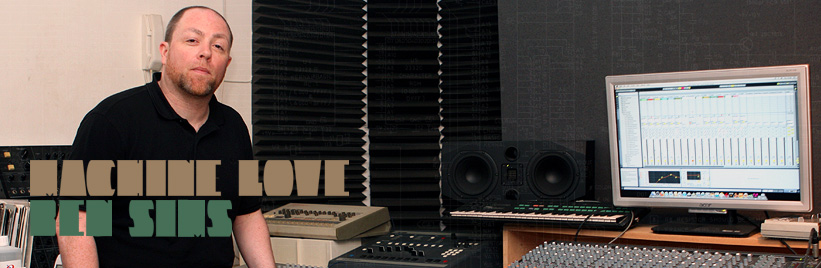
Machine love: Ben Sims

One of the planet's most prolific techno practitioners opens the doors to his studio.

"I'd never really considered myself a producer." For someone as prolific as Ben Sims, this might seem like a surprising statement. Sims has been among the most reliable forces in UK techno for over a decade, releasing waves of 12-inches through his own Hardgroove, Ingoma and Theory labels, while pushing his sound at some of the biggest techno events on the planet. But, as he admitted when we spoke in his east London studio last month, it's only recently that he's begun to come away from an unwavering commitment to the servicing the dance floor through his long awaited (and much pondered upon) debut album, Smoke & Mirrors. By extension, he doesn't mind labelling himself as predominantly a DJ. Much of his music down the years has simply been derived out of a need for a particular type of track for his sets. It just so happens that countless others have found a place for his productions as well.


You mentioned to me that you only spend a couple of days in the studio per week. Does that put a lot of pressure on you to get things done?

Well, it depends. I work with an engineer as well so he is a lot more up on the programs and that kind of geeky aspect of it...We will start out by adding something to the computer that might help, and just kind of mess around. The album was the only project that really had a deadline or set goals. Everything else was just if there was a certain kind of track that I didn't have in my set last weekend. I think the album is the only thing I have done that has really made me get out of my comfort zone.

When you say "a certain kind of track," could you be more specific?

Yeah, it's mainly if I'm DJing and I want to change the direction of my set midway. Or I want to go quite house-y for a while or strip down what I'm playing, and flicking through my records or my CDs I don't really have that track, and it feels like I have to force something in there. I will usually come back and try and make bridging tracks that make my set easier or flow better.

Do you have a lot of material specifically for your sets that's unreleased?

I'd say probably 25% of my set is re-edits or re-tweaks of other peoples' tracks, or special versions of the tracks that I've done just because maybe the one that went out just didn't work as well as I thought it would, so I went back and changed it. But I couldn't justify putting it out again because most people wouldn't notice what the changes were.

What would you typically do to someone else's track if you were doing a re-edit?

A lot of the time it would be approaching it the same way as... I started out trying to make hip-hop years ago, which was simply looping up a bit of that record, or take a bit of that disco record, put a stab from another record and just make these kind of mash-ups. Just take the key bits out of things I like and make a track out of it. A lot of the early stuff I first put out was really just mash-ups of other people's records.


So has sampling always formed the backbone of what you do?

Yeah, I think it has mainly come from a hip-hop background and just associating it with that DIY aspect of making music in your bedroom that can involve samples. Lots of my favourite hip-hop records are literally just a drum machine and a James Brown loop and a stab or something else. So I think I have definitely kept that kind of mentality when it comes to making music—and I think some people like that and some people really don't. I think that is why I have never been too geeky about the production side of things, because part of what I do is kind of an extension of my record collection.

Have you made a concerted effort not to be geeky?

I don't know. I think there were certain points where I tried to really embrace the, kind of, technology. I used to totally be hardware and analogue sequencers and old shitty Ataris and I was kind of happy with that set-up, but I was well aware that the sound quality people were getting with updating and new production skills were really leaving me behind. So I did make a concerted effort to try and change everything and stop using so much hardware stuff and start to get more digital, and I just got kind of lost in it…Just trying to keep up with things like, "fucking hell this person is using this program, I need to start using it," rather than it just it being about the ideas or what I was trying to do with the music.

Over the past two years when I have worked with Paul Mac as my engineer, and he is free to do the running away geeky thing, whereas I will have the ideas and I won't need to worry about keeping up with current sounds or current programs as much because he can do that.

For how long did you feel "lost"?

I would say probably from about 2001/2002 until about 2008. I was really just trying various ways of doing it and ways I was comfortable with. I bought a Mac and I kind of jumped onto Logic after using Cubase for years and I just couldn't do what I wanted it to do. I went back to PC and I bought one of those Carillon set-ups, and I wasn't happy with that. And I went back to Mac again, and a lot of people were doing the Ableton thing, and it took me a while to get my head around that, but finally I'm happy with that and keeping up to date as I need to, but I still need help or assistance to get the best sound out of it.

I think in many ways I still treat it like hardware, where I run everything red and everything distorted. I am kind of analogue-minded, where you can get away with that, whereas if you do that with digital it sounds like shit. A lot of the time in particular when I was doing the album, rather than Paul coming one day a week and us working together, I was working six days a week on my own and he would come in one day a week and basically go, "No, that bass is cancelling out this, and this is wrong." He'd basically help me do it…It's not that I can't do it on my own, just the results are far better if I work with someone that is more clued up on the technology.


It's an interesting idea: because of the way peoples' brains and approaches differ there might be a perfect set-up out there for each person.

Yeah, I think it was just the way that you can generate ideas quite quickly [with Ableton] and in the same way dismiss them quite quickly. I will constantly start working on something—little rhythms and arrangements and basslines and stuff—and then it will be like, "right that's quite good but that doesn't work with what I want to do," so I just save that in a folder and work like that until I get to where I want, but I will have made the basis of five tracks getting to the actual idea that I want.

Am I right in saying that you've recently reintegrated hardware into your set-up? Because there was a time where you were solely producing on the computer, right?

Yeah, that was when I was trying to kind of adapt with the times, and just try and take things down the digital route because everyone seemed to be getting a far better sound than me.

So you had kept all of that stuff throughout?

Yeah, I kept it, but it would be a case of maybe just hooking something up and just sampling a couple hits from it and doing everything with the computer. With the album I wanted to kind of have a balance of the two and kind of go back... I definitely feel like I do still experiment a lot with hardware.

With the album I definitely went back to incorporating more of that stuff in it, whether it just be me pissing around with the synth for a couple of hours and just recording a little bit of things or using an analogue sequencer or whatever, which are things that I haven't done for years.

Did you totally switch mental gears when you knew you were going to start working on the album?

Yeah, I definitely felt like I was able to experiment a lot more and I definitely did a little bit more at home. Say for example, a couple of the tracks have the Yamaha DX100 in it, and it sounds like shit now compared to new synths, but it is something that I always loved when I was younger and loved playing around with.


"I know if I had done an album
maybe ten, twelve years ago...
it would have been shit."


Did you have any concerns that your style wouldn't suit the album format? I know you've had deals lined up with Peacefrog and Tresor in the past that didn't come to fruition.

Yeah, I definitely feel like there was a part of that, and also that I wouldn't be able to make an album that I would be happy with, that wouldn't experiment enough...I think because I just continued doing club 12-inch after club 12-inch for so long I didn't feel comfortable coming out of my comfort zone of just doing club bangers to play at the peak of my set. So it took a lot of time to be confident enough that I could actually try something else.

I know if I had done an album maybe ten, twelve years ago when it was first being discussed it would have been shit and I wouldn't have been happy with it. There are a lot of 12-inches that I listen to from back then and I'm like, "Aw, that sounds bad."

Do you feel like you have maybe had a lack of confidence in yourself down the years?

I think definitely with...it's not really classing myself as a producer throughout any of this. I've always just classed myself as a DJ, and I'm just making DJ tools for me to play. People did like my music and it sold and I got to remix some great people and stuff like that, but I wasn't ever confident that I was capable with doing any more with just those DJ tools. And apart from the past couple of years, just spending more time in the studio and making more of an effort and pushing myself a little bit has made a lot of difference. It has only really been the past kind of year-and-a-half where I felt I have been capable of doing an album.

You've always seemingly had a knack for peak time grooves, though.

I think initially it was trying to make the stuff that I wanted to play, or trying to make the stuff that I thought I wanted to hear when I was still very much going to parties every week. I used to go to big raves in '88 and '89, we used to have a sampler at home and I would come back home and try to recreate the kind of memory of almost the whole night in just one track. The tracks were terrible, but what I was doing was fun and I think I have always kept that kind of...

I want to make memorable tracks, you know what I mean? Not necessarily the peak time bangers, or the one that you play for the last record when people go home, but I would like to be able to make the tracks that people remember. I think for a long time I was just trying to make the kind of mixable tracks in the middle. I don't know if I got necessarily a knack for doing it, it just takes a lot more work for me to do something that's different from a typical Ben Sims track.


Obviously your music has been predominantly loop-based over the years. How would you typically go about creating or sourcing a loop?

I think for a long time I would just kind of almost lazily bring a handful of old disco or funk records to the studio and I would just sample bits of this bassline and just kind of construct it from that. I'm a passionate hater of sample CDs and sample libraries, though. I just think it's really lazy. You are not really bringing in your own influences or music from your past.

What would you be sample typically? Single hits? Loops?

Bits of both, really. Moving into the digital world rather than just using hardware samplers—the [E-mu] SP 1200 or something like that—you're not just limited to little hits. But sometimes you can be really lazy and just take a massive chunk from someone's record. Ideally [I'll sample] a particular disco track that I'm just playing loads at the time and I just want to feel that track, and it may just be the case of taking a little bit of it and really feeling it down so I know it's there and maybe nobody else will.

How do you typically construct your drum tracks?

Recently I'm going back to taking hits off old drum machines and just classic 606, 909, 808 and constructing rhythms out of that. But I have also added sample hits of old disco records…I construct it in Ableton.

Are drums your usual starting place?

It always used to be putting a load of samples into the computer or the sampler. I think nowadays because of the way I work with Ableton and the fact that you can kind of keep taking ideas and putting them in folders, now it may be more the other way around: having a bassline and a riff and to build a track out of that. I definitely always used to start with the bass, sometimes I still do that now, but I tend to find I will just continue to add samples on top of each other until I just have this wall of noise where I have to strip it back and start again.

Has this process become easier down the years?

I think so. I mean, definitely reintroducing the analogue sequencer…Well, I didn't have one before, I had like an old Korg, but they are definitely very, very useful for getting little quirky rhythms and basslines together. They won't always be useable for the track that you are working on, but you can keep saving them. I've got at any one time 50 different rhythms in a folder somewhere. I can start on one of them and make a track from that process. I can come in and twist a couple of knobs and the basis of the main track will be there in a couple of minutes. Other times I will be sitting there all fucking day and not get anything.


How would the main bulk of a track come together?

I'm definitely not one of those guys that could just start with a kick drum and say, "alright, in 16 bars it needs to do this." I will work the complete opposite way around—what I'm aiming for is the core peak of the track and I will work my way backwards. What I'm aiming for initially is just that groove, that funky rhythmic thing and I will build out from it.

And how do you going about giving a sense of progression?

A lot of it would be filters. I mean, one of the things that I used to do pretty much with every track when I was still using hardware was filter the loops and the drums through analogue keyboards and kind of let them self-modulate the filter so it would have this kind of movement that the machine was just doing on its own. Because most analogue keyboards have a mind of their own anyway, I would just filter things through there and I think that is definitely something that I have gone back to. You can make a static loop or groove have this kind of life of its own.

Which synths are you favouring these days?

I think definitely the [Access Virus] Indigo was one of the key things in the album.

Are there others in particular?

Not really. As I said, the DX100 but that was really to get the kind of old raw, authentic, crappy, what I like to call "Casio sounds."


Has gear lust played much of a part in your production life?

I think that once I conquered the iconic bits that I wanted when I was younger and couldn't afford, then no. I am not one to be devouring Future Music. I suppose I first approached getting hardware as more of a materialistic, "I must own a 303," kind of thing.

I think that it's also a problem with people who are obsessed with the technology side of it, and the constant updating and constant need to be upfront. Sometimes you don't spend enough time on the music and the original idea and why you are doing it in the first place. When I tried, it completely fucked me up for years so...I think I am happier having a set-up I like and occasionally adding to it rather than thinking of ways to change it.

Words / Ryan Keeling
Published / Wednesday, 23 November 2011

comment 16 Comments

Photo credits /
Sam Donnison

Also available in / Japanese


Share this article


Features


Other features
One of Germany's most popular DJs speaks.
Over the past weekend, the Leeds night celebrated 20 years in business. RA pays tribute to its extraordinary legacy by talking to some of its key protagonists.
RA sits down with the two brains behind New York City's largest live disco band.


About  
Staff  
Mobile (beta)  
Submit event  
Copyright © 2013 Resident Advisor Ltd.
All rights reserved. Terms & Privacy.