RA
RA Japan
Global
Local
Music
Interact
Search RA
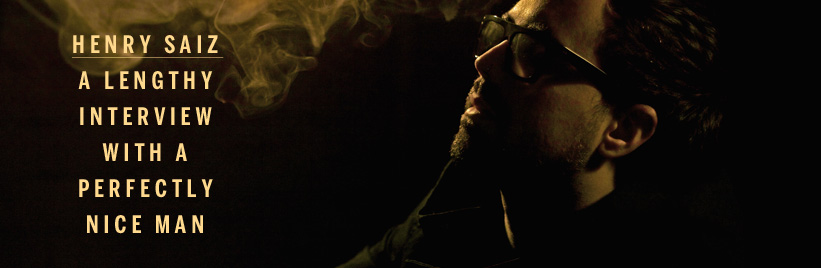
Henry Saiz: A lengthy interview with a perfectly nice man

The David Foster Wallace-addicted DJ and producer talks LSD therapy, his upcoming album and more.

There's something genuinely mind-expanding about spending four hours talking tunes, trips and tales with Henry Saiz. The Spaniard is just as inspired by the writings of David Foster Wallace and the paintings of Salvador Dali, as he is by the drums, basslines and melodies that get thrown down at clubs and festivals.

Similarly his environment plays a direct role in influencing the shade of his musical output, with Saiz planning to relocate to the Canary Island of Lanzarote to record his maiden artist album in May. "It's the best place for me to do it, because it is so inspiring; you're in the middle of nowhere surrounded by volcanoes. It's like being in contact with nature, which is something I really need when I'm doing music. I'm pretty sensitive to my environment, so I really need to be in a place where I feel focused and inspired."

Indeed, there's a grandiose nature to Saiz's vision and production approach that could easily be mistaken for pretension if it wasn't for the passion and sincerity that radiates from him as he sits, slightly nervously, chain-smoking rollies in his manager's apartment in the El Raval district of Barcelona.

Although cutting his electronic music teeth producing Warp-inspired sonic contortions in his bedroom in Madrid, there's nothing obscure as such about Saiz's current production work. His compositions are rich hypnotic sound excursions that explore the middle ground between melodic techno, progressive and the artist's own take on disco-influenced house as Hal Incandenza, while his Tyrane side-project with best friend Luis Deltell allows him to delve into electronic-influenced pop/rock with stadium-sized effect. All are superbly crafted courtesy of his background in sound design, working on TV shows, documentaries and commercials.

It is under the name Henry Saiz, however, that he's made his biggest mark. And it has hardly come bigger than last year's sumptuous contribution to the Balance series, which saw him utilising vinyl, cassettes and reel-to-reel tapes to evoke a vintage vibe. The first CD even contained field recordings from over 100 tapes made by a pre-teen Saiz. It was an experience that reminded him of the poignant power of music. "It was a really therapeutic process because I came back to all these memories I had completely forgotten about; it was like facing myself in a really deep way. I was listening to these recordings of myself when I was 10 and it was really shocking. [laughs] I now have a much better knowledge of myself now [based on what I was doing back then]."

At present Saiz is in conceptualization mode for his debut artist album, which has already been given the provocative title Reality Is for Those Who Are Not Strong Enough to Confront Their Dreams. As part of the project he will soon launch a call for people to upload sounds to Saiz's website so that they can potentially be included in the long player.


So, can you explain the concept behind the unusual method you're using to collect samples for the album?

While I was working on my album concept I came up with this idea of making people participate in the whole process and exploring the concept of adding people's thoughts, voices and sounds and integrating them into the album as a kind of ghost member of the project.

Something like a choral album orchestrated by me where the people involved don't really know their role in it. It's hard to explain and sounds ridiculously pretentious [laughs] but it is just the way I work and I felt it could be really interesting and new. That's what motivates me when doing music.

What sort of samples are you encouraging people to upload? Can they be anything from the everyday to the obscene?

Definitely not loops or parts of their tracks. It's more like something personal; thoughts, ideas, voices, singing, poems, soundscapes or samples. Whatever is honest and emotively interesting. The obscene is part of us, so is welcome. [laughs]

What's your criteria for choosing what samples get included? Will only a very select few be included?

That's something I can't possibly know right now, it really depends on how I connect with the sounds while writing the album. It's a very abstract feeling indeed. It's not really a rational criteria; I usually let myself be guided by my "subconscious" or whatever you want to call it.


"I love to take hallucinogenic
drugs when I'm making music."


Quite a provocative album title you've chosen. What inspired it?

I was on one of those eternal flights to Australia, watching Slavoj Žižek´s The Pervert's Guide To Cinema on my iPad and obsessively thinking about my album during the flight. Žižek said this sentence that refers to the message in David Lynch's Blue Velvet about how sometimes it is much more challenging and hard to face the dark side we all have than to just let yourself go with the flow that society dictates, which is supposed to be tangible and "real." In my point of view, it's like a weak and vague substitute of what our perception of the world could be.

Honestly, I hate to define these kind of things as you can't avoid sounding like a total pretentious fuck, but I'll take the risk. [laughs]

Saiz will record his new album in Lanzarote.
I know it's still in the early stages, but can you talk about the feeling of what you're trying to create with this album? Do you have a sense whether there will be more lightness or darkness—any idea what sort of elements you want to gravitate towards?

I want to create a balance of these more techno percussive sounds, because I really want to explore this thing. I want it to sound somehow really primitive and really tribal, but not in a tribal house sense. This is why I am doing it in Lanzarote because you can feel this ancestral vibe, like you're connecting with nature.

The energy you can find in a place with volcanoes—it's really sensitive. So people who go there and are sensitive to all this energy and stuff, they're like "whoa"—because you are in the middle of a natural disaster that happened thousands of years ago and you can see how earth is a living being, the lava flowing, etc. So I really want to do something tribal in that sense, especially with electronic music, there's something really tribal about it, which started in Africa. I think the album will be like an essay on how I see humanity, how I see music and the direction of our civilization and where it will go.

All these feelings we have now that are pretty dark—it's like the zeitgeist of this era. I don't want [the album] to just be dark though. I want to find some hope as well. I think it will be quite a therapeutic process. It will be quite based on samples: I want to sample everything that sounds interesting and translate that into music.

So you'll go out with your DAT tape and get field recordings?

Yes, exactly, that will be the first part of the process to catch all these sounds, because I never use libraries of sounds like that.

Raja Ram of Shpongle once explained how he would go out into the jungles of Brazil and take Iowaska and then come back into the studio with Simon Posford and sketch what he saw when he was tripping off his head and then Simon would try and translate these sketches into sound. Do you ever do drawings in this way? Do you see music as pictures or colours?

Really interesting question actually. I follow that method. I love to take hallucinogenic drugs when I'm making music. I don't do it all the time, otherwise I would be fucking crazy. [laughs] But once a year at least, I do LSD therapy and sometimes I don't even make music.

Will you do this alone and at home or out at a festival?

No, alone. I'm used to doing it alone in the middle of nowhere, in the middle of nature. Places like Lanzarote where the place is so flat, it gives you that sensation of calmness. It's something I really love to do, because it allows me to organise all my thoughts: like "I want to do this" and "this is honest," [whereas] "this is not." I'm pretty organised with those things. I like to have a clear image in my mind of what I'd like to do. I think it's a good thing if you're making this type of music.

Do you take a pad and make sketches?

Yes, I have like hundreds of notebooks full of messy drafts that only I can understand. Sometimes it's text like brainstorming things or anything that makes me feel that I'm going the right way and doing what I want to do. [For example] I have this idea and I want to develop it in the studio. Sometimes you just sit down in front of the computer and things flow, but for my album for example, I have my notebook and I'm always writing down things I should add to the album or something like that.

With the album, was it a case of deciding to go away into nature, take LSD and sort everything out and create a vision?

Yeah, I think everything is part of a process and you get inspired every day and, of course there's no need to be on acid all day [laughs], but for me that is the confirmation that what I'm doing is right and honest. Sometimes you're working for some labels and you have an audience and people want to listen to your hit, and they want everything to be like that. You kind of feel forced to repeat a successful formula, but that's not honest. This method allows me to see what is honest and what I want to express. Actually I think it's pretty healthy and people should do it.


"When prog house was big,
I was playing black metal."


When you were nine years old, I understand your dad was quite influential. He introduced you to Jean-Michel Jarre? Can you take me back to that time and what it was like?

I remember clearly the first time I listened to electronic music. It was in the car during one of these holiday trips with my parents and my brother. I was mesmerised by the landscape and my father put this soundtrack on from Kubrick's Clockwork Orange with those amazing classical music pieces re-worked by Wendy Carlos.

I used to listen to a lot of classical music because my mother loves it, so when I listened to all those classical compositions but with all these strange new sounds from synthesizers, this was something that really shocked me; all the beauty of the synth tones and how different it sounded compared to classical instruments. I didn't know someone could do something like that with all the textures and those extremely vast palettes of sounds and tones.

Then I listened to Vangelis and Jean-Michel Jarre and Tangerine Dream, then I started listening to prog rock like Pink Floyd, Camel and The Beatles from the '70s of course.

That explains why your music is so based around composition. There's that musicality there that connects it back to your childhood when you saw that classical music could be placed in a different context.

For sure. Classical music was always a big influence. Because of that and my metal background…

You're a metalhead?

Yeah. Actually it's funny, because people always say to me, "Oh I'm sure you were a prog house lover." Actually when prog house was big, I was playing black metal in a band around Spain. [laughs] My best friend Luis and I both left the band and I started to do electronic music by myself and now I have my own band with Luis, Tyrane.

I definitely have metal influences in my music, not really from classic heavy metal but for more extreme metal like black, death and doom...I think everything comes from the same point; [it comes] from classical music and gives it all this musicality and harmonic complexity and stuff, but you're just using a different message with metal and some types of electronic music, but [it's still] all about that energy and that "epicness."


When did you start tinkering with production and making your first tracks?

I was listening to lots of Warp Records at the time I was in a black metal band. If you like metal and you like this energy, you can feel almost the same with extreme electronic music and experimental music. So I started to try and figure out how these guys did all this fucking crazy music and all this complexity and technical epicness.

The first electronic music album I did by myself was probably '96 or '97 I think. It's funny because it sounds like it could be a new record on Warp or something like that. It's proper experimental electronic music. I think I have good technical skills now because I started with something really complex in the beginning. I'm going more minimalistic and slow [now by comparison]. Sometimes I think I should release these early albums on my label for fun. Maybe I'll do it someday.

Oberheim DMX

Machine love: Saiz on his studio


I work based in Ableton and Reason. I just got Reason 5 and I really love it. Some people think Reason is not 100% professional and you have to use Logic, but for me it's one of the most powerful tools on the market. Ableton is the main sequencer I'm working with, but I play most of the things live, like bass guitars, drums (using my Drumit five electronic drum), guitars and percussion. I like to experiment with a lot of effects and guitar pedals, and of course I record as many things as I can. The music has a more interesting feeling and energy when it's played live by a human—it's just my choice anyway.

You have live instruments in the studio?

Yes, I have lot of vintage stuff: synths, mixers, guitars, bass, drum machines and so on. But of course I use a lot of software like Reaktor and post-production tools. I feel comfortable using those kind of tools I think because of my sound designer background. I did a lot of sound design for TV; it's like Trentemoller, he used to work as a sound designer and you can feel it with his music because it's so elaborative and a lot of his sounds are well-designed so it makes you see music production in a different way.

Do you have favourite synths that you use?

I love the Oberheim DMX and the Roland TB-303—I have one and love it—it's just like my baby! The acid lines I do are always with the TB-303. I have some classics like the Korg 101, E-mu SP-12, a lot of old shitty Casios. I buy a lot of stuff from eBay too—it's a producer's drug you know! [laughs]

Do you make stuff yourself too?

Yeah, like James Holden made his own modular synth? I wish! I'm not that nerdy! [laughs] If I work with too many wired things [after a while] it's like "What's the point?" It's amazing and it's really interesting, but I start to feel like a scientist and not a musician. Sound design and the experimental part of the process is always important. I try to spend all my composition time on making music, although of course there's a huge experimental component in electronic music making and I really enjoy it.
You started out making music for TV and production. What sort of projects did you work on?

I did three cartoon series for Disney and Nickelodeon. I did a lot of commercials and a lot of things for advertising and some documentaries and some design for TV shows. It's really, really fun to work on that. But, at the end of the day, you are not doing art, you're doing the things they're asking for. Of course you put your creativity into it, but the final word is from a guy in a suit in Los Angeles who may say "this sound is not good for business." It's well-paid and it's a great job, but I felt like I really needed to focus on my own music, so I stopped working for them. Now I've started doing some ghostwriting for some pop and R&B artists in the UK, which I love. [It's] really mainstream commercial music like Britney Spears and Kylie Minogue—I love them. I'm also doing some selected films and TV series.

You've spoken about being really inspired by art. Are there any particular artists who have blown your mind?

I think my main reference besides music is David Foster Wallace. For me he is the best writer of the last century and my all-time favourite writer. I really recommend his work, because it's amazing. He committed suicide like three years ago [September 2008], which was something really devastating because I felt really connected to him. It was like when someone in your family dies.

He wrote my favourite book, which is Infinite Jest. It was really an amazing and big influence in how I understand the world. Of course there are also names like Stanley Kubrick, David Lynch, Bergman, Roy Anderson, the symbolic period of painting and other painters like Dalí or Rousseau and many, many others. I love writing, design and architecture… There are many interesting artists out there.

You've spoken about the great vibes among the artists signed to your label, Natura Sonoris, but generally is it like this in the Spanish scene? Generally speaking do you feel like there is more unity than infighting and bullshit?

Yeah, I think we are living in a kind of golden age here. I think one reason why, is because lately there's a good relationship between labels and producers. We're friends. I think collaboration is essential for a good scene; like what happened in Berlin years ago. I think that community feeling is really important for a scene to grow up healthy. I can work with someone like Marc Marzenit who has his own label or John Talabot or Pional or Dosem, etc. It's "the union makes the force," which is a Spanish saying. For example, in places like Mexico or South America, people love electronic music there, but they just don't collaborate at all; so some of them waste time and energy fighting for venues, DJs and things like that, instead of trying to work together. That doesn't make things easy.

Have you played in Berlin?

Yes, but just twice. [Saiz struggles to remember specifics about the gigs, mentioning that one was a label showcase for Marc Marzenit's Paradigma Muzik.]

Berlin is amazing, but it's very snobby. You wouldn't be "techno" or "house" enough for them.

Exactly. To them I'm just prog house because of the labels I've been involved with. They don't even stop to listen; "OK, it's not prog house, it's something different," It's a city I really love, but yeah, it's really snobby in that sense. It seems like I'm in the middle of nowhere [between house and techno] and some promoters don't want to take the risk. If I'm playing there, of course I'd play a set that really fits with the club and the crowd.

Besides I don't think I'd ever play something like old prog house or anything cheesy and old-fashioned. I never think in terms of styles, I just try to play music that has soul and sounds emotive and honest. It doesn't matter which label you want to put on it. I think it's a question of time and releasing stuff on different labels.

Do you sometimes think that being released on labels like Bedrock and Renaissance might hurt you in this respect, if that makes sense?

Yes, it makes sense. But, on the other hand, I can say that I'm proud of being part of this. I'm not playing very often in Berlin, but I'm playing in many other places, and labels like Bedrock have opened these territories up for me like South America, Australia, etc. I think it can be even more interesting to play in places like that than in Europe. I can take a flight and have some fun in Berlin anytime, but to go to places like South America or Asia…if I'm playing these because I'm related to Bedrock or Renaissance, then I feel like it's something positive.

Besides I think they are legendary labels full of amazing music, so I'm very happy to be part of that. I don't really give a fuck about trends and musical prejudices.

Published / Friday, 09 March 2012

comment 27 Comments

Photo credits /
Volcano - Lanzarote Tourism Board


Share this article


Features


Other features
The Scottish producer is unrepentantly old school in his music and views. RA's Nick Connellan chats with him around the release of his new album.
RA speaks separately to electronic pioneers Vince Clarke and Martin Gore about their new project.


About  
Staff  
Mobile (beta)  
Submit event  
Copyright © 2013 Resident Advisor Ltd.
All rights reserved. Terms & Privacy.