|
 |
 |
 |
 |
 |
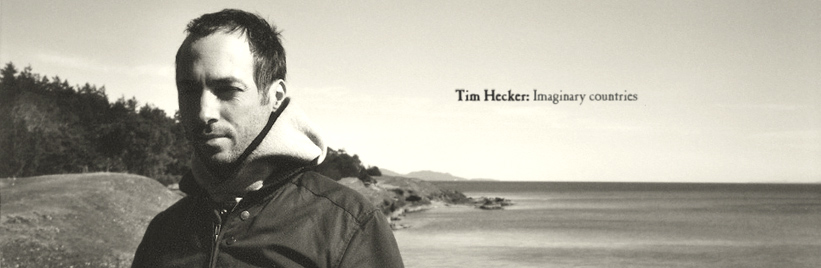
Tim Hecker: Imaginary countries
Complexity and ambiguity are the hallmarks of one of experimental electronic music's leading lights in both music and conversation. RA's Holly Dicker peels back the layers.
Ambient, experimental, glitch, drone, classical, quasi-metal—the music of Canadian sound artist and composer Tim Hecker has amassed a number of quantifiers over the years, though none have ever quite managed to define it. Since departing from Jetone—his early techno project—Hecker became engaged in a more abstracted exploration of electronic music, based upon the timbres of space and "non-representational" forms of sonic material. Haunt Me, Haunt Me Do It Again—his full length debut, released in 2001—introduced the melodic limbo between noise and structured sound he would continue to test with increased complexity on Harmony in Ultraviolet and An Imaginary Country.
Hecker's music has culled him a discursive fanbase. He's toured with bands like Godspeed You! Black Emperor, Isis and Jesu alongside regular appearances at left-of-centre festivals such as Mutek. In 2011 he cemented his esteemed reputation with Ravedeath, 1972, his seventh and perhaps most compositionally avant-garde album to date. Over the following months he'll be performing a series of organ concerts throughout Europe, the first of which will be at Berlin's CTM next week.
Hecker and Ben Frost at Belgrade's Dis-patch festival Can you tell us about how Ravedeath was made?
At a point where I had material for Ravedeath, I'd say about four or five months before the album was finished I took these kind of half-baked pieces to Iceland where I was going for basically a week just to get away. My friend Ben Frost—who helped work on the record—suggested I use this great church. So we rented it for a day and set up a way to perform the organ and use my forms of sound manipulation that did something to the material of the organ.
So the album started essentially as digital constructs, which were worked with organically and then re-manipulated in the studio?
I actually began to write them with piano in mind and I used a lot of piano pieces to kind of play with motifs. I actually recorded all that early stuff and released it as Dropped Pianos, but the more I worked on it in the studio the more it became these sort of suffocating, internal, mixing desk only-type of pieces with digital reverbs.
I felt it lacked a kind of three-dimensionality that I've never been really good at getting with my music—almost a fake kind of liveness. So I took it at that point to an actual physical space and, with really good microphones and recording techniques, we got a pretty fantastic way to contrast that sterile nature of the pieces I was working with.
How will this translate into a live performance?
It's hard to say. There's a kind of structure that's set but there's a huge improvisational prospect to it that you can't even prepare in advance, that really relies on the nature of the organ, the tuning it's in, the way the microphones react to the PA, whether they catch much feedback. It's always different and it's really kind of chaotic so I don't know what will happen but often they go from really vulgar, pummelling kind of intense concerts to really spacious super wistful, very sparse, almost minimalist in every form-type of concert. But it's really space-dependent.
What set-up will you be using for Organ Concert?
I play at the organ console. The pipe organ itself is microphoned. Those microphones go into my computer and I process that organ sound. Now, my main set-up—my mixer, my laptop and synth—go out to a PA system in the space itself. So you have this hybrid of sounds coming out from my set-up and the organ itself filling up the space naturally or traditionally.
Are all your live shows generally improvised?
My set-up really allows me to transform sound: stretch it, cut it up and distort it. I follow a structure generally that gives me some sort of sense that the work is going through a trajectory, but given those kind of limits of structure I put on things I really allow it to spin out into different ways. There is a fair degree of improvisation for sure.
Do visuals play a role in your shows as well? I mean, I've seen videos of where you're performing in almost complete darkness. Do you use visuals or are they something you kind of avoid?
I do occasionally. I'm not a pro-visual kind of person in terms of music performance. I am really preferential to bare naked sounds, and the darkness is insanely effective in channelling the senses to the ears. It doesn't really remove visuality, but I find people focus too much on what the performance is, and the gestures that are taking place on the stage—and I do too. So I like to minimise those types of not-always-fruitful thought patterns, to just take sound on its own terms.
 Hecker's live performance at Cafe OTO in 2010 was so loud that a glass fell off one of the tables in the venue.
The amalgam of digital and organic strands in Ravedeath, coupled with the choice of album cover led many to see it as a comment, or critique about technology in music. Is this the case?
The record is not about the technology. In some ways it isn't about anything at all, like an expression of bare composition. That's just one side of the narrative you can glean from the packaging.
But really I'm not against or for technology. On that issue I'm super ambivalent. So I use the most cutting-edge technologies, I also use the best of things from the '70s, like tube compressors. But that doesn't mean that I'm pro-technology or against it. I'm not some kind of Luddite that wishes we went back to the sweet old days of magnetic tape or anything. Not at all. But that doesn't mean I subscribe to all the digital dogmas that are pervasive in our world.
Are all your albums inherently conceptual?
Record titles or track titles are a chance to cloak the work with a kind of poetic garb. That isn't glib in any way, I take it very seriously—and that's not saying that the titles are about nothing—but often people run with that stuff so far that you need a meaning structure around it to interpret a work. But often people build up such a sort of ornamentation around the work they actually don't get to the substance of it.
Is the process of music-making more important than the end product, or vice versa?
It's hard to say. I'm not a process-orientated person; I don't find it necessary to talk about it. I think that it's kind of like sausage making—you don't want to know. These records process-wise are very brutal, bloody, bone-crushing experiences. They're not pre-set pieces of work. I would say the end goal is what matters, the piece itself. How you got there is not as important, personally.
Bone-crushing? Is the process so torturous for you?
I wouldn't say it's like hard work but it is intensive. I've always been hesitant to release material. I do it so slowly that I almost sometimes wish I'd just let things go more glibly. It's not like each work is this pummeled, chiseled, life-sucking perfection object. I definitely know when there's a point when things get overworked. But having said that, it is pretty intense to get to that point.
Being a musician is very strange right now, at least for me. I've been active for a decade and I still don't understand what the contemporary scene is like in some ways and it's perpetually confusing, but also good. I don't have a fixed position in terms of my own work. I'm always trying to understand things and drawing inspiration from different sources or things I encounter. But there are also some enduring aspects that haven't changed since I began ten years ago.
Can you elaborate?
It's hard to say, just general feelings about what music should achieve, what its ideal state would be. For me, it's some form of intellectually satisfying ecstatic music that I keep failing at achieving. I wish it was more ecstatic, I wish it was more brain-explodingly robust, and each time I finish a record it's kind of a failure to get to those points.
Your music has wide appeal, and been affiliated with drone and metal—touring with Isis and Jesu for example. Do you see yourself as part of these communities?
I've done a lot of pieces that are definitely drone and I enjoy the kind of meditative state that occurs from really well done work in that kind of field, but I've mixed feelings about the genre in general. I'm not seeking to make connections with the metal world. It's just stuff I listen to. If it happens to find similarities or sympathies then that's great, but I don't think of it in terms of strategies or networks or genre affiliations. I'm really more interested in the bare transcendental aspiration of work or bare esoteric elements.
Would you consider yourself to be somewhat of an isolated artist in that case?
No, I think that paints too autonomous a picture and it's not that at all. I have lots of connections and I find the more good musicians and collaborators and people I know, it's richer for everybody. It's very beneficial and I work in a really close network of people whose work I respect and they respect mine, and we share pieces and we share ideas and talk about things. Most of the people I work with are autonomous like me, doing their own work; just in the same way a painter works in their studio and will have a critique secession, like salons or something.
Do you do a lot of collaboration work, using guest instrumentation or do you do most of it yourself?
Ah, it's mixed, I go through periods where I work with different people and sometimes I'll actually do everything myself. Collaboration for me is sort of ideas and the thinking and the talking through the development of pieces. Getting thoughts from people and thinking about how you can push the work further or why it's deficient or what's good about it, more than two people jamming in a space and recording it. I do that too but actually almost the conversational parts of music are the best parts for me in terms of interacting with other people. Like journalism—interviews are one of the rare occasions that a musician like me gets to really think about their work and discuss and bring words to things that aren't often spoken.
|
|
|
|
|
|
Published / Friday, 27 January 2012
9 Comments
Photo credits /
With Ben Frost - Dis-patch
Broken glass - Tim Ferguson
|
|
|
|
|
 |
 |

Features
|
|
|