RA
RA Japan
Global
Local
Music
Interact
Search RA
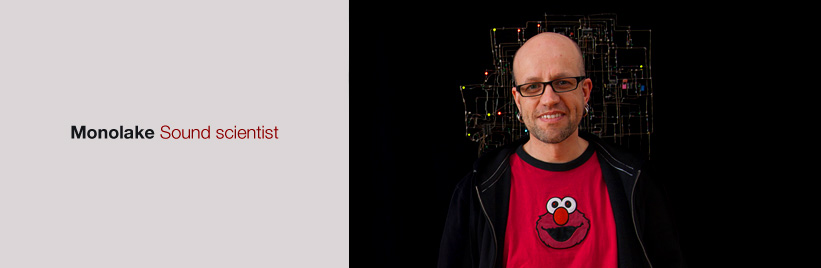
Monolake: Sound scientist

One of electronic music's peerless innovators talks Skrillex, Ableton and clichés.

There is a funny set of photos of Robert Henke. He's in Berlin's Hardwax record store, and there's about ten of him in each shot, doing different things, wearing different clothes, sporting a different haircut even. It's a neat metaphor for the artist known as Monolake. He's a software designer, a musician, a thinker, a writer and a few other things besides.

Over the years, he's been a relentless collaborator—Monolake has had two and three members at various moments—but he has been on his own for his last two albums, Silence and the forthcoming Ghosts. They're the first two parts of a trilogy of music that, in a music landscape suffused with content, sounds like little else. Henke's drive to evolve is easy enough to hear in conversation. As he sees it, things only happen when you're interested and engaged in what you're doing.

In advance of his appearance at this year's 5 Days Off, where he will present his new The Ghosts In Surround live show, RA's Todd L. Burns talked to the sound scientist about his most recent experiments.


"I believe art cannot exist without clichés."


I wanted to begin with the new album. You've said in the past that you've always learned something. Or that you're always trying a different approach on each album. What did you learn with Ghosts?

Well, with Ghosts I tried to figure out what I can do with recordings. In the past I was using field recordings, but it was mostly ornamental. I would use the field recordings to create an atmosphere but never really worked with them in editing percussive sounds. This changed for Ghosts.

Did you go in to it thinking that was what you wanted to do? Or did it happen naturally over time?

It happened naturally, because at some point I figured that this is a sonic world which works very well for the colors I have in mind, so I started recording all kinds of metal stuff. At the very beginning of the process, though, I felt that it's gonna be a very metallic-sounding record so...

So greys and blacks were the colors for this album?

Greys and blacks and metal, yeah. It didn't really go in this direction. But this was the initial thought process.

Those colors you mentioned. Are those the colors of previous albums as well? Or do you even think in terms of that?

I certainly do, yeah. I mean, in general, I like sounds which are slightly inharmonic. And I like sounds which don't have a precisely defined pitch. I will take sounds that are fresh and bright, and then I will play it ten times and it gets lower and noisier and lower and noisier each time and at some point I get rid of everything which is clear. So I guess I like these more foggy sounds in a way. To me, it rewards more careful listening. And this is of course why the bright tunnel sounds are so effective in pop music production. Because they are in your face. I mean, I just happened to listen to Skrillex because it's... You can't escape it currently.

Well, you can. You seem like the type of person who would have to go out of your way to listen to Skrillex.

I'm curious. And I learned to skip my prejudice, you know. There are a lot of reasons why I could say I hate this kind of music. But then, on the other side, I think I should at least try to understand what makes people like this stuff so much.

What did you figure out from listening to him? Anything? Anything positive?

Hah. Well, first of all as a technique his use of contrast is of course very intriguing. Even if I don't like how he executes it. Like, what kinds of contrasts he is choosing and what kinds of sounds he's using and what kind of clichés. His success seems to be based on this contrast between cheesy melodies and the evil dubstep cliché. And, without the contrast, it would be completely unbearable. If it would be only the evil dubstep cliché sounds you would immediately want to turn it off after ten minutes. If it would be only the cheesy melodies and vocals, then it would be unbearable. The combination is what makes it interesting to me.

More than anything, I find it very exhausting to listen to.

It's absolutely exhausting. And that is the very interesting thing. It's something you listen to for the very first time and you think, "oh, wow." And you listen to it the second time and you think "ooof." I believe that my music works exactly the other way around. You listen to it the first time and it's kind of "Yeah, hmm, it's OK." You listen to it ten times and you think, "Hmm, interesting detail here."

You say that Skrillex has these clichés, but do you find that experimental electronic music also has its own clichés?

Of course. I believe art cannot exist without clichés. I've never seen something 100% unique. I only see unique things if I don't know enough about what other people did. The more I learn about art in all forms, the more I understand that it's all a slow process. It's just people adding on top of each other.

I believe more in interesting evolutions than anything revolutionary. I think what distinguishes interesting music from less interesting music is people either using the cliché in interesting ways or repeating it exactly. Sometimes the most successful and intriguing music is the one which uses the cliché, but looks at it from a slightly different angle. It's the same in movies. What makes a good movie? That you can somehow anticipate the next movement, and then it comes—but from a totally different angle. That's when you think, "Damn, this is cool."


Do you believe in ghosts or the supernatural?

No, I'm a complete scientist. But, at the same time, I know that sometimes you can't help and feel things are—especially in a foreign environment... It's very easy to get very irrational. I once had this really strange feeling when I was driving at night through the desert. I felt haunted...it just felt wrong. And all my rational thinking didn't stop me from feeling this. I found it a remarkable experience. I like the topic. When I decided the title I wasn't aware of the fact that ghosts are a big topic currently.

I think it goes very well with Silence, in a way, because after silence...

There are the ghosts!

And, of course, that lends itself to experimental electronic music of a certain bent. "I don't know what that sound is...it must be something from the ether." Is that a goal of yours? To create sounds, timbres which you've never heard before?

Hmm, I don't think so. Not anymore. As someone who has been involved with the creation of tools, I feel that currently everything is available. I mean, of course I can imagine new treatments which allow you to achieve similar results in different ways. But if I simply look at the sonic results, I'm not missing anything in the palette anymore. It's really just about working method.

Do you think we're finally at the point where it's basically all there? That there isn't a lot to get to?

In terms of a spectral excitement [laughter], I would say so. In terms of articulation, we are not nearly at the beginning [laughs]. What I mean with articulation is: people still hit black and white plastic things to play tonal music. And every attempt so far to find new interfaces for musical expression hasn't really led to anything as widely accepted as the simple chromatic keyboard. This is something which is very strange in a way.


"Making art is more important for
me than making commercial tools."


You are still heavily involved with technology and how to bring those changes about, though, right?

Yeah, but as far as Ableton is concerned, I decided to move myself completely out of it. I simply don't have time to do all the things I want to do. And making art is more important for me than making commercial tools. That's the main reason. The other reason is that to run such a big ship as Ableton, you need to make a lot of decisions which are business decisions. I found it harder and harder to localize myself in such an environment because I have different ideas, you know. And I can have different ideas, because I don't need to cater to DJs, songwriters or whatever. I cater to the people who like to listen to my music, and that's it.

It must have been tough to divorce yourself from it. To realize that this product that you've spent so much time on... To understand, in a way, that it has to become this commercial thing, but that it could've gone a different way, or could've been used in a different way by many more people.

It's always easy in retrospective to say, "Oh, things should have gone in this or this or this direction." At the beginning, [Ableton] Live was a much less mainstream product because the concept was so revolutionary. It became mainstream simply because everyone liked the new approach. There is nothing wrong with that. But, for instance, I'm personally very addicted to detail. For me, it's all about the details and I like to work on the details and that's why it takes forever for me to release a new album. That's why my music is maybe better in the textures, because that's what I spend my energy on. For the development of a large scale software product one always has to look at the whole picture from the distance. I am not good at this.

I think that you're remarkable in that your micro is amazing, but your macro is also very strong.

Yes, but that's not how I see it. [laughter] I see myself as a good sound designer and a lousy composer. Well, that's my own perception and I know that people might see it differently and some people obviously do because some buy my records. But I sometimes wish I could just make the one big gesture which is good, and that's it. And it never works like this.

But the problem with the commercial product is that you always have to make compromises because a) you have to cater to a large audience so you're a bit in the pop music trap. And b) you also have to deliver a lot of things in a very short period of time. And these two constraints very often work against my ideas. At some point I just felt that this is not the environment anymore where I can really contribute what I feel is essential.

In the past, you have done mastering with Rashad at Dubplates & Mastering. Did you do the same with Ghosts?

No. I wanted to choose a completely different working method, which includes mixing the album somewhere else once it was done. I wanted to hopefully create an overall sound which is more one shape, sound-wise and mixing-wise. I work in my apartment in a little bedroom studio, because I enjoy working in my living environment. I never considered this to be an environment where I can do a final mix, though, until I bought new speakers. These speakers really changed everything.


What kind of speakers are they?

It's a totally unknown guy from Switzerland. The company is called Strauss Elektroakustik. Suddenly I heard so many details of my music that I finally felt comfortable mixing in my own space. At the same time, the Swiss distributor of those speakers is also a mastering recording engineer, so I ended up having this person that comes from a complete different background do the mastering. He records jazz, string quartets, things like this. I was extremely happy with the results.

Was his approach about certain things surprising to you?

My approach with most things was that you often need to get rid of a lot of frequencies in order to clean things up. If there is a specific resonance you don't like, you notch it out. This is something which absolutely makes sense if you have problematic productions. 99% of the music which has been cut at Dubplates & Mastering was "problematic," because it was made by people with no engineering background.

This Swiss guy comes from the background of having a really good recording with the best microphones. The last thing you would do is notch out frequencies, because it immediately becomes a little bit artificial. So his approach was making very gentle touches whereas mastering at Dubplates would be notch, notch, notch. He created soft hills. I was very surprised to see this because he just slightly changed the color balance between the different tracks. And that's it. And, of course, a little bit of compression at the end to glue all the things together. But it was an incredibly gentle approach in comparison. And I was very fascinated by that. I was very skeptical that this could be the right approach for club music because it was so different from what I was used to.

You seem very passionate about the mastering process. You have an interview with Rashad where you go in-depth in explaining it.

Well, I guess it goes back to Skrillex. What makes it so exhausting? To me, what makes this type of music so exhausting is the fact that it's completely in your face all the time. Imagine something like Skrillex where the cheesy piano parts have low volume and then the drop comes and the bassline stuff doesn't occupy the whole spectrum. It wouldn't work. The new dubstep aesthetic is having a bassline which fills up the whole frequency range. While, if you look back and listen to the UK dubstep from six years ago, the bass was a sine wave. If you have laptop speakers, the old stuff simply isn't there.

Skrillex's basslines have five million overtones, which will even translate to the speaker of your cellphone. That's what makes it work on a commercial level: The fact that it's completely flat and full-scale all the time. What excites me, and what I like, are the holes. The silences. There are parts in the music, which are empty and then it becomes full again. And mastering has a lot to do with that.


"I always start with the things I know
the least about, and then go back
to things where I feel confident."


You've mentioned dubstep. Do you feel like you're part of any sort of lineage or do you think you're out on the periphery?

I think I have to start from the beginning: Before I was exposed to the whole electronic club culture, I was simply interested in electronic music because I liked the sound and I liked the machines. Depeche Mode, Ultravox, Yello, Kraftwerk. These were my roots musically when I was young, and still certainly an influence in my sonic taste.

Then I came to Berlin and two things happened at the same time. I discovered techno, and I was introduced to electroacoustic academic computer music. At this time there couldn't have been a bigger gap between these two types of music. On one side the music was only possible at institutions with big computers running overnight to create one minute of sound and, on the other, you had a young, sweaty Richie Hawtin at Tresor with a 909, 808 and a cheap effects unit playing Plastikman stuff live. And in a moist, dark, loud environment where everyone was on E, I was always...

Stuck in between.

Stuck in between, indeed. And, I mean, once someone wrote a really harsh review of I think the Interstate album. "He doesn't know where he belongs..."

Look at the title of the record.

[laughter] I know. I guess it has to do with the fact that I was never really into drugs. I've always found it not very inspiring. And, on the other side, I experienced way too many people who completely lost it. There were people who potentially could have been making really amazing music, and instead completely killed their brains. I saw a lot of those cases in the early '90s in the city. I also never became a DJ, so I was always somewhere in the middle.

With my connection to the whole Basic Channel environment—which I still think was a tremendously important influence—I would say my roots as Monolake are certainly the Basic Channel idea of "timeless states." The idea of an endless groove. Plus, the interesting sonic manipulations of the mid-'90s drum & bass scene, where I really felt that people were exploring their tools as deeply as possible.


You seem like you're always busy. Do you like having ten things on your plate?

Five, five would be nice. [laughter] Actually, no I don't like it. But the problem is that I'm interested in too many things. So that's why it's hard to say "OK, I don't want to be involved with software anymore." That's why it's hard to say "no, I'm not gonna do a talk about this or that" at this conference. Whenever someone approaches me with something I find interesting I'm immediately open to jump in the boat and say, "Yes, I'd like to do it!"

That's the hardest thing, learning how to say no. What are you focusing on now?

Aside from Monolake, there is a project I'm currently working on that has to do with lasers. I was always fascinated by lasers, but when I was a teenager it was completely out of reach. Over the last five to ten years the technology has advanced in a way that the things I'm interested in are kind of affordable and do-able technically. And so I'm trying to get a laser-based sound installation in galleries where I try to explore it.

In my experience, there are people who have knowledge about lasers and technology, and they come from the engineering side. They have super bad taste and the result is the laser shows we all know. Lots of colors, constantly changing, drawing Mickey Mouse figures on the wall. Stuff like this.

Classic rock albums being played in planetariums.

Exactly. Amazing technology, horrible content. And then you have people who come from the artistic side who have great ideas but have no engineering background as far as this specific tool is concerned. Those people rely on the people from the laser companies to provide them with a translation of their ideas. I'm in this lucky position that I am this geek engineering person. I understand how this technology works, and I have a clear idea of what I could do with lasers. I'm very convinced that I can do something different.

What do you find interesting about it?

Currently, the visuals. I always start with the things I know the least about, and then go back to things where I feel confident.

That makes sense.

Yeah, but most do it the other way around. [laughter]

Yeah, I guess that's the problem. Because obviously you have to spend more time with the things that you are unfamiliar with. And then...

Then the fun starts.

Published / Tuesday, 14 February 2012

comment 35 Comments

Photo credits /
Christian Olofsson

Also available in / Japanese


Share this article


Features


Other features
Oklahoma: The unlikely home to one of experimental electronic music's most fascinating labels of recent vintage.
The multivalent UK producer has roots in Detroit and the United Arab Emirates, but it was through access to the internet that his sound has evolved. RA's Ryan Keeling explains.
RA's Oli Warwick talks to some of the key local protagonists who explain the rising part the Lithuanian capital has to play in the global electronic music scene.


About  
Staff  
Mobile (beta)  
Submit event  
Copyright © 2013 Resident Advisor Ltd.
All rights reserved. Terms & Privacy.