RA
RA Japan
Global
Local
Music
Interact
Search RA
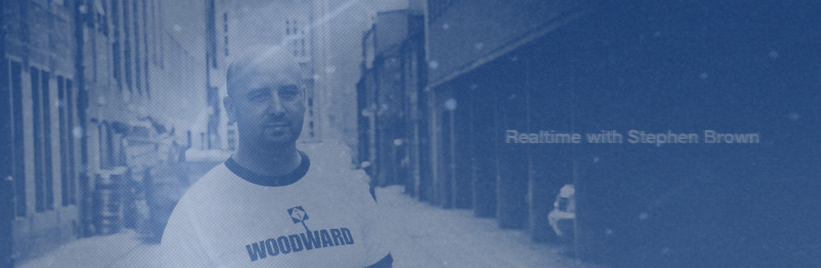
Realtime with Stephen Brown

The veteran Scottish techno producer opens up about the music that changed his life and his regrets about a path not taken.

Stephen Brown is the type of guy you hope the music industry could accommodate a bit more often. Humble to a fault, the Scottish techno producer never had the confidence to believe that he could make music a full-time job. He missed a couple of key opportunities along the way, leading to a situation where Brown has made the music thing an enormously time-intensive hobby of sorts. This distance from the grind, however, has made all the difference in the world. Throughout the '90s, Brown found a home on Djax Beats, joining in the hard, fast and melodic techno dialogue between Europe and Detroit. He later was afforded the chance to release on Derrick May's Transmat and DJ Bone's Subject Detroit, but lately he's been enjoying a great deal of interest from artists like Skudge and other old-school leaning artists and imprints raiding techno's history for underrated classics and new tracks from old masters.

Unencumbered by the expectations that drive producers to release track after track in the race to get the next booking, Brown's output is striking in its absolute indifference to trends. As you'll read in this interview with RA's Todd L. Burns, Brown simply does this as a love letter to the musicians that inspire him, and the joy of creation itself.


What was it like when you were first starting to go out?

Basically, it was brilliant. In '85 I would have been 15 years old, and introduced to breakdancing for the first time. Some friends of mine had electro tapes of music that I'd never heard before. I went along to my local record shop to try and get hold of them, but you couldn't. It was then that I realised these tracks were imported. It was a really exciting time for me: The mid-'80s, breakdancing to electro music, it was probably the pinnacle if I'm honest.

What was the crew called?

The South Side Breakers. [laughs]

Were you a good break dancer?

I wouldn't say I was that good, no. [laughs]

When you first heard house music was it a pretty distinct difference between that and electro, or did it seem like a natural continuation?

When I first heard house music it was alien to me. I had never heard such sounds put together like that. The strange sounds and unpredictable arrangements were not like the electro I had been listening to before.

How long did it take for you to find out how it was made?

Within the year I had purchased myself a 606 and a 303 from second-hand stores, and I was playing out in clubs under the name MD3. Mike Dunn used to go under the name MD2, and someone said I should go under that name for some reason.


"I never had the confidence to believe
it could have been a full-time job."


It seems interesting that you would start playing live immediately, as opposed to DJing. I would have thought DJing would have been the easier option. Were you pretty rare, especially in Edinburgh?

Yes...I didn't jump onto DJing. I did some, and I like it. But I wouldn't class myself as a DJ. I can play records, but DJs are people like Jeff Mills and Rolando. Those guys know what to do with records. They don't just play them back-to-back, you know? So I decided to step aside.

In the early '90s you stopped playing out for a while to work on music. Can you tell me a little bit more about why?

The reason I focused more on making music than DJing is that I was being approached by labels to make music more than I was being asked to play at clubs. If I'm honest, I prefer to produce than to DJ. [At that time] the music that I was hearing in clubs was not inspiring me at all. There seemed to be a lack of soul and melody. For me, anyway. On a positive note, it pushed me to focus on my own music.


When you came out with some of your first stuff, who did you send it to?

I always wanted to target people from Detroit because, for me, it was a way of saying thank you. I've always had a day job. I've never looked at making a living from making music and definitely not DJing, so whenever I made music if I could give it to people like Derrick May, Jeff Mills or Claude Young, and they liked it? That was a bonus. Whether they wanted to release it or not was another thing. But if they liked it, for me the job was done.

Why did you never want to do music as your full-time job? Or did you want to, and it just never came to be?

If I'm perfectly honest, I've never had the confidence to believe it could have been a full-time job. It was always a hobby. I was an apprentice electrician at the time. I think I did miss a few opportunities back in the early '90s when I had the chance to tour with Miss Djax and Steve Poindexter as part of the Djax Tour, but pulled out. I regret that now.

Tell me about the stuff that you were putting together in the mid-'90s. Can you put your finger on what was so special about that music?

As I say, I'm really inspired by the things that I hear. So there's no point in me saying, "I'm the son of a jazz musician and so it was a natural progression that I make this type of music." That's nonsense. My dad didn't like music and my mum was into Barry Manilow, so there's no logical progression. But whenever I was buying music in the period that you're talking about, I was buying music from Kenny Larkin and Steve Rachmad, and I'd listen to those albums over and over, and there was never any lack of melody or production or rhythm. Those were the tracks that just kept making me make music basically. I was shut off to most other things. I'd go to record shops and listen to records, maybe skip a little through the beginning, middle and end. If it didn't do anything, that was it. Kenny Larkin and Steve Rachmad inspired me during that period.

A couple of nights ago I was watching an interview with Kirk Degiorgio and I cannot believe the similarities between him and I. He talks about growing up on the same type of music and he talks about not having the same keyboards that everybody had to make music back in the day, but he made do with what he had. In the interview, he was talking about melody, and how you can be playing a chord or strings or whatever and one note out can make the difference between making a Detroit-sounding track or a trance-sounding track and he's absolutely right. What he was saying is exactly what I've thought when I'm on the keyboard and thinking, "Oh, that sounds a bit too much Adagio for Strings as supposed to just strings that would just fill a techno track."

Do you have a nostalgia for vinyl or does it not matter to you very much?

It doesn't matter to me much anymore to be honest. Minds are like parachutes, if you can't open them they're useless. For a long time I was a part of the community that was totally against Ableton Live. I wasn't against samplers, I've never been against samplers because at the beginning people thought that samplers would be able to steal people's music. But people like Todd Terry have shown us that it's not about stealing music, it's about making instruments and doing your own thing, having your own sound out of that. When people were first doing things on laptops and playing with Ableton, I completely turned my nose up to it as most people did. I just jumped on the bandwagon. But then I realised how much I'd been missing about four or five years ago. There is a nostalgia thing with vinyl, sure, but if you're not open-minded, you're going to miss the boat.

What happened four or five years ago?

I decided to get a laptop just off my own back. Basically I make music in Logic, so I play all my own melodies via the keyboard into Logic. But then I got familiar with bouncing audio, so these melodies that I had made, I was bouncing as audio tracks and then I realised that I could put them into Ableton and play them back and they would all play back in time. So I had like three or four years of unfinished tracks that I threw into Ableton in the clip view and I could play them back in any order. That is how the new live set was made; it was almost like a DJ mix of my own tracks. That was a defining moment, where I thought, "There's nothing wrong with this."

What's been inspiring you lately?

The music that's inspired me recently is artists like Burial and Actress, and the whole German thing, the whole Berghain sound, Ben Klock, Shed etc. They have a sound, the music's not full of funk by any means. In fact, a lot of it is white noise. But the production is in a class of its own. So I've been inspired recently, not by the sorts of melodies that I have been in the past. I've been inspired by records that I've been putting on and thinking, "Wow, that is a big sound." Those Ostgut Ton guys have got it down to a T. You can listen to the music, and it's not doing much from start to end, but you're trapped in the loop. Skudge too.

You also mentioned Actress and Burial. They would seem like unlikely influences for you.

Well, when you're hearing records that you can't quite put your finger on how they were made, it's exciting. It's like watching a David Lynch film, and you're trying to work out what the hell he's thinking when he's putting in scenes that have no meaning to the film. When I hear Burial's music and some dubstep and Actress, I'm listening to it and thinking, "How the hell do they do that? They didn't do it in 4/4 time in a step sequence over 16 beats to the bar..." So it gets me thinking and that inspires me, I'll go away and try to work out how they did it.

What would you like to be doing music-wise in five or ten years? Is it just a question of continuing on? Obviously you said it's not your full time job so that puts you in an interesting position.

Yeah, I mean I'm sitting in the studio just now... Some guys my age play football and then they become unfit, so they become football coaches or they do martial arts. I do some martial arts as well but I'm by no means fit. Where would I like to be in ten years time? I think probably still doing the same thing. I'd like to play out a bit more. I'd like to play out the music I make here, which is unreleased because that's what I do when I play live—it's mostly unreleased tracks. When I'm playing in a club for an hour, I'm playing my own music. That's pretty hard, you know. If you're a DJ, it's fine. You can pull out all the big tracks. But when you're playing your own music, you might get booed off stage. I'm lucky: That's not happened to me yet.

Published / Friday, 04 May 2012

comment 9 Comments


Share this article


Features


Other features
Can't decide who to call to write your next DJ bio? We're here to help.
RA's Jono Buchanan simplifies one of the most misunderstood of production processes.
RA talks to the respected German deep house producer about his love of hip-hop and the art of sampling.


About  
Staff  
Mobile (beta)  
Submit event  
Copyright © 2013 Resident Advisor Ltd.
All rights reserved. Terms & Privacy.