RA
RA Japan
Global
Local
Music
Interact
Search RA
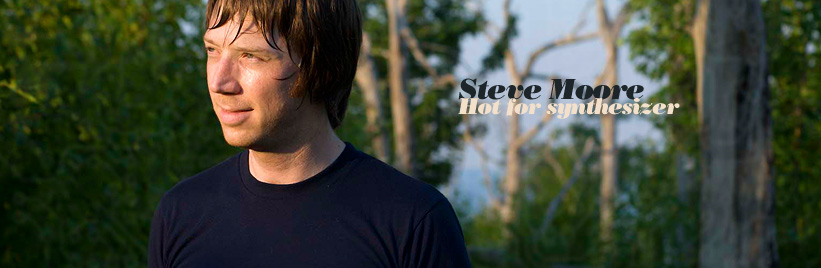
Steve Moore: Hot for synthesizer

The American producer doesn't make tracks for dance floors. But they sure seem to work well on them. RA's Nick Connellan explains.

Steve Moore didn't grow up listening to house or techno. In fact, he doesn't even like dancing. As a child in Pennsylvania, he was always more attracted to bands, a preference which largely persists today. Titan, the Brooklyn-based outfit he plays bass for, craft a style of music somewhere between progressive and stoner rock. And though they might sound similar to other synth-based acts, he constantly refers to Zombi, a collaboration between him and drummer Anthony Paterra, as "my band."

As a solo artist, Moore's emotional machine epics have soundtracked three movies, while last year?and again this year?he found his way onto Ron Morelli's precocious L.I.E.S. imprint, perhaps his first brush with a side of electronic music that's still very much a mystery to him. Judging by the album he just put together as Lovelock for Prins Thomas' Internasjonal label, however, he seems to have figured it out pretty well. Though he might be a self-declared outsider, it's plain that the librarian-by-day has plenty to offer dance floors at night.

Do you remember the first music you were passionate about?

Yeah, I think one of the first cassettes that I remember playing until it actually broke was the Miami Vice soundtrack. Not just the Jan Hammer score but also with Phil Collins' "In the Air Tonight," Glenn Frey's "Smuggler's Blues" and "You Belong to the City." That was the best thing in the world. That, and Van Halen 1984, which ties into all of this because that was when these guys started using synthesisers as key instruments. Eddie Van Halen would play synthesisers and not guitar on entire songs, with maybe only a guitar solo. I like that. I like when rock bands incorporate synthesisers.

Do you think being so attached to Van Halen in your early years has had a big effect on your career?

Yeah, definitely. People like to write my band Zombi off as a Goblin tribute band or John Carpenter tribute band, but if you really listen to it and dissect it, I think we sound a lot more like Van Halen than we do Goblin; we just sound like the songs that don't have guitar, and if they didn't have vocals. We wrote more like a rock band than we did an Italo disco horror rock band or whatever they want to call us.

So was Anthony [Paterra, half of Zombi] into Van Halen as well?

Yeah. And actually on a few of our albums I used Alex Van Halen's drum sound as a template for what we were going for with Tony's drums. We're big admirers of Van Halen.


You studied music at college. Did you have ambitions to do music as a career?

I think I've always been a little bit too much of a chicken to pursue it with the energy that you would need to make a full-time career out of it. When I went to college, I ended up graduating with a music education degree simply because I started to realise that the music that I wanted to make wasn't necessarily music that was going to pay the bills.

You've never made a living from doing music full-time?

There were a few years where Zombi were touring pretty much non-stop, we were doing probably doing close to 200 shows a year, we'd only have a couple of weeks off, three at the most between tours. That's probably the closest I've come to making a living from just being a musician. Although I never actually made any money on any of those tours. It was just being unemployed and travelling.

So just breaking even.

Not even breaking even. I got into massive, massive credit card debt with those tours. [laughs]


"I don't like to dance, I don't go
to clubs, I never really have, so
I have no club perspective."


Is it something where you still think, "I wish I'd tried harder ten years ago." Or are you happy with how things have turned out?

Maybe five years ago, I may have wished I'd given it more energy, more something I guess. Now I feel like I've found a pretty good middle ground here. I'm able to work a full-time job that pays my bills. So when I do have time to work on music, I can do whatever the hell I want, I don't have to worry about whether other people are going to like it or whether I'm going to be able to license it or get somebody to release it, I don't care; I'm just going to make the exact music I want to make.

And your priorities have probably changed now that you have a kid, right?

Yes, very much so. Basically touring is totally out of the question; I don't even really have much of an opportunity to do one-offs or fly-ins or anything. I'm just very happy being at home with the family, working on music when I get the chance.

Do you have a plan in place for your daughter's musical education? Do you ever think, "I can't wait for her to get old enough, so I can show her this record or that record?"

My plan for her is: I'm going to expose her to as much music as I can and give her any opportunity she wants to play music. In doing that, hopefully by the time she's in high school, she will be in a place where she will be rebelling against me and going to business school and then she'll have a prosperous life and things will be set for her.

[laughs] Like reverse psychology?

Exactly. Sort of the opposite of my upbringing I guess.

We were talking about your early years in Pittsburgh before. I get the impression you're not particularly interested in traditional 4/4 house and techno.

No, I have no interest; I'm not really into too much dance or techno or house music. There are things that I like about it. There are elements definitely that I like about it and actually there are a lot more people doing it, I feel, the right way these days.

But when I was growing up and hearing dance and techno, I just felt like all the stuff I was being exposed to, their heart was just totally in the wrong place. And I don't like to dance, I don't go to clubs, I never really have, so I have no club perspective. I don't DJ, I've never DJed, so I don't know the mechanics of how to make a song that people are going to want to dance to or that DJs are going to want to play. Where I approach things is almost like if a film composer was to make a song that sounded like a techno song; it's sort of outsider techno.

So you're not very keen on the idea of functionality in music?

Well yeah, but not necessarily traditional functionality. I picture the techno, house, whatever songs that I make being used for opening or closing credits. [laughs] Not for 3 AM in some club in Ibiza or something.

Why is that?

Just because that's what I know. I don't know 3 AM in Ibiza. I know I watch a lot of movies though. [laughs]

That's interesting. Most people who are making electronic music are people who have, at one time or another, nurtured a love for that kind of thing or come through there. It sounds like you bypassed it altogether.

In the '90s, I have to say, there were always techno or house songs that I thought, "Oh wow, this is actually kind of cool," but there was always just too much of an emphasis on wild partying or…something. I like to make my songs a little more broody. It's like techno or house music for introverts.

How important to you is the presence of strong emotions in your music?

I would hope that people would feel some type of response to the music I make, and I think I feel it when I make it, but not necessarily the emotions that most dance producers would want their audience to feel. Not joy or elation or some type of desire. I would rather people feel like they're alone in outer space on some desolate planet, maybe.

You seem really interested in space and the cosmos.

Yeah. [laughs] I guess I am.

What interests you about it?

I guess you could thank Carl Sagan for that; he just made it seem so cool. I remember when the cosmos program was on TV and it was like the coolest thing. I think about ten years ago they reissued it on DVD and I bought the box set immediately and reconnected with that stuff that I hadn't really thought about that much for a long time, but over the last ten years that television series has really become very important.

What interests you, the fact that it's really unknown, that there's still so much to discover?

Yeah. It puts things into perspective. There's all this other stuff that dwarfs what we have going on here in our lives. I think that's sort of terrifying and inspiring at the same time. I guess that's?terrifying and inspiring?some feelings I'd like to get across in my music.

Do you think this fascination with space comes with the territory for people who make krauty prog rock stuff?

It seems to be, and I don't necessarily know which comes first; people that make this music become interested in outer space, or people that end up making this music are somehow genetically predisposed to be fascinated with outer space. Growing up, all through the '80s, space was always associated with crazy synthesiser sounds. [laughs] So I think there's just no way to separate them at this point.

You're also interested in horror movies. They're a big thing for you, aren't they?

No. It was. But as I grow older, I really can't stomach it anymore. There are people making horror that really nail it and are doing a really good job of making non-trashy [stuff]. I just can't deal with the violence, I can't deal with the misogyny; it's too much. When I was a younger man, yeah, those are the things that young men fantasize about; violence and sex.

Tell me about the film scores that you've written.

Zombi did a couple as a band, the two of us worked on them together, and I've done three on my own. Two of them were under the Gianni Rossi alias and they were really just straight up trashy '70s, early '80s, slasher-sounding sleazy disco rock kind of stuff.

How do you usually approach scoring? Do you ever worry that the music might be too overpowering?

I really like to follow the director's lead, because I'm not a fan of overscoring movies. I feel like a lot of my favourite movies have very minimal scores, and there are large portions of the film with no score at all. I feel like music should really only be used at integral moments. I always feel like I want to take a more minimal approach and then if the director wants me to pick up the pace a little bit, then I'll follow their lead.

Some directors are easier to work with than others. I like when directors have a sound already in mind that they want you to work with, but at the same time it's way more fun to just work with somebody who just sits back and goes, "Do your thing, we want to hear what you think this should sound like." That's ideal; that's the dream job.


How does that approach differ from when you're just by yourself making music?

Usually when I'm just writing music on my own, I'll get an idea in my head at a really inappropriate time, like when I'm just about to fall asleep or when I'm at work and I have no means of jotting it down or anything, so I'm going to have to force myself to remember it. It's like the Mitch Hedberg joke, where he says something to the effect of: when I get an idea for a joke when I'm lying in bed, I have to either get up, walk across the room and find a pencil, or convince myself that it's not a good idea.

There are a lot of artists who say they keep a pen and paper beside their bed because they get their best ideas in the middle of the night. Why do you think that is?

I think because that's the point where you're closest to functioning on a completely subconscious level; you become really relaxed and you stop worrying about whatever is going on during the day. Those are the times when my mind wanders and I'll notice some melody, some bass line or some rhythm going through my head and then I'll be like, "Wait a second, this song doesn't actually exist yet, I need to get up and go over to the computer and sketch this out real quick and then work on it some other time."

The same thing happens sometimes if I'm just watching TV. They say that watching TV, the brain goes into this state of...my parents would have said that it was rotting my brain, but in a way it kind of lets your brain totally recharge. It's very zen, you just are. [laughs] I get a lot of ideas when I'm watching TV and movies.

So you're trying to tell me that TV is just as valuable as doing yoga or something? [laughs]

Look, I grew up watching probably five, six hours of TV everyday; I'm just trying to justify my own life, my addiction to television. [laughs]

What are your favourite machines at the moment?

For rhythm, I've been using a Roland CR-78 on pretty much every track that I do, all these songs that I did for Ron [Morelli] for the L.I.E.S label, they're all CR-78, except for "Ancient Shorelines." That's a Sequential drum track. All the others, I typically use a CR-78 for the kick and for some of the additional percussion like the bongos and the rimshot. I really love the CR-78 cowbell. And my Sequential Pro One, that's what I use for a lot of basslines and even a lot of the leads. I could do a lot with just those two machines.


"When I was a kid, the idea of someone in Russia ever hearing music that I would
make was just totally inconceivable."


It seems like in some ways, you're not the biggest fan of new technologies.

[laughs] No, I guess not. I just find the older technologies more inspiring. I use Ableton, I do a lot of sequencing. A lot of tracks I'll plug in the sequences in Ableton and then run MIDI out to my CD converter and then into the old synthesisers. So guess I kind of like the way the old and the new interact.

More than that, I get the impression you're not really into the internet and the whole global communication thing that's happening.

In some ways I am, and in some ways I'm not. I feel like nobody would hear the music I make if it wasn't for the internet. I don't really get a lot of press, so I have to rely on the internet to be able to post my music and have people hear it. I think I would probably live a more fulfilling life if [the internet] didn't exist but at the same time, I wouldn't be able to do what I'm doing. I wouldn't have people in Russia posting comments on SoundCloud links, you know? In a way, I think that's fascinating, I really do like that. When I was a kid in the '80s, the idea of someone in Russia ever hearing music that I would make was just totally inconceivable.

Whereas nowadays if you're a 15-year-old kid you'd be like, "Yeah, so what?"

Yeah, I'm sure. Really, that's kind of sad, because when you look at the state of the world right now, it's really only fascinating if you've lived through some other times I think. When I was a kid the Berlin Wall still existed, you know? The idea that I release music on labels in Germany?in just Germany, not East or West?is nuts.

Published / Wednesday, 25 April 2012

comment 8 Comments

Photo credits /
Shawn Brackbill and Ryan M. Todd


Share this article


Features


Other features
The raw and dirty sounds of New York's underground.
Ahead of his appearance at this year's Bloc festival, RA catches up with one of the most distinctive DJ and producers in house and techno.
What's life like as one of the planet's most popular DJs? RA's Will Lynch shadows Seth Troxler for five days at Miami WMC 2012, finding out how extremely high and low things can get.


About  
Staff  
Mobile (beta)  
Submit event  
Copyright © 2013 Resident Advisor Ltd.
All rights reserved. Terms & Privacy.