|
 |
 |
 |
 |
 |
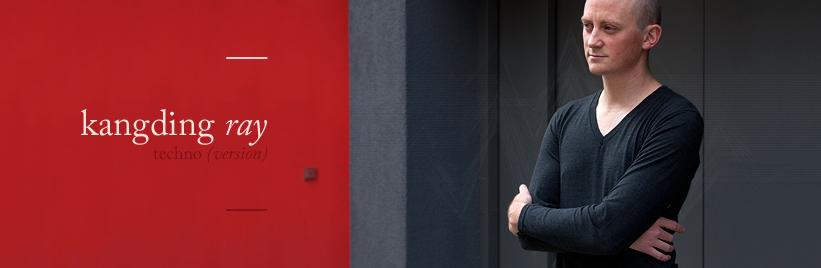
Kangding Ray: Techno (version)
The Raster-Noton artist has caught the techno bug of late, releasing some of the most physical music of his career. RA's Todd L. Burns investigates.
Kangding Ray comes across like your typical Raster-Noton artist. Composed, articulate, clad in all-black. But the music he releases on the experimental stalwart is yet another example of its loosening remit. You could call his last album, 2011's Or, a dance floor effort if you wanted. (Plenty of DJs did.) David Letellier has always fit his label home, but he's also helped change the perception of Raster-Noton with each successive release. His intricate structures were the typical digital constructions you might come to expect from the label... but they were also very much songs as well—the one thing that seemed taboo on the resolutely audience-challenging imprint. There are high-brow concepts that you can consider when listening to Letellier's music. But his music goes down just as easy without them as well.
You used to be an architect. What kind of things were you designing?
When I started to work as an architect in Berlin I was mainly doing competitions for all kinds of different buildings like schools. Later on I was part of the architect team in charge of the design of the future Philharmonic Hall of Paris. They were looking for someone to do the interface between the acousticians and the architects.
What did the acoustic people want, and what did the designers want?
Well, it was very abstract. It's a philharmonic hall so it's basically all about geometry, volume and reflections, calculating how the sound spreads over the room. The acousticians want the right amount of absorbing and reflective surfaces, the right weight and textures of materials. And obviously the architects want it to look beautiful. Yeah, so there is a lot of interfacing work to do—compromise.
Is that work something that you can bring in to what you do in music? I remember reading an interview where you said people ask you that all the time, and that you don't quite know if you have a definitive answer.
Yeah, I usually don't talk too much about it. Obviously there is. I use this knowledge all the time, it's part of my culture, but I don't think you can really hear it directly. Maybe if you know this you can listen to the music in a different way, but I don't think it's necessary to know that to understand what I am doing.
"I need to suffer to get to
know what the track is about."
It seems like on Raster-Noton, though, the music often lends itself to high-minded theorizing. Is that something you think about a lot, or is something you want to keep separate?
I want to keep it separate, but of course having a strong concept before or after to bring the music to a point is something I like to do as well.
How do you bring in a concept afterwards exactly? I would think that it would have to be before or during, and then it steers you in a direction.
It usually goes much more like a back-and-forth process. Over the course of the production of an album or record the concept comes by itself, and then I have to go back to the track and work with it in light of the concept. It doesn't go in only one direction.
In reading about your music-making process, you seem to make a number of versions of tracks, so it must be easy once you've kind of figured out where things are going in general concept-wise to twist a track to fit the overall narrative of what you're doing.
That's pretty much what I am doing. [Raster-Noton label head] Carsten Nicolai is always telling me to be more direct and not do so many versions. He tends to prefer the early version of tracks—the rough ones, the number 2 or something when I am at number 38. But in a way, when you go through this process, you know what the track has inside itself—the essence of it. I need to suffer to get to know what the track is about, and then I can twist it like you say.
You use the word "suffering" in there.
Yeah, it sounds like it's a painful process, which it is a bit for me sometimes. Sometimes, though, it's easy and brings joy from the start.
I read in an interview once that playing live is the entire reason for what you do.
Yeah, pretty much.
I assume that's so you can stop thinking about things so much?
Compared to the process I went through making the tracks, it's like pure happiness. I get free drinks, I get to play in front of people and get paid—it's amazing. I am so lucky to be able to do that.
Where do you play these days?
Ever since the last album I have been booked much more in a club or techno festival context. I think the album got quite a good response from the techno scene. I am quite happy about that. It's a music I really wanted to bring to this environment. Of course I'm always a bit in between—the strange act or the flow breaker—because I am obviously more broken and noisy but it does work I have to say.
Did you know before you started Or that you wanted to be more forceful with the beats?
That was the goal in the beginning, definitely. I knew that the atmosphere would be heavy beats, dark and representing a sort of image of our era—in an abstract way, the state of our modern societies.
What is the state of our societies in your mind?
We're in a sort of floating moment where people think, "What's the point of this?" We fucked up everything: the environment, the economy...and so it's a strange end of the world feeling. There's a hope of a rebirth, but not through technology. I don't know... It's very hard to describe, but for sure the hope of a brighter future through technology is a bit gone.
So you're saying the future relies on us recognizing that maybe technology isn't going to...
Yeah, or maybe not only technology. But also the way we structure our society and so on. That's the "or" in Or. Can we think a bit differently? Find another way to develop things? I think a lot of people realize this. I can't give any answers, I don't even know myself.
"If I had the answers, I wouldn't do music..."
It's also the French word for gold; I imagine that you enjoy that double meaning.
That's the whole point, yes. Gold is the only metal which has a constant and stable value and which has had this value for thousands of years. It represents a sort of stability in this unstable world.
How did we get here?
I don't know.
You don't have any answers. Just questions. Just "or"'s.
Yeah, that's pretty much it. If I had the answers, I wouldn't do music maybe. I would do something else.
Do you DJ at all?
No, I don't know how to DJ. I can't beatmatch two vinyls. Of course I do little DJ sets sometimes in small contexts, but not as a professional musician.
Do you think that helps or hurts when you try to go out and make a record that's aimed towards the dance floor?
Well, some DJ friends told me that they really appreciate tracks coming from non-DJ-orientated producers, because we don't know the rules. We don't know that you need an intro like this. I don't know what you need as a DJ, and I have never tried to ask what they need.
You almost don't want to know...
No, I don't. It's a mysterious world. But also I don't make tools. I make tracks. I am really happy when I hear them in clubs played by other people, but I know it's a challenge for them—or it's sort of a decision to play this one.
Tell me about the Monad release you're doing for Stroboscopic. They're very open-minded of course, but they're a techno label at its core, which is something new for you.
When they first approached me, I said no because it is a digital-only release and I wasn't really keen on doing that. From an egoist point of view, I really like to have my productions in a physical format. I like to put it on my shelf. But I really liked the Monad series, they have really great productions by really great artists so it was very tempting [and eventually I decided to do it]. I thought it was a natural process to do this on Stroboscopic, because it makes a link to the techno elements on Or. Because it's digital, I tried to be as far as possible from the medium. I only used analog machines and synths, so it's a bit dirty and raw. I really liked the contrast with this because I knew that at the end it would be encoded to a digital format.
Were you always a techno fan?
I don't come from a techno background at all. When I was a teenager I was in rock bands listening to Nine Inch Nails. I really discovered techno when I came to Berlin 11 years ago.
Do you like to dance?
Yeah, I like the immersive power of a club with good sound. It's unbeatable as an experience. I think it's a social phenomenon, like a parallel universe where different rules apply. I think it's important that this universe exists actually, because you can't find this anywhere else in the society. Outside, it's a controlled space, with shops and CCTV. There is no other place where there is this reunion of people in this way...
Do you think there is a political dimension to it that can be taken out of the club and used in some way?
Yeah, definitely. The energy of rave culture is deeply connected to a political resistance in a way. It is a political action in itself almost to do this. To produce this context, to make it happen. I think it is definitely at the core of it. It is deeply connected.
"The energy of rave culture is deeply
connected to a political resistance..."
I guess you could see that in the GEMA protests this past week. Did you go to those?
Yes.
Why did you particularly find it important to be there?
As an artist I actually don't find a need to rely on an organization like GEMA to earn my revenue or money from my music. I would rather be paid directly for what I do—playing or selling records rather than relying on an obscure black box that does statistical calculations on what is played on the radio. I want to be in control of what I do. It's an interesting thing because I am on a German label, so I have no choice, I am not a GEMA member, as I am a SACEM member, the French equivalent, which is probably not better anyway, but through the label, I am still connected to GEMA. I think I will try to avoid being controlled or attached to organizations like GEMA or SACEM in the future, but I'm not sure if it's even possible, because of the way the music industry is structured.
It seems like everything has been moving so fast over the last couple of years, and these organizations simply aren't able to keep up with the changes in how music is being consumed.
They were built in a totally different system, and now they don't represent the way music is played and produced right now. Not at all. I don't think they have any idea of what type of music is being played in clubs.
|
|
|
|
|
|
Published / Monday, 16 July 2012
12 Comments
Photo credits /
Header + Other - Christian Olofsson
Live - Fran Holguin
|
|
|
|
|
 |
 |

Features
|
|
|