|
 |
 |
 |
 |
 |
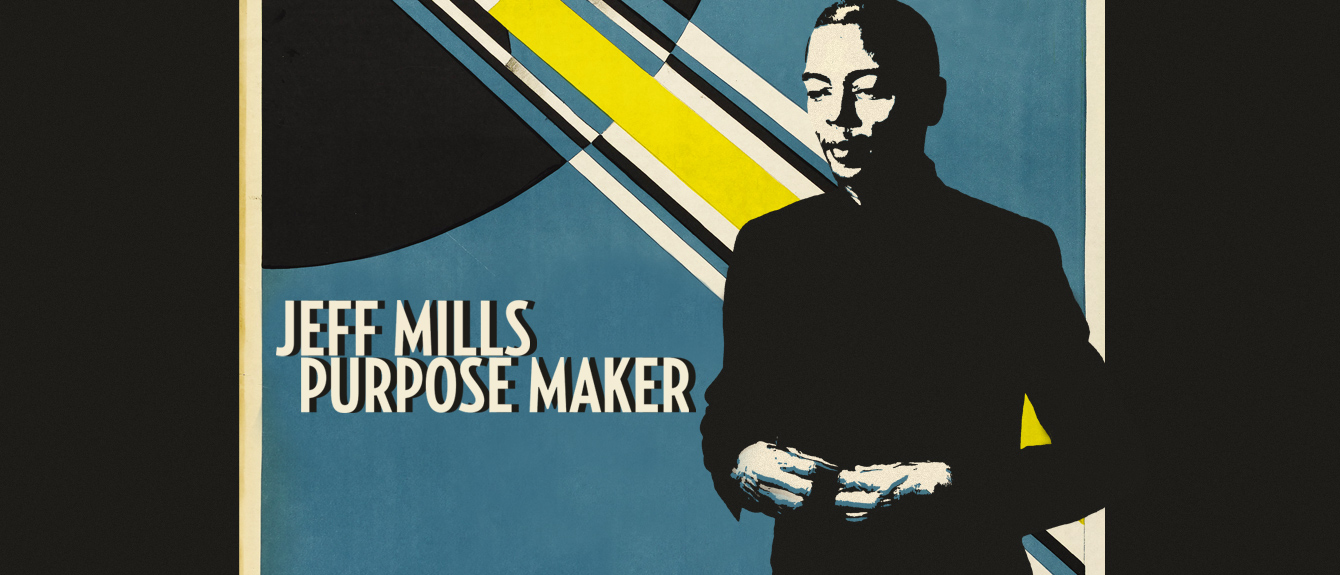
Jeff Mills: Purpose Maker
The techno pioneer talks about space, time and the future with RA's Todd L. Burns.
Jeff Mills is a visionary in the literal sense of the word. The DJ/producer has visualized a great many things in his storied two-decade plus career, and brought them to fruition. His philosophy has always been to push forward into the realm of the unexplored—whether audiences are ready to follow or not. More often than not, they have been: Mills remains one of techno's most important and adventurous figures. We caught up with The Wizard via email in advance of his performance at this year's Club to Club festival, where he will DJ and premiere a new live show with the multimedia artist Claudio Sinatti.
You mentioned recently that you've had a "constant desire to describe what the future will be and sound like." Where do you think this desire comes from?
I suppose this desire to anticipate comes from being optimistic and always expecting tomorrow to be better than today, but also being overly pre-cautious to the point that I feel I must do or say something. I think it's this way because I equate life as being a combination of good and bad experiences and our lives as the process that leads to either one. In fact, we spend all our lives and effort working towards having more good than bad experiences.
Memory plays a great role in this. With the ability to hold and forget things in one's past, the mind shapes an overall impression of how the world works. Or at least, how the world is supposed to work. I, like so many others in the creative world, are hoping to contribute to the process by trying to show people the beauty and harmony in life, even in times when its difficult to see/hear.
Has it gotten harder or easier to see the beauty and harmony in life as the years have passed?
For me, it's gotten easier. I believe this comes from understanding and having true purpose and direction in my musical career. What I should do is exactly what I want to do. There is very little doubt. I second guess much less than when I was younger and have a clear view of where I'd like to go and be in my future years. I assume this comes from being in the music industry a while and studying others as examples of what to do and not to do. I think a great part of my view is based on knowing how this level of the entertainment business works. I know firsthand that the structure of electronic music is far from perfect. This is normal in an industry where many people are vying for the same stature and prominence.
You also said in the same interview that you want to explore "subjects that are relevant and useful to the listener." Can you talk a bit more about this?
Yes, subjects that could be useful to everyone. Not just subjects that generally relate to the social atmospheres of clubs and dance events. My background and influences in music starts from an era that precedes the creation of the category "dance music," so I still very much remember the times when music was pretty much a few styles, but the most memorable works were those which really related to the everyday lives of people. The thing I remember the most was that it wasn't so much about what the music was called then it was what the music had to say—the message. How often is it that people wish to hear someone saying nothing meaningful at all? It's rare.
I'm working with the subject of the future and all that surrounds it because it's a topic every human being can relate to. The future is all about us.
You've said that 1996 was the year in which you "made the commitment" to spending the rest of your life to creating this style of music. What happened in that year?
What happened was that the electronic music industry I thought that I and many participated in and contributed to was being directed by people that had little interest in bringing a better quality and level of music to the attention of others. Somewhere from 1990 - 1995, it went from being a new form of expression to [being about] only [the] desires of a few that had (or wanted) very little to say musically. At this point, it started to become less about music and more the persona of DJs/artists.
As far back as I can remember in my career, there had always been this aspect, but it wasn't until the mid-90s that many people that were reasonably influential began to strategically distort, dismiss and mute the truth about what certain people were doing. It was realized that there were definite and effective ways to make people choose and prefer particular sounds of music, admire certain artists or DJs more than others. This is normal competition and it's fair. I'm not the type of person to complain, but I could see that the creative ground that was being lost because DJs were more into spraying the audience with water and throwing cups [in the punk rock fashion] was more important than playing a better quality of music. When I began to see large amounts of talented artist/DJs purposely not showing the limits of their skill (because by doing so they would somehow decrease their chances of being admired), I thought that this type of electronic music is something I prefer not to be part of. It wasn't something I thought I could contribute to because it was a manner that had died and was being revived from another bygone era.
In Europe, the word "techno" was abandoned by most dance music media. The United States created the term electronica [that was supposed to encompass all electronic music] and everything and everybody associated with techno was supposed to be over.
"I'm only interested in improving
the experience of music, not preserving
what has already been made or done."
Do you ever worry that as the category of "dance music" has been formed that it's become harder to relate what you do to anything other than a club experience? Obviously you do everything you can to avoid this in the gigs that you choose, but I wonder if it's inevitable in some ways.
I think the only thing standing in the way of real progress in dance music is the creative capacity, allowance and understanding of the people that present and play it. From what I can see, the audiences have been ready to move on and out quite some time ago, but the fear that "change" might affect the stability of the clubs and festivals might be too great of a risk. This might have something to do with a certain percentage of promoters and DJs getting older and having more financial responsibility, seeing less in the value of enhancing and more value in the direction of consistency and predictability.
It seems like you're interested in doing scores for older science fiction films. Why is this genre so conducive to your music do you think?
I've always worked hard to try to put as much truth and emotion in music as I could. For instance, I chose not to use a computer/software to DJ mix or in the studio for sequencing because I'd rather limit myself to only what I can do physically. What the dancer or listener would experience is the accumulation of all my years of knowledge and skill. I think that this technically limited, but genuine way tends to speak more in spirit and means more from a human-to-human conversation.
When composing music for film or for satire that revolves around humans in normal and abnormal situations, I suppose the common links between various natural human reactions becomes easier to detect.
Did you ever have a moment at which you thought you had lost your way musically in your career?
No, I've never had that moment. I come from an era of music where many things were not certain. In order to make things happen, people had to take chances and hope for the best result. Take that result and expand upon it until we get it right. I believe it's not possible to lose "my way" because I'm only interested in improving the experience of music, not preserving what has already been made or done.

You've often described your work in abstract terms. I'm curious if this is something that you've done from the very beginning, or whether it is something that has occurred over time. Also, why do you find it the best way to describe your music and what you're trying to achieve with each project?
In truth, I always consider presenting in abstractions because I do not really want a listener to fully understand its meaning at first encounter. I always imagine that if I put out a few interesting points of the concept, only the listeners that are curious enough will pursue the idea behind the concept more. In doing so, that listener would have the ability to see how the dots connect to a wider and deeper meaning—which would then explain and make sense of why the music sounds the way it does.
In truth, I rarely know whether most listeners venture further into the subject after listening to the release. I never see reviews, comments or discussions about what my albums are really about—it is mostly whether people simply like it or not.
I describe what my intention is about every release because I still hold the belief that music is still a special form of communication and that explaining its concept beforehand or in addition to the music might be considered as rational for what the listener is about to encounter.
What release have you done that has gotten talked about in a deeper way, in your mind? Why do you think that one connected more so than others?
The concept of Something In The Sky is one that I can see/feel people can deeply relate to. I think it's like this because the idea of humanity constantly looking over its shoulder to see what might be a threat to it is something that's embedded in our DNA. The aspects of opposing views, contrasting belief systems, fear of physical harm and death all contribute to the reasons humans have lasted this long. The idea of intelligent life in the universe, other than our own, sets the stage for a better understanding for who and what we are, but also for confrontation. We are animals and are instinctively protective of our territories.
What is the last great book that you read, and how has it impacted your music-making?
It was The Culture of Time & Space: 1880 - 1918 by Stephen Kern. Basically, it's about our conception and measurement of time was by design by a few rich and wealthy people that needed to get their workforce to and from the factories on time. Reading this book led to me conceptualizing the Time Mechanic 12-inch vinyl series. Only but a few releases, the concept dealt with the re-organizing and modifying the perception of time by disorientating the sound's presence.
|
|
|
|
|
|
Published / Monday, 05 November 2012
24 Comments
Photo credits /
Oneness & blast-off from WWW Shibuya - Tadamasa Iguchi
Mutek - Inna Spivakova
909 Request - Sleepy & Boo
|
|
|
|
|
 |
 |

Features
|
|
|