RA
RA Japan
Global
Local
Music
Interact
Search RA
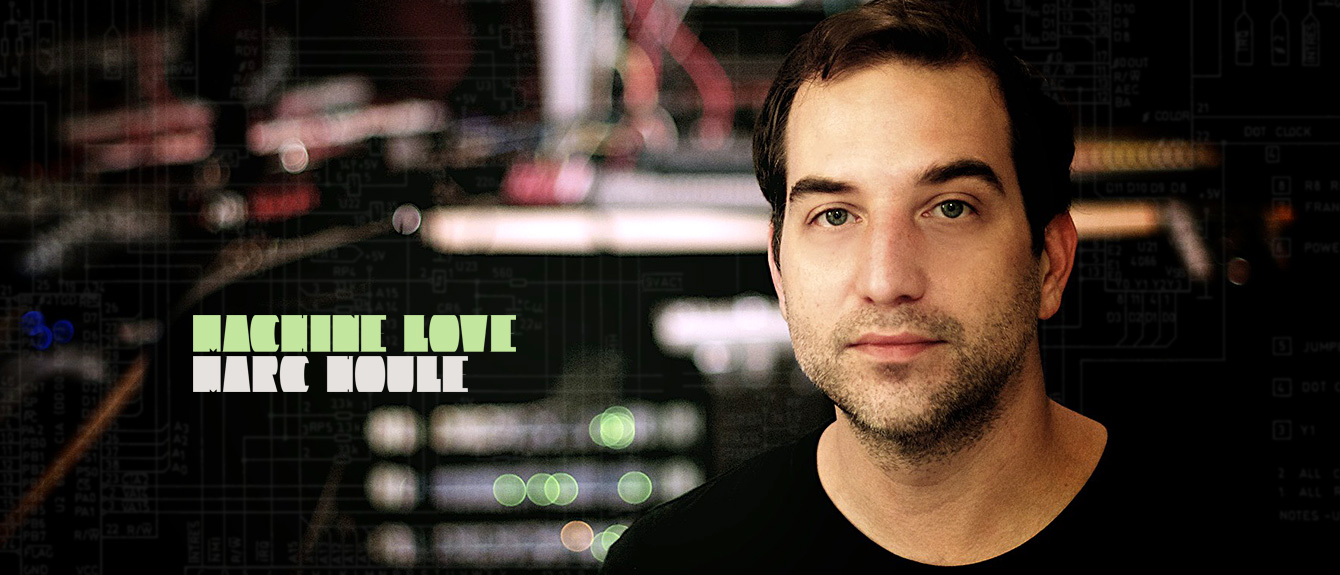
Machine love: Marc Houle

The Items & Things boss counts down five of his favourite synths.

"It's like, how do you first like girls?" Marc Houle is trying to recall how he became interested in synthesizers. "When you were little you didn't really care about them...and then at one point that's all you thought about." He does, however, remember his first: a Roland JX-3P he picked up after coming under the influence of electronically-inclined bands like Depeche Mode, PiL and New Order. Growing up in Windsor, Canada, the sounds emanating from nearby Detroit (in particular Jeff Mill's sets as The Wizard on WJLB) were also key, tuning Houle's ears to the possibilities of synthesis from an early age.

Latterly his love of oscillators was channelled into producing minimalist house and techno for Minus, the label through which he built his career during the '00s. The relationship yielded four full-lengths and era-defining singles such as 2006's "Bay of Figs" before Houle moved on to run the Items & Things label/collective with friends Magda and Troy Pierce. Undercover, Houle's fifth overall album, dropped earlier this year on the imprint, the most overt recognition of his '80s synth pop and new wave influences to date. Although the focus of his recorded music has gradually shifted away from the dance floor, the constant across his discography has been the throb of real synthesizers. Houle keeps an ample collection at his Berlin studio, but for this edition of Machine Love we asked him to just tell us about his favourite five.


Do you remember how you picked up your Juno-60?

I think it was a trade. My friend had a Juno-106, and I thought that was really cool. But then when I traded for a Juno-60 and I plugged it in for the first time, I was like "Oh my God, this is like 20 times better." It was simpler than a Juno-106, and you do less on it but the sounds were warmer and had more of a personality. They made my spine tingle when I first started playing it. I was a New Wave guy, and the Juno-60 does beautiful synth pads. And I was also a Detroit and Chicago fan, and it does incredible basslines. It's easy to make basslines really quick, it's like instant gratification. It was the perfect synth for me.

Were you programming your own patches at that point or using its presets?

It doesn't really come with sounds I don't think. There are only like 30 or 35 parameters you can really change on it, so it's pretty easy to just make a sound right away. It's like the perfect basic synth, extremely warm and extremely lush if you want it to be.

Have you turned to it down the years for particular uses?

No matter what, if I'm doing a new album or I'm doing some tracks, I always go back to the Juno-60 to add some stuff here and there. I can't stop using it even though it's years and years later. I'm still extremely addicted to it.


"I just really, really hate midrange."


Have you thought about why you like it so much?

Yeah. I mean, the chorus is beautiful, it makes everything sound nice and wide and very distinct. It can be lush, like I said, if you play pads. You can't really get a strong midrange sound out of it, which I love, because I detest midrange. So this thing has beautiful bass, really nice distinct highs, and all together that's kind of my sound. Whatever I like in music is all in this one keyboard.

Has rounding off the midrange been a theme for you?

Yeah, I always turn the mids down as much as possible. Whenever I queue a track the mids are gone, when I play guitar, the amps have mids down, when I play drums it's always a quiet set instead of a midrange set. I just really, really hate midrange. It's funny... no matter what genre of music I listen to, whether it's metal like Black Sabbeth, if it's rock like the Smashing Pumpkins, if it's New Wave, early Depeche Mode. All those things have no midrange.

Are there particular tracks on which the Juno-60's featured prominently for you?

Yeah, every one. It's so weird I keep getting more synths, but I keep using that one. On the last album there's one track called "Juno 6660," and that was just part of an experiment where I was trying to make a track with a single synth. The Juno track was the one I liked the best for the album so I ended up using it. It shows you how much I favor that keyboard.

I hesitate to use the word conceptual, but do you often apply those types of rules to music making?

Oh yeah. To me, making music is fun and it's almost like a game, so whenever I do make music I don't just sit there and say like "Oh, I'm going to write a song." There's always a reason for it. Like, "Hey, what happens if we do the same arpeggiator on ten different keyboards?" or "What happens if I try to make a song in [the time signature] 9/8 today?" It's more fun that way.

Do you feel as though you've always managed to maintain that sense of fun in the studio?

Sure. I mean, when I was in my 20s I was also into graphic design, and before the internet was around I would go to libraries and scan fonts in with my little hand scanner, and cut and paste them so that I could have different fonts. Then I started becoming a professional graphic designer and all the fun slowly disappeared as I did work for corporations. So I eventually quit that and just started on playing music full-time. When I started I realized I could never make music for other people, because then all the fun will just slowly disappear. So I always have to do it just for myself, and keep things fun and like a game. The last thing I ever want to be is bored of making music.


Let's talk about the Korg Mono/Poly. Do you remember when you first came across one?

In the mid-'90s I was trying to get rid of all my digital stuff because I was really tired of the sound, and so I traded in some stuff and got a Mono/Poly. It was another one of those things that I took home and I didn't know what I was getting into. A lot of times when you pick up a synth at a pawn shop back then, none of your friends had it, you'd never played on one before, there was nowhere to look to hear it, you couldn't like google it or something back then. So you're just kind of like, "Well, this synth looks nice so it's probably cool," and it was always fun to start playing it for the first time.

Did you find the Mono/Poly easy to get into?

Yeah, most synths have recurring themes. All the filters on most of the synths look the same, all the envelopes look the same, ADSR, everyone has ADSR, so you kind of know. But then there would be some weird stuff on every synth. The Mono/Poly has some weird X-Mod and some weird effects buttons. It took you like six months to finally kind of understand what was happening.

What's X-Mod?

Yeah, exactly. I can't explain. Cross modulation, I guess. When you use one... I don't know. It makes sounds. All this time later I can turn on the Mono/Poly and get exactly what sound I want within seconds just from fooling around with it for all these years.

What do you tend to turn to the Mono/Poly for?

While the Juno is really good at basslines and pads, the Mono/Poly is really nice for the leads I think. It can sound like a Minimoog almost, it can be very thin if you want it to, it can be thick as well. You can kind of put it in any frequency you want. It sounds very fresh and modern as well, even though it's old. It's really, really amazing.


What about the ARP2600?

When I got it, it didn't really work at all. You'd put some knobs up, and it'd just start squelching. But after getting it repaired a few times and slowly figuring it out better, I started to get some nice sounds out of it. It's a nice synth, and it's one of the most important synths in music next to the Minimoog I think.

It seemed like those two synths were in direct competition, so did you have a particular preference for the ARP?

If you've heard a Minimoog, it's [makes sound] big and round and takes up most of the song. I don't like that for some reason. I'm not sure why, there's just too much. A Minimoog bass is nice, but for leads it's just too much to have a [Emerson, Lake and Palmer] "Lucky Man" solo going on in the middle of a track. With the ARP you can control a lot more. There's are four different wave forms on it that you can choose from, and there's beautiful sine waves. You can go really deep and warm; you can go very aggressive, sawtoothy; you can make it sound like a 1976 Pong if you want the nice square waves. Because it's semi-modular, you can put stuff where it shouldn't go and end up with weird results.

Has modular synthesis been a thing for you at all?

I wanted it to be, but I think it's just too much. For some people it's really fun buying all the different stuff, and setting up a modular system. I'd rather walk into my studio look around the room, know what each sound does and what sound each synth makes. If I need a certain sound in a song I can just look to the DX7 and start playing something. With a modular system, you're just playing and getting lost in a world for a while. That's great, but I need the instant gratification.


"[The Arp] is kind of like an old car.
You know if you drive it out
that you'll have to fix it."


Have you had many issues down the years maintaining your ARP?

Oh yeah, it breaks down all the time. There's always something going on with it. It's kind of like an old car. You know if you drive it out that you'll have to fix it.

Has it ever got to a point of real frustration in using older gear? Have you ever thought, "You know what? I'm just going to upgrade to something modern"?

The other day I came in my studio after being gone for a couple of weeks. I just wanted to make a song, so I turned on the 808 and it starts going "burrrrppp." I turned it off and on, off and on, and it's just going crazy spitting out these crazy sounds. I was just disheartened, and then I started getting mad and so I started hitting it and it started working after that. It's the same with my Mono/Poly. A lot of the glitches from the old gear find their way into tracks, though, because it's something you could never reproduce. Some of those accidents are good, but usually it's just frustration. So if you were starting up now and asking me what synths you should buy, I'd say, "Don't buy any, just stick with VSTs and get a laptop." You'll be much happier.


What do you like about the SH-101?

The SH-101 is a good utility synth. It was inexpensive at the time I got it, but it does a lot. For a beginner, it's got everything you need on it. It's great.

Are there particular things that you think it excels at?

As a live performance synth, you can bring it and use it for bass. You can use it for synths, drum sounds, noises. Anything you want. You could be onstage with a kick going, plug that thing in and then boom instant techno show. Just randomly hit three notes and make a cool bass sound, and there it is: "Instant Detroit/Chicago sound."

What's been your attitude towards taking studio equipment on tour with you?

Every year I keep trying to take more stuff, but it's just impossible because half the time I'm playing in a micro DJ booth, and I'm by myself and working with a weird sound system and there's time constraints where you have five minutes to set up... When I play live it's only my laptop with the sound card and the controller, so there's no analogue gear. I always try to bring analogue stuff to my live shows so that the show will sound better, bigger, warmer—all the stuff I experience in my studio. But it just never seems to work out. I haven't found the perfect piece of gear to bring with me that will express everything I need. One day I'm going to find the right piece and just start going with it.

How are your keyboard skills at this point? Do you feel pretty confident that you could express yourself in the live environment?

All the stuff I make is me playing around in the studio live. My music is very simple. It's not like I'm playing a Blue Oyster Cult tune or something. I'm not at that level, but yeah I can play songs. If I have something in my head I can just play it.


What was your impression of the DX7 before you picked one up?

Awful, I hated the DX7. All the early '80s stupid digital pop music, "bling, bling, bling" and all the really bad R&B? All the DX7. All the bad metal bands. It was the worst synth. Every track that was on the radio had a DX7 at that time, because it was so revolutionary, but they used it all in such a strong, breathy way. I got it four years ago because there's something about me... Like as much as I hate it, I kind of love it too. 1985 Prince sounds, crap digital, it's kind of fun.

It's kind of midrangey too, right?

Yeah, it fills the [frequency] hole that a lot of my other stuff won't. No matter what the track is, whenever I play the DX7 it cuts right through to the front. It's right in your face. As long as you can avoid all the really bad sounds, it's a really fun synth. Right now there's like a billion patches for the DX7 because it's been around for so long, and so that's kind of the way I work with it. I just go and get some digital patches for it.

Have you ever made an attempt to program it?

No, I don't really understand it. I see the diagrams where the first A goes to B then it comes back to F which comes back and splits... But I don't want to understand it because I don't use it enough. It's not my baby. The other synths are fine, they're like friends and stuff. This one is just really cool because it makes things cheesy and fun.

Did you ever end up picking up another synth in this style?

Oh yeah I have a bunch of digital ones to fill in the void if that one doesn't work: A [Kawai] K3m, K4, K1—a bunch of Ks—the DX100. The DX100 is probably the synth most associated with Detroit other than the 303 I guess. It's got those Detroit stab sounds, and nice bass sounds, and the origin sounds are very Detroit sounding. So if you get a DX100 and you just go through the presets and just start playing stuff you'll be like, "Hey, I know this song it's that Detroit track."

Do you ever use software synthesizers?

For software I like having a computer going because if I'm walking through the house and I want to record some ideas really quickly I can open up my computer and start playing really fast and get all the notes in. And then later I take all those notes and I spit them to certain synths. As for software synths, I don't have any love for it, not like these guys. When I walk in the studio [it's] like they're my friends. I've been with them for years and I know their personalities.

Words / Ryan Keeling
Published / Wednesday, 17 October 2012

comment 9 Comments

Also available in / Japanese


Share this article


Features


Other features
RA's Andrew Ryce follows along as the celebrated Brazilian DJ/producer performs his final ISAM show in Los Angeles and preps his new album as Two Fingers.
Nick Connellan profiles the
Nick Connellan profiles the "new" masked techno producer who wants the focus to be placed squarely on his music.
We go to the UK to find who your favourite selectors rate.


About  
Staff  
Mobile (beta)  
Submit event  
Copyright © 2013 Resident Advisor Ltd.
All rights reserved. Terms & Privacy.