RA
RA Japan
Global
Local
Music
Interact
Search RA
Kazantip: Life with no pants

RA's Will Lynch travels to an "imaginary republic" in the Ukraine where, if you're looking a bit too uptight, you're liable to have a jellyfish thrown at you.

On a Thursday night this August, two days before the final party of the 20th edition of Kazantip, I sat in a black SUV rumbling across the bumpy stretch of land that separates Simferopol airport from the Black Sea. My travelling companions included two English drum & bass DJs and a young girl from Moscow named Tanya, who had hitched a ride with them. The DJs and I were a bit weary—worn out from travelling and unsure about what would happen next. Tanya, on the other hand, was practically bursting at the seams.

She'd been religious about Kazantip since her first time there five years earlier, when she decided to go on a whim while her boyfriend was out of town (also at Kazantip, it turns out, despite what he'd said about a "sports trip"). Now she was headed there by herself, penniless, with nowhere to stay, and so excited she could hardly sit still. As we got closer, sweeping spotlights and stray lasers picked out the site. Tanya sighed as she gazed out the window. "It's so great... you don't even know..."


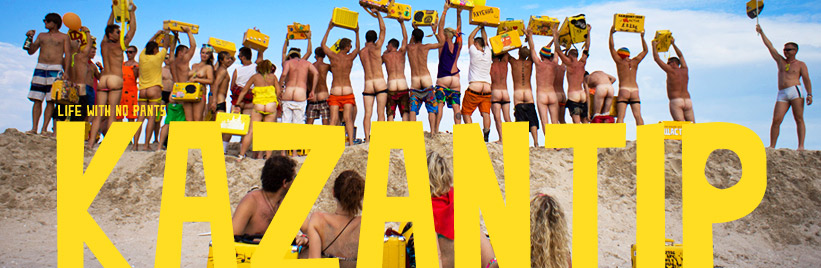
It's not unusual for people to get misty-eyed about Kazantip, a month-long extravaganza that takes place on the beach every summer in Crimea, a politically autonomous region of Ukraine. Most of the appeal is obvious: weeks of endless partying in a beautiful and remote location where people are friendly, clothing is optional and a generally surreal atmosphere prevails. As the website puts it, Kazantip "exists in a parallel reality," a dreamworld conceived by one man, Nikita Marshunok (AKA "The President" or "President Nikita I"), whose philosophy is captured in two phrases: "summer all year round" and "life with no pants."


President Nikita
He's also quoted as saying: "Kazantip is not what you think. Rather, it's what millions of people on Earth dream about—a perfect land, an attempt to create a new, improved society." That may sound over the top, but for tens of thousands of people (especially from Russia and Ukraine), Kazantip really is a kind of utopia. Much like Burning Man (which, incidentally, is the only festival President Nikita respects), it creates a Mad Max-style atmosphere where flamboyant self-expression is the norm, even if that means, say, walking around in nothing but a headdress and a small orange baggy over your genitals.

People slip into an emotional state that's a notch above the usual festival glow—a sustained, hedonistic zen that comes from weeks of marinating in this weird environment. It's a far cry from the dour vibe you tend to get in cities like Moscow, where people rarely smile or laugh in public, and if you ask someone how they're doing, they say "normal" instead of "good." At Kazantip, people are always beaming, friends are easily made and if you're looking a bit too uptight, you're liable to have a jellyfish thrown at you (I speak from experience).


Something you're constantly told at Kazantip is that it's not a festival—it's a republic. This is much more than just a gimmick. There are examples of it everywhere: attendees are called citizens, tickets are called visas, troublemakers are "deported" and all of the top managerial positions are held by "ministers" (Minister of Foreign Affairs, Minister of Propaganda, etc.) There is a national food (grilled corn on the cob and sunflower seeds), a national sport (kitesurfing) and a national anthem, or hymn, which is available as a ringtone on Kazantip's website (along with instructions to "stand up while listening"). The security is handled by a private company called Typhoon, who carry themselves like a military outfit, stalking around the beach in full camouflage (Ukrainian police are supposedly not allowed inside, "except as guests"). Intentionally or not, the President's role parodies the current political climate in Russia: Kazantip considers itself a democracy, but one that keeps electing the same guy over and over again, and everyone seems fine with this.

Music is not the main attraction at Kazantip—at best it's an important ingredient. The thing to do is just stroll along the beach, biding your time in the dozens of cartoonish bars (one seems to be modelled after the Mos Eisley Cantina in Star Wars) and poking your head into the various dance floors. As you do this, you're likely to hear a strange and slightly hilarious medley of sounds—psytrance in the Prostranstvo, drum & bass in the Coliseum, that absurdly big room remix of "Somebody That I Used to Know" on the main stage, Russian language covers of Bob Marley in the egg-shaped Faberge and so on. Probably the most baffling stage was the Shit Palace, a Parthenon-style structure that houses the press bathrooms (i.e. the only toilets where you don't have to pay two hryvni every time). The music in here ranged from Blackstreet's "No Diggity" to the Rednex cover of "Cotton Eye Joe," interspersed with Russian folk ballad sing-alongs, and the place always seemed to be absolutely going off.

There is some house and techno to be had at Kazantip, mostly at the venues down by the beach. On the night before the closing party, I saw Shaun Reeves and Ryan Crosson in the Croissant (a tent structure shaped like a croissant), then Jay Shepheard playing at sunrise on a tiny outdoor spot called Space Bar. None of them had appeared on the official lineup (many artists are added last minute and never officially announced). There were some big name headliners over the course of the month—Sasha, Kenny Larkin, Laurent Garnier, Danny Howells, Paul Woolford—but the vast majority of the lineup is Russian DJs who are unknown in the West. Nikita admits the music is "background," and says the important thing is the interactions among the "citizens." Furthermore, he thinks festivals that lure in an audience with big names are by nature too commercial. At Kazantip, the draw is the experience itself, not the names on the bill, which theoretically makes for a more devoted crowd.


This partly explains why Kazantip remains relatively unknown in the West, even as it becomes increasingly legendary in Eastern Europe. Somewhat misleadingly, most Western perspective on Kazantip is shaped by a 20-minute video that appeared on Vice a few years ago, which painted a memorably lurid scene: Russian mafia everywhere, naked girls pouring vodka on themselves, people fucking on the beach, girls making out with dogs, etc. (There was even a brief clip of a young boy performing cunnilingus on a grown woman to get a free T-shirt, which has since been edited out.)

Kazantip did have a sleazier edge back then—Roland Stach, a former minister, intentionally brought sex tourism to Kazantip until he was sacked (at which point he unsuccessfully tried to set up a shadow Kazantip in Portugal. You can hear Nikita tell the story in this video). In the Vice video, Nikita says he wants less "sex, drugs and rock n' roll" at Kazantip, and by now he's mostly sorted this out. Nonetheless, many Western attendees still expect a booze-soaked orgy, and despite a still-considerable level of debauchery, find the event disappointingly tame.


###


The truth is that Kazantip has a very strange way of being unhinged. Yes, there's nudity and a bit of raunch from time to time (it's the only place aside from Berghain where I've seen acts of S&M on the dance floor), but it also has an odd conservative streak. Drugs are prohibited and, aside from a little bit of weed, are 100% invisible during the event.

Even sexual promiscuity is frowned upon, if in a fairly tongue-in-cheek sort of way: to help citizens avoid sex out of wedlock, speed marriages are provided onsite. This is explained in article 15 of Kazantip's "constitution": "On the whole territory of the Republic love is welcome and encouraged in all of its aspects, but [not] sexual promiscuity. For the avoidance of doubt, there is a special social institute—FAST MARRIED, meant to legitimate citiZens' relationships. CitiZens [who] suddenly fallen in love with each other may effect quickie marriage in heaven, i.e. get through The Fast Married ceremony. Quantity of heaven-made wedlocks FM is not limited. And God bless your unions!" To clarify, "heaven" is a metal tower overlooking the beach where marriage ceremonies happen at a rapid-fire pace all day (unsurprisingly, these unions are not recognized outside of Kazantip). In the end, as ridiculously saucy as Kazantip can get, it usually stops short of being depraved.


In fact, the whole thing is actually quite sweet. A palpable unity really does exist among the "citizens," including the ministers and the president, all of whom seem to really believe in what they're doing ("republic" and all). President Nikita can often be spotted among the citizens, riding around the beach on his Segway. (I saw him one night heading off to his living quarters at sunset, infant son tucked lovingly under his arm, polka-dot pants flapping wildly in the breeze.) Kazantip is essentially his gift, a kind of "techno resort" (as one friend put it) where people enjoy an easygoing freedom that's rarely available to them otherwise.

The claims of a "new, improved society" are not entirely without substance. To take one example, social class is remarkably insignificant at Kazantip: the crowd mixes thousands of average working people with celebrities and what one might call "high net worth individuals," such as Mikhail Prokhorov, the billionaire owner of the Brooklyn Nets and recent Russian presidential candidate, who's allegedly a regular at Kazantip. Tickets are cheap (€160 for the whole month), and there's a well-known way to get in for free: by designing a vintage yellow suitcase and submitting photos of it a few weeks before Kazantip begins. Anyone whose suitcase meets "state standards" gets in for free (based on how many people you see carrying these things, state standards seem pretty friendly).


There are other traditions tying the crowd together as well, most notably the sunset ritual: every night at around 7:00 PM, people stake out westward-facing spots to watch the sun go down. Slightly cheesy chillout music plays, and as the sun falls closer to the horizon, everyone on the beach starts having a moment; couples cuddle each other, the crowd gets quiet and on top of the UFO bar, and a man stands stoically by a gong with an enormous mallet in his hands.

The sun finally disappears—a more distinct moment than you might expect if you've never watched it second-by-second—the gong sounds, and everyone cheers. Naturally, this was especially bittersweet on the closing night. Red balloons were handed out to be released when the gong sounded, and everyone on top of the structure where I was seated—ministers, citizens, and the President himself—looked on in solemn reverence as they floated away from the beach.

Later that night, a huge portion of Kazantip's citizenry gathered on the main stage for one last hurrah. The whole place was packed wall to wall (or to be more specific, from the Coliseum to the Shit Palace). Sometime around 2:00 AM, fireworks exploded overhead and everyone gazed up at them like a bunch of six-year-olds, savoring the last few moments of indulgence that separated them from the dreaded return to normal life. The music was, well, pretty terrible (an electro house cover of REM's "Losing My Religion") but there was a deep sincerity to the whole thing that was hard not to be moved by—a sense that this whole thing, as goofy as it is many ways, really makes an enormous amount of people very, very happy. Someone I was with even admitted to tearing up a bit.

The 20th edition of Kazantip may turn out to be a milestone in more ways than one: according to a higher-up I spoke with shortly after arriving, there's a chance it may not be able to return to its current spot, where it's been for over a decade. The reason for this is simply that "the Ukrainian government is changing," and there's no telling whether they'll continue to give Kazantip the freedom it needs. This kind of uncertainty is a part of life in societies across the former Soviet Union, and arguably is part of what makes Kazantip such a potent escape. In an informal press conference that weekend, Nikita described Kazantip as a haven from things he has no control over. "It's difficult to change the world," he said, "but it's possible to set up your own small world that works how you want it to." There could hardly be better proof of this than his own "imaginary republic."


Balloons

Words / Will Lynch
Published / Tuesday, 28 August 2012

comment 21 Comments

Photo credits /
President Nikita - Christine Neder


Share this article


Features


Other features
Big hooks, big hits: The Italian imprint isn't as big as Hot Creations, Visionquest or Crosstown Rebels...yet. RA's Todd L. Burns explains.
We step into the German producer's studio to chat Voyetra 8s, Hartmann Neurons and other synth arcana.
Jonny Coleman tackles the multi-farious scene in one of America's biggest cities.


About  
Staff  
Mobile (beta)  
Submit event  
Copyright © 2013 Resident Advisor Ltd.
All rights reserved. Terms & Privacy.