|
 |
 |
 |
 |
 |
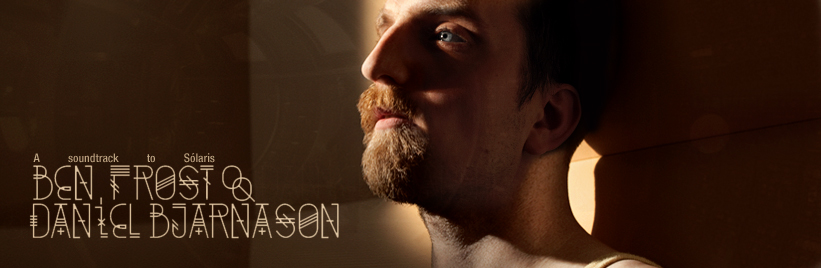
Daniel Bjarnason and Ben Frost: A soundtrack to Solaris
RA's Andy Battaglia charts the genesis and development of the commissioned piece that the Icelandic duo have been working on for the past two years.
"It needs to feel like it's a trick on your ears when you come in, like if you weren't looking you wouldn't know..." Ben Frost was talking to a room full of quizzical musicians holding violins, cellos, stringed bass—things that the glib among us might think have been supplanted in the service of making sounds that scan as transgressive or strange. The musicians knew what they were doing, as the orchestral pros had been trained in the art of translating oblique instruction into actionable aid. But this was something new and different for everyone involved.
It was two years ago in Poland. Early rehearsals were taking place for the project that would come to be Music for Solaris, an ambitious piece premiered at the Unsound Festival in Krakow in 2010 that has since traveled to cities such as New York, Reykjavik, Vienna, Budapest and Berlin. (It will be presented this week at the latter by the festival CTM before rolling on this weekend to Brussels and The Hague.) Performances of it include up to 40 people, and the cast involved answers to the call of two leaders. One who plays a piano jammed with nuts-and-bolts, and another who has made a habit of gracing some of the world's finest stages, surrounded by serious listeners and flooded by expensive light, without shoes.
So it goes with Daniel Bjarnason and Ben Frost, who composed Music for Solaris together. The idea was to make music inspired by the 1972 film by Andrei Tarkovsky and the 1961 novel by Stanislaw Lem, both of which mingle post-human ruminations on metaphysics with fantastical science-fiction airs. It was commissioned by Unsound to be performed with 30 or so players from Krakow's Sinfonietta Cracovia, a group put through various avant-garde paces by its founder Krzysztof Penderecki.
Some sample words and phrases from my notebook at the first performance, two years back: "sinuous," "unstable," "unsettling," "'wrong' notes," "like [architect] Zaha Hadid's idea of seeing something from different vantage points at once," "throbs, seems to breathe," "eerie," "like if you fed a blind person grapefruit for days and then gave him a lemon instead."
It's odd music, orchestrally summoned but otherworldly in its effects. It was composed, conceptually, to be that way. The setting of its origin story was Reykjavik, Iceland, where both Frost and Bjarnason live and work around the hub of the label Bedroom Community and Greenhouse Studios, where nobody seems especially interested in distinctions between classical music and noise, earthy folk and synthetic pop, polyphonic art songs and reductive spells of silence.
It was there that Frost and Bjarnason first got together to improvise while Tarkovsky's Solaris was projected in front of them on a screen. "The score [by Eduard Artemyev] always felt to me like it was emphasizing and compounding the idea of Solaris as a science-fiction film," said Frost. "At the time it probably made a lot of sense, at the pinnacle of the space race. It was very new the way he was doing it then, but it became dated. And it never achieves musically the effect I think Tarkovsky was going for, which was to make a film about an inner space as opposed to an outer one. In that regard, the fact that the story is set in space is kind of irrelevant."
This was seven months after the first rehearsals in Krakow, around a performance of Music for Solaris in Reykjavik in the summer of 2011. It was there, during the improv sessions at the beginning, that Frost took to rethinking music for Solaris with an electric guitar and effects, while Bjarnason played beside him on prepared piano. Frost fixed on what he called "gaseous clouds" of chords transmitted via strange tunings, while Bjarnason pressed at his piano with deliberately placed detritus inside to ring and buzz the strings, a la John Cage.
Once the initial improv sessions were done, recordings of what had happened were fed into Melodyne, studio software new to them at the time. "You're able to feed audio into it and it detects, or attempts to detect, all the note data and all the harmonic information in that audio," said Paul Corley, who works closely with Frost and played a significant role in conceiving Music for Solaris. "It's like black magic. It gives you an insane amount of control. But since it's a piece of software, it's never perfect, especially with prepared piano and a guitar with effects."
In line with source sounds made ethereal by design, the data displayed in Melodyne was full of wrong notes and phantom presences. "The sound of a prepared piano is off, awkward—it doesn't make for clear notes," Corley said. "You might play a C, but if you have a clothespin inside the piano, you get a weird harmonic C, so Melodyne thinks you're playing a C and a little bit of a G and a little bit of an F at the same time. Plus there are all these upper harmonics that come from resonant frequencies in the room… Lots of errors come across."
The mix of miraculous processing power with the specter of inevitable mistranslation and mistakes cohered eerily well with the story of Solaris itself, in which an astral traveler is joined in the depths of outer space by a simulacrum of his dead wife. Her presence in the space station, both uncannily accurate and not quite right, is a sort of quantum projection empowered by the mysterious effects of the planet Solaris, which roils in psychedelic swirls outside.
"The feeling of loss is the defining aspect of the film, that's always how I've always reacted to it," said Frost. "Conceptually, if you want to take it the whole way, this is all about taking something that exists as a whole without context or knowledge of how it's supposed to work and trying to make sense of it based on this two-dimensional image of it. The orchestra humanizes all of those translations, and humanizes all of the mistranslations as well."
Arrangements for the orchestra were written by Bjarnason, who consulted the strange Melodyne data in the final score for the piece. The result is music that skews toward the contemplative minimalism of composers like Giacinto Scelsi and Arvo Part, with spectral guitar parts by Frost that wander in.
"Daniel has this incredible vocabulary and understanding of music," Frost said. "I studied music all through school. I'm 'classically trained.' But my relationship to music from the time I was 14 has been guitars and amplifiers and listening to Nirvana, not delving into the intricacies of string quartets. His understanding of the mathematics and grammar in music is much different than mine. He has an ability to take what I do and invert it or extrapolate from it and make the scope much bigger. Instead of it just being 'red,' it becomes 30 different kinds of red."
The same effect plays out on a recording of Music for Solaris released last year by Bedroom Community in a through-composed LP form. It was recorded by all involved outside Krakow at Alvernia Studios, a galactic-looking complex of high-tech facilities used for the production of music and post-production for movies. Members of the Sinfonia Cracovia orchestra were spread out through the space, working over sounds meant to evanesce.
"It's a lot to ask from a orchestra to play as quietly as they can, as a directive," Frost said. "It's a musical dialect that you can't just drop into a normal conversation. It's like trying to command everyone's attention in a bar while whispering."
The same reductive impulse figured into the visuals conceived for the live experience by Brian Eno and Nick Robertson. Near the start of work on Music for Solaris, Frost met Eno by way of the Rolex Mentor and Protégé Arts Initiative, a program that pairs "rising artists with great masters for a year of creative collaboration."
"I've gone on record many times expressing my distaste for video and music," Frost said, "so when Brian came up with his idea I really felt like it was his interpretation of it, his way of solving a problem that needed to be solved. He provided an elegant solution for it. In the end he went through the same processes that we have musically, in that he's stripped out and there's less information. There's something about all of this that seems to demand less and less and less."
The visuals employ images from the film—slowly morphing portraits of characters, suggestive stills of Pieter Bruegel's painting The Hunters in the Snow—as well as color-field abstractions that hover on screen with a sense of kinetic inaction. At one point the screen empties and fills with a shade of static yellow that seems to suggest all colors burning brightly and burning out at once. The music in the air around it could be its fuse and it could be its ash. Or it might not be "music" at all.
|
|
|
|
|
|
Published / Wednesday, 19 September 2012
4 Comments
|
|
|
|
|
 |
 |

Features
|
|
|