RA
RA Japan
Global
Local
Music
Interact
Search RA
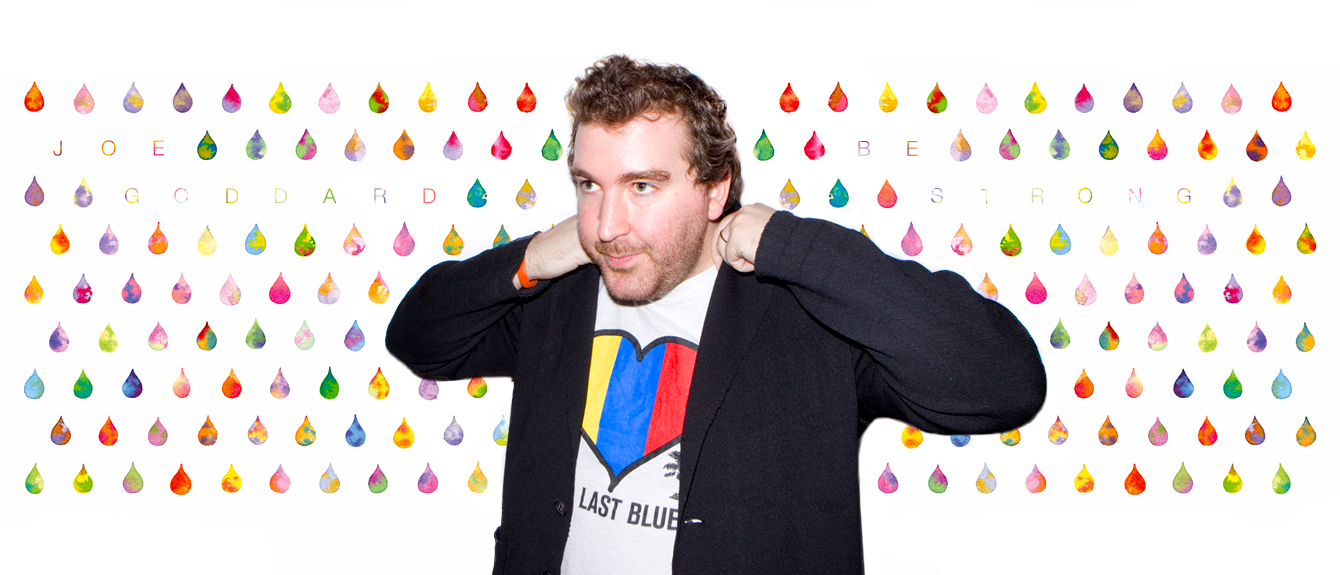
Joe Goddard: Be strong

The Hot Chip and 2 Bears man discusses house music utopianism and becoming an ageing raver, with RA's Tony Naylor.

As one-fifth of Hot Chip, half of 2 Bears and flying solo under his own name, Joe Goddard is one of the busiest men in British music. Working at the intersection between pop, indie rock and club music, the 33 year-old Londoner has been responsible for many distinctive musical triumphs, recently via his rambunctious house revivalism as 2 Bears and the lung-busting 2011 anthem "Gabriel."

He also co-runs the Greco-Roman label, dabbles in remixing and choice side-projects, such as his involvement with burn studios' 2013 Residency. In May, Goddard and fellow artists Steve Lawler, Maceo Plex, Fatboy Slim and Solomun will decamp to Ibiza to mentor a group of young DJs for burn's now annual competition on the island.

"While I'm working I feel very comfortable," he says, "It's the thing that I love most, I guess." RA pulled him away from the mixing desk and the initial groundwork for the next 2 Bears album (expect dancehall, more house music and "quite a lot of slower, soul-influenced things"), to talk Ibiza, ageing-ravers, conflicted nostalgia and house music utopianism.

How important was dance music to Hot Chip's evolution? Were you and Alexis [Taylor] discussing it, and were you inspired by it, when you were putting the band together?

The first record, Coming On Strong, is more influenced by soul and R&B. But from about 19, when I went to university, I started to get very interested in garage and house. Basement Jaxx's first album was blowing up—it was an easy gateway drug into house music: catchy, full of hooks, elements of rock and funk in it, and, at the same time, UK garage was top of the charts. I thought those records were genius. I was good friends with Kieran Hebden—I went to school with him—and he would play me 12-inches, like "Scrappy" by Wookie, and blow my mind.

I came down to London almost every weekend, and went to fabric and the early FWD>> nights at the Velvet Rooms, lots of drum & bass nights, and that's where I got seriously into house music. Prior to that, I'd gone jungle raving a lot when I was 16, 17, but that was the first time I got into house music and since then it's been an obsession. Now it's by far the thing that I'm most into.

I wouldn't say Alexis is such a clubbing person. He doesn't take any drugs, he doesn't have a history of staying out all night, but he's very aware of what's going on in dance music and loves it. And the rest of guys in Hot Chip similarly, so it's been a big part of what we do for a long time. I still think you hear more new ideas in dance music than anywhere else. You can look at the Rinse schedule and see any number of exciting mutations.

You mentioned being at school with Kieran Hebden. This was the Elliott school in South London that Burial and the XX also attended. What was going on there that inspired so many people?

I find it difficult to explain. The only thing I can think is that there was a good ethos of trying to encourage people to be creative and individual. There were a group of older left-wing teachers who were committed to the school, trying to instil this idea in the kids that you don't have to just go out and be an accountant. It was a comprehensive school, kids from all different backgrounds, and they tried to give everyone the idea that you could do and achieve what you want.

Today, you're a 33 year-old father of two. I wonder if when you're DJing or clubbing you ever think: "Fuck, what am I doing here?

I feel it about a lot of things. I don't want to outstay my welcome making music. I want to be doing something that's interesting, and has a point to it. You get momentary feelings in clubs that this is something for younger people. Other times, it's just such an exciting place to be that it feels completely right.


When the Daphni album came out, Dan Snaith said some interesting things about how, despite his age, he was still drawn to nightclubs and still had musical epiphanies in clubs. Ultimately, however old you are, it is inescapable that this music is best heard over loud systems in small dark rooms at 4 AM, isn't it?

Absolutely. You can't get around that. To get into that state of mind, where a track can really hit you, you kind of need that: not necessarily to be high or pissed, but to have that as the absolute focus. You need a dark room and a few hundred people sharing that experience. I remember Dan making that comment and I know exactly what he means. That's what makes dance music special. I don't find I have that experience so much going to see a band at 9 PM. It's about a DJ playing a few more minimal beat-driven records for 45 minutes, and then playing something completely out there—psychedelic, epic, more of a song—and just feeling a big connection to everybody in there with you. Those are the moments that everyone wants. I still have that, and I still love it: that sick feeling you have in your stomach, when you don't know what the record is, and you have to find out. That's what makes this culture so powerful and so addictive.

Around the 2 Bears album release, you talked about dance music in quite utopian terms. "I believe house music can be a secular spiritual experience, when it's done right," was one memorable quote. Do you genuinely believe that? Dance music is a pretty commercialised world these days, isn't it?

I'm not saying that every time I go out or DJ I have that experience, and a lot of dance music isn't like that. It's an enormous business that all the biggest brands in the world have a piece of. If you look at what's going on in America, I don't think there's much spirituality about that. But I think when the conditions are right that is still possible, and I think it's possible because with people mostly not being interested in organised religion nowadays, there's a massive hole that needs filling, in terms of people feeling a sense of communion or togetherness. Dancing and singing together, as a group, has existed in human societies going back hundreds of thousands of years. That's still a need today.

That [connection] still happens when Theo Parrish plays the right record. You look around, people are smiling and there's a certain community in that room. You don't get that in a football stadium when Avicii's playing, I don't think. But you do at some parties. It's not the same as a religious experience, but it is a room full of people all feeling the same way at the same time, which is quite a powerful thing, still.

You've produced anthems unorthodox ("Over & Over") and traditional ("Gabriel"). Can you sense which will work?

With "Over & Over," I remember getting it mixed by Tom Elmhirst at Metropolis in West London, and feeling: "Fuck, this sounds powerful and exciting." But we didn't have any experience, then, of what's going to become popular or a hit. We weren't prepared for it at all. If something makes you dance about in your chair and smile, you know you're on to something, but you don't really know what it is, apart from that. These days, when I'm working on a track, and I start to get that feeling, the main thing in my mind is to try to hold onto that excitement—not to work on it a bit more, and start to get discouraged.

The 2 Bears' album was steeped in Chicago house. Why? And what were you trying to revive with that, if anything?

The aim wasn't to revive something. That's not the priority, but if you listen to that music, made by laying down tracks on tape, using a few drum machines and synthesisers, it has a lot of life to it. It's less polished; there'll be slight mistakes, issues with tuning, certain things coming in too loud, and those things make the record feel human, alive. It has faults, as we all do. That's something that is great in all music, but particularly in early electronic music. I guess a lot of people are feeling like that at the moment, because you get a lot of records that are trying to get some of that energy into them. That's something that in Hot Chip and 2 Bears we try and do. It's a matter of not ironing out all the creases.

I can understand why people use old analogue equipment, but the current vogue for '90s NY garage seems odd. Dance music needn't always be fiercely futuristic, but that nostalgia seems regressive.

The thing in Europe and the UK of records really trying to capture the sound of old Masters At Work or deep house, there are problems with that, yeah. It's nice, it's comforting, but it's slightly dull. It would be amazing if something completely different came along and swept everything away. In the way that Simon Reynolds talks about post-punk and acid house doing. I guess in America dubstep is doing that. They're having a real moment where hordes of teenagers are getting into music which sounds quite different to things that have gone before.

But I wrestle with this issue. When you go clubbing you need a relatively clear rhythm to dance to, it can't be too esoteric and crazy, and we've been through a lot of the rhythms that fit that. If a new thing did come along that really blew everyone away, I can't completely imagine that. Hopefully, some 17 year-old will. That would make me incredibly happy.

What advice will you be giving as a DJ mentor?

Try to be individual. Dance music's a big world populated by a lot of people who're quite interchangeable. Trying to develop something unique is key. You shouldn't feel compelled to pick up that latest big tune from Beatport. It's difficult, but you have to have the confidence to really search through the music you love and play it in an interesting way.

The mentoring work will take you out to Ibiza. How do you regard the island?

My relationship with Ibiza is different to most clubbers. I never went as a youngster. Hot Chip's background is indie music and we made a name for ourselves in the early days of DFA, LCD Soundsystem and all of this stuff. Which, initially, was kind of opposed to the Ibiza stereotype of "mindless house music hedonism." It was more gritty, New York basements or whatever. That was the idea. But, with Ibiza, I've been the last couple of years, to DJ at Space mostly, and I've had a really good time. It's a strange turnaround because, at one point in my life, I would have defined myself as not really being an Ibiza person.

Words / Tony Naylor
Published / Wednesday, 27 February 2013

comment 10 Comments

Photo credits /
Header - Thomas Butler for RBMA


Share this article


Features


Other features
RA's Aaron Coultate talks to the iconic French artist about vintage synths, vaporized techno and society's fear of the future.
Our top picks for the first festivals of spring.
The Brooklyn outfit is assembling one of the unruliest rosters in the game. RA's Jordan Rothlein investigates.


About  
Staff  
Mobile (beta)  
Submit event  
Copyright © 2013 Resident Advisor Ltd.
All rights reserved. Terms & Privacy.