|
 |
 |
 |
 |
 |
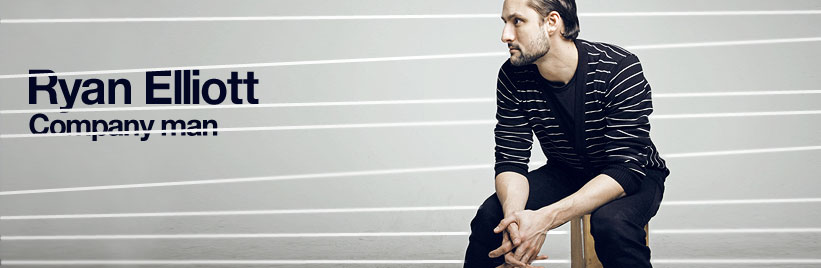
Ryan Elliott: Company man
Christopher Thomarios talks DJing and working nine to five with Spectral Sound's employee of the month.
Ryan Elliott is a bit of a Jekyll & Hyde character. On one hand, he's structured and exacting, waking up early every morning to tend to his responsibilities. He trains for marathons. He even occasionally uses Excel to prepare his DJ sets. "There is a duality to Ryan," says Sam Valenti IV , the founder of Spectral/Ghostly, "He's very organized which allows him great flexibility as an artist." Yet the flipside is a loose creature of the night who couldn't care less whether his shirt is tucked in, or what people may think of his, er, unique brand of dance moves.
Ryan's career is also an anomaly in this day and age: He has made his mark through DJing and DJing alone. It's a trajectory that has kept his profile fairly low – he's only released one mix CD , 'Spectral Sound Vol. 1' from 2005 – but recently his waters have been rising, with big breaks at Sonar by Night in 2006, the DEMF in Detroit, and DC-10 in Ibiza.
Ryan might be a company man by day – he works nine to five as a financial analyst – but he's also a company man by night: He's part of the DJ wing of Spectral Records, the ying to Matthew Dear's producer/live show yang. It's an association Ryan takes very seriously: "I'm always flying the flag," as he puts it. It's a work ethic that his boss seems pleased with: "Ryan is committed to the art of DJing, trying to take himself further, but always interested in connecting, first and foremost." says Valenti. "He's constantly challenging himself and re-introducing classics into his sets." Due for a raise then.
RA caught up with Ryan in Columbus, Ohio, at a delightful place called Jimmy V's in-between his afternoon and evening sets at this year's CONAR.
How did you get into techno music?
Music has always been the art form that appealed to me the most. Growing up I was always glued to the radio. I was never a movie guy. I’ve never been a book guy. Music is what I’ve always been into. Going out to clubs was something that I enjoyed doing as well – it just wasn't based around dance music. When I came back to Detroit after university, I started going out to house and techno events and the now legendary Club Motor. It was a natural progression from there – really getting into the music, wondering where I could buy the music that I was hearing, wondering what that person in the booth was actually doing. I was quite naive at the beginning. The first parties I started going to, I could never understand why people were getting there after two a.m. I was like, “There are no more drinks being served. Why are they getting here now?” That’s how new it was to all of us. I never had that friend that was into the scene or into DJing, so my discovery of this music and this culture was very independent. It was my roommates that actually wanted to buy decks. We got them on New Years Eve of 1999 – we all went together and bought the typical 'learner setup'. I was instantly hooked. I bought a proper setup a few months after that, and I've been obsessed with DJing ever since.
Do you wish that someone had shown you the ropes?
It was actually better that I went it alone. It seems that when people actually bring you into this scene, they tell you what to expect, what to like, how to do this, how to do that. I didn’t have that. I learned to beatmatch by myself. Of course when I started listening to dance music, I listened to it all. It was trial and error, but it was my introduction to dance music. A perfect example is Mark Farina, the house guy, he did 'San Francisco Sessions.' There was a track on there that was a Perlon record. I really liked the song, which led me to ask what Perlon was all about. It just feeds on itself. You find a Perlon record, you find someone else that likes a Perlon record. It just opens up all kinds of doors. It is just a very innocent way of getting into this kind of music. I liked being out late. Being in a dark club. It’s late. It’s repetitive. On my nights off, I like to go see somebody and just stand in the corner and dance. It’s just what I like to do. Perhaps it’s because I came from a very structured childhood, but it’s like, “I’m out late, later than I should be…and it’s a school night!” – I’ve always loved that and I always will.
"I love that dance music moves at the speed of light."
You graduated with a degree in economics and finance and now you're working for one of the big three Detroit automakers as a financial analyst. How do you juggle that life with DJing?
It's not as hard as you’d think. Most shows are on the weekends, so really it just becomes an issue of getting a flight on Friday night to get to my Friday shows, and then getting an early enough flight at the end of the weekend to have me back in Detroit Sunday night. I consider it a nice problem to have actually. I have no problem managing them both. As a person I have a very artistic side, but I also have a very button-down analytical side. I’m very torn between the two. I enjoy getting back into the groove Monday morning, using the analytical side of my brain and getting up early just as much as I enjoy leaving all that at home for the weekend and flying off to a new city for a show. We all know that different activities work different parts of the brain. I like that fact that I'm able to pursue both. I'm a runner. I like pushing myself because I've always thought that tests of endurance, mentally and physically, always make you a stronger person afterward. Traveling can do that as well.
What do you like and dislike about working in corporate America?
To a certain extent, I enjoy the routine and the security. Many of the people I work with are very intelligent. They are nice people, they are smart people, and the atmosphere is challenging. Working for any large organization will have its good and bad aspects. Sometimes corporate culture can be bit daunting, but that certainly is not unique to any one company – it’s a very common occurrence.
And dance music? What attracts you to that?
I like that it moves at the speed of light. It's a very what-have-you-done-for-me-lately type industry. One month in dance music is like three years. You are constantly forced to stay on top of what's going on and I really enjoy and appreciate that. You can say that you hate the speed, but you know what? Every single show I play, I have to play as well as I can. I can prove myself again, or I can wreck myself again. I love that it moves at the speed of light. Also, right now I like that all the genres are melding together. It is, however, still a very misunderstood culture, especially here in the US. The general public wouldn't understand if you told them you were out dancing all night. But if you told them you were up all night in Las Vegas gambling, they’d say that sounded like a great time. Am I missing something?
What do you like least about it?
I don't like that dance music has such a high turnover of people. This music has a scene attached to it, and sometimes the social side is unfortunately more important than the music to some. I guess that's a minor complaint. To be honest there isn't much that I dislike.
You’ve gotten a lot of favourable press recently – URB just listed you as a Top Ten Up and Coming Techno Star, RA's top 10 DJs, etc – how does it feel to start getting such positive accolades?
It feels really good. I put a lot of time and effort into DJing, and I want that to show in every set. But one should never be totally happy or static. Even tonight, if I didn’t have a show here in Columbus, I’d be in my basement playing records. That speaks about how much I like this music. As little as Matthew Dear is home, if he and I are both home, he comes over and he and his wife, and myself and my wife Eryn get a few bottles of wine and just play records in the basement all night and dance.
When I first started touring, especially in Europe, I was probably given some of those gigs on good faith because of the people and the label that I am associated with. But you have to prove yourself when you are lucky enough to get those opportunities, otherwise they probably won't come again. I am working harder now than I ever have, and will continue to do so. There are lessons to be learned and improvements to be made every time I step into the booth. To be continued....
"I want to be known first and foremost as a DJ."
I’ve heard that you do your best to stay up to date with DJing technology. What is your current set up?
I’m using a laptop running Serato, two or three turntables, a looper, and sometimes effects. I've been using Serato since the start of 2006. I was hesitant to use it at first, because I've always been a record store rat, but I've found that I'm still buying just as many records as I was before. Everyone uses his or her tools differently. Serato (or Final Scratch) allows me to play edits, loops, promos, old records that have been encoded, new records, new mp3s and so on all through the same interface. Like it or not, people think differently about a track if they see that its coming from a CD deck or a record. I like the fact that Serato masks that delivery. What is coming out of the speakers is what should matter.
Where do you see DJ heading in that sense?
Fact: the days of turntables in the booth and traditional beatmatching are numbered. Once people get over this stigma, you’ll see the DJ setup change dramatically. We are in a very exciting time. It's one of those instances where technology is ahead of what most people are willing to accept as okay. I have a very hard time with people who say beatmatching separates real DJs from those who are just "playing music." True, beatmatching is part of it, but to me it’s only a small slice of the pie. More important is choosing the correct tracks for the correct moments, creating mood, creating surprise, building tension and so on.
Your sets are pretty bass heavy.
The bassline is everything. It's what moves women’s hips!
You’ve also got a bit of a reputation for mixing records in and out really quickly. When you first hear a track, do you think about how to splice it as many ways as possible? Do you have OCD? What’s the deal?
I do catch myself thinking about what I would change in a song, even before I'm through the first listen. I don't purposely set out to play sixty tracks in a two hour set. Keeping songs paired down helps me stay interested as well. I've found that you can usually edit any song down to four or five minutes, and not lose any of what the artist is trying to convey. But playing records fast is not my objective. I guess it just happens when I play. It’s not a conscious decision. It doesn't feel as if I'm going through tracks at a brisk pace. My mother has given me a book in OCD though, so maybe I should look into this….
How much do you reedit the tunes you play?
I edit about 90% of the tracks that I play. They may not all be dramatic changes, but I almost always find something that I tweak. Many times it's just taking a six or seven-minute song and condensing it down to four, or taking vocals out, or repeating the best loop of the track a few times. I usually cut out the middle as the best parts, for me, are the beginning and the end. The more that you can change or alter the music that you’re playing, the more original your set will be.
Most DJs these days need to produce in order to get some name recognition. But you’re doing rather well just DJing behind the decks.
I've said before that I want to be known first and foremost as a DJ. I was exposed to this music and this scene in the superstar DJ era. As much as we are all glad that era is over, there were a few of those DJs that you could depend on to give you a really good, exciting set almost every night. The advent of laptop production has brought more great music and great producers than I think anyone ever thought possible. But it also has taken away from the amount of time that people spend working at DJing. I've always been drawn to this side of the fence, so this is what I focus on.
How was the DEMF for you this year?
It was perfect. Every party we played was off the hook, from the Spectral party, to the festival, to the Monday morning after hours, to the Monday night after-after hours.
You played with Matthew Dear a couple of times…
Yes. When Matthew and I used to do our night at Goodnight Grace in Ann Arbor years back, we were able to play together every week. Both of our travel schedules have changed dramatically since then, so getting us together in the booth doesn't happen as often as we would like. It was a special set. We were both home, in Detroit, for a lot of our friends - you know, our turf. Usually when he and I play a festival together it is like bigger, faster, stronger, and people like it. But this year we played really housey and really, really deep. The people that are the hardest critics on me said it was the best we had ever played together.
How do you feel the festival is progressing from year to year?
I can't say enough about the great job that Paxahau has done with the festival. The attendance may not be as big, but the momentum is unreal. People from all over the globe are coming now. You could match the talent here during those three days against any festival. It’s truly a different town on those long weekends. Paxahau execute it perfectly. Their appreciation and knowledge of music coupled with logistical know-how is second to none.
"The bassline is everything. It's what moves women’s hips!"
You have been really consistent in releasing your charts at the very beginning of each month. How much feedback do you receive from them?
I get quite a bit of feedback on my monthly charts. I do them because it helps me keep my music organized. I buy and receive lots of music monthly and breaking music into monthly blocks helps me keep my head around it all. But I will not chart something until it is actually released. I also do the charts because a lot of labels are working really hard to get some recognition, and if I'm really into one of their songs, I should give them the attention and recognition that they deserve.
You play a wide range of venues from museums like the Guggenheim and the Getty to clubs of every size to lounges and even in front of 12,000 people at Sonar last year. What type of environment is your favorite?
I guess if I had to pick one, playing in front of 12,000 people at Sonar would be a good choice! But seriously, I enjoy them all. Different environments change the tracks that you play, and the way that you play them. The Ghostly/Spectral roster has been very lucky in that we do play a wide range of venues. Playing the Getty at sunset, or Sonar by night, or DC10, or the Guggenheim on a Friday night? I enjoyed them all so much, it is hard to choose just one, but being in front of 12,000 probably wins out. I like to be able to balance myself against any situation and be flexible enough to play it all.
Let’s run through a few distinctions between you and your labelmate Matthew Dear. Who has better hair?
He does, hands down. It’s a lot thicker and requires less product.
Who has better dance moves behind the decks? Matthew tends to have more of a swaying technique and you have more of a schizophrenic movement…
Schizophrenic movement? Excuse me? He would disagree, but I am a better dancer. In the twelfth round I would win, because of the endurance I have from running.
Let’s talk about fashion. A lot of techno fellows are moving towards tighter and tighter trousers that look way too uncomfortable to exist in at hours at a time. Do you consider them just another fashion trend or are they the beginning of the end of the afterparty?
All of this is a fashion trend. I'm a fan of the slimmer trousers, but fashion changes quickly. You may not think so now, but I'm sure we will all be wearing wide legs and pleats again soon!! Everything old is new again.
Is the minimal scarf dead?
HAHAHA! I’ve never worn a minimal scarf. I’ve worn a scarf, but…
I beg to differ! Last year I saw you in one. Any scarf that can go around your neck six times fits the category.
[Laughs] The minimal scarf is not dead. It will be back for the ’07 season! Maybe not a white one, but a black one.
What’s upcoming for the rest of your summer?
Lots and lots of touring. I'm getting married in the fall, so wedding planning as well.
So who gets to DJ that one?
It’s still up in the air. As you can imagine, it’s a tough decision. We want a really good mix of things our parents would like and things that we would like. That's going to require a unique DJ. I'll keep you posted on that one.
|
|
|
|
|
|
Published / Thursday, 12 July 2007
29 Comments
|
|
|
|
|
 |
 |

Features
|
|
|