RA
RA Japan
Global
Local
Music
Interact
Search RA
Young Seth Troxler
Young Seth Troxler

Mohson Iqbal talks Detroit, acid research and teshno with Spectral Sound up-and-comer Seth Troxler.

"I started listening to house when I was seven or eight years old," says Seth Troxler. It sounds like one of those dubious claims to authenticity you often hear from dance music characters, but do some fact-checking and the young DJ and producer's story actually checks out. Seth’s stepfather was part of the Opposite DJ crew that rolled with Jay Denham's Black Nation label, and his mum was pals with Trackmode's Brett Dancer. Yes, he’s that young—twenty two to be exact. “Growing up all I listened to was Dance Mania cuts, Prince and Chicago house,” says Seth matter of factly. Time flies, doesn’t it?

Troxler isn't quite a household name just yet. As a producer, he’s had just a handful of B-sides on Spectral Sound, Items & Things plus some low key 12"s on Esperanza and Circus Company. The recent Berlin transplant, however, is one of a handful of Michigan acts who have started bubbling out of Detroit's underground and student party set over the last few years. Names like Troxler, Ryan Crosson and Lee Curtiss are part of a new generation of musicians from the Motor City who are merging European minimal house and techno with local influences, not to mention adding a wacky brand of humour to dance's often dead seriousness. Track names 'Crosson Likes Poo' should clue you into Seth's slightly juvenile spin on minimal.

But don’t cast Troxler as a Detroit protégé. He's actually from Kalamazoo, one of those cities with a name synonymous for the middle of nowhere, which lies exactly halfway between the two poles of Chicago and Detroit. “It's like where Black Nation Records started,” explains Seth helpfully. “I moved to Detroit when I was thirteen.” There he fell in with the musician crowd, getting a job at the record store Melodies and Memories where he worked alongside Reggie Harrell and Terrence Parker. “Theo Parrish also worked there when it first opened,” enthuses Seth. It's really cool. One time I met Aretha Franklin, who came in to buy some music.”

Chalk it up to the youth thing, but talk to Seth and he's quick to stake out his connections and credentials. He tells me as a teenager he brought the likes of Magda and Riley Reinhold over to play Detroit. He used to go directly from high school to Ann Arbor to play Spectral Sound parties. His first single was signed to Omar-S’s FXHE label sitting alongside cuts by Jersey's Jus-Ed and Omar-S himself. His first European tour? The Panorama Bar and Robert Johnson.

The names and references whizz by, but behind the CV is a passionate mind brimming with ideas, curiosity and a genuine desire to right dance music's wrongs. "I really think dance music is in a stale spot right now,” says an impassioned Seth. “When record shopping was a feeling, you got home you laid on your bed and the music meant something. As a whole, the dance music industry with mp3 sales are going in a direction where we as artists need to be more vigilant of our role in an historical sense and to make this music art again—art and culture."

Sounds like a guy with convictions then, and he’s got plenty of time ahead of him to set things straight. I checked in with Seth in between gigs in Mexico and New York to find out more.


You started DJing from a young age. What were you spinning back then?

When I was fifteen, I started out with this huge crate of records that my stepdad gave me. It was stuff like Dance Mania, D.J. international and Metroplex. When I started buying records it was Chicago stuff like Undaground Therapy, Roy Davis Jr etc. Also a lot of Classic Music stuff. Then when Perlon started, I thought this was for me. I think the EP with 'Bushes' was the first one I got turned onto so then I started collecting those records. Around that time Richie also started playing this kind of music at his Control parties. When Superlongevity first came out and Richie brought Ricardo to Detroit, that's when Detroit really started getting it. Of course there was already the old M-Plant stuff, but this new step into minimalism hadn't really been so exposed to people in Detroit until then. By the time Superlongevity 2 came out I had got more into the new minimal sound so then I kind of switched over my sound more towards that. Of course I still play a lot of house today. I'm still a house DJ more than anything.

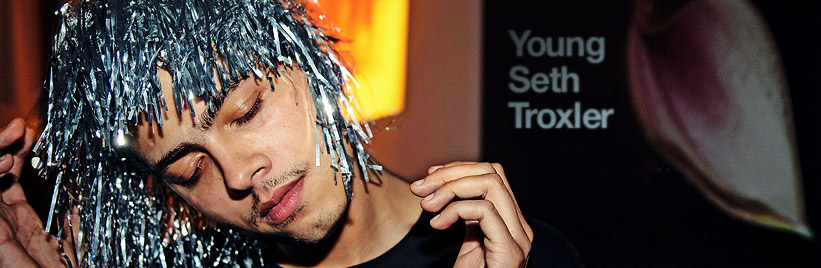
Seth Troxler wigs out
Seth wigs out for the WMC. “I may wear a wig. I've got a stylist working on this one for me. I don't know what I'm going to wear yet, but I know it's going to be over the top. It's going to be stupid."

Given your upbringing around music, did you always know you were going to pursue music or was it more of an accident?

I think it was more accidental. I'd always had a big interest in just listening to music, but when I was a kid, a lot of my friends were a lot better musicians than me so I played a lot of sports instead. I used to play basketball and travel leagues. So far every thing's happened by accident even up until a few years ago. In Detroit, you try to make stuff and do stuff, but it's all just for fun. You don't really know that there's a dance music industry or anything. Then you start coming over to Europe and then it's like whoa, this is going on! Then things happen, and it becomes like your job. I went to school for graphic design and I was planning on doing that, but things just kind of changed, I guess.

How did the Tesh Club parties come about?

In early to mid-2000, Ryan Crosson and I teamed up and started Tesh Club. I’d just moved in with Lee Curtiss, and we had this super huge basement with my Mackie studio monitors. Around this time we got really sick of going out because everything was getting quite boring, repetitive, kind of the same, you know? No one was really into the new music that we'd been fortunate to hear coming to Europe. There were a lot of us on the same wavelength so we ended up having this deep concept phase for about four months where we took lot of acid and did "research" about all the old records we really liked: all the old Perlon stuff, the old house records, basically a whole spectrum of music that we were really into. We did weird recording stuff like making samples with water and voices.

What is the “Tesh” thing all about?

Bruno Pronsato actually came up with this "tesh" thing after he came back to America. He was saying that in Germany they can't say "techno", they say "teshno". So Bruno came up with all these funny things like unicorns and stuff, kind of like a fantasy world to go with that. He was joking of course, but we ran with it. Soon we were like, "We're playing teshno." And the joke was that it was sexy, more downbeat, more experimental, like techno house. So then we started calling the parties in the basement Tesh Club as a joke. After that we started developing the concept in terms of sound, and we came up with this whole manifesto about the elements that had to be in it.

What did you come up with?

First we had “slap-your-girlfriend drums”, which were kind of like Mexican, South American, drunken Spanish offbeat drums, like what Ricardo does. And then we had “L.A pads”, like a boulevard of broken dreams thing: “I'm an actress and I moved to L.A but things aren't really working out and now I'm a stripper and addicted to meth." (laughs) There was also this “Sunset Strip pad”, like if you're from L.A and you're cruising down Sunset Strip listening to Sheryl Crow. And we had “the cool chord”, too. I think Lee's music around that time period was the most influenced by it. Like when he was doing the Kalimari stuff, that was all based on the manifesto.

Sounds like good times. Nowadays you're living in Berlin, so how did you get from your throwing parties in your basement to Europe?

The first week after I graduated highschool I went over to play this small FXHE tour at like Panorama Bar and Robert Johnson. After that I continued going over every summer to play. When it came to finishing my degree, America was in a really weird spot and there was nothing really going on in Detroit. It seemed like all my friends were in Berlin so it was the obvious move. It's cheap, it's really easy and it's kind of like a friend and family base, you know? America is not really in the best position now in terms of dance music culture so I had to move if I really wanted to take it seriously.

"In Detroit, you try to do stuff, but it's all just for fun. You don't really know that there's a dance music industry."


Some of the hardcore Detroit dudes are really impassioned about where they're from. How do you think they feel about someone like yourself who used to live and work in Detroit upping and moving out?

I'm pretty cool with different sets of people. I think a lot of people would like to get out of Detroit. A lot of those older Detroit guys only ever play there for their entire lives. In some ways I was always a bit of transplant. I didn't get there until my high school years so for me it wasn't such a hard move. But I see people who were brought up there, and have all their friends there being stuck and having those ideas.

Would you like to see more guys going over to Europe from Detroit?

Yeah, it’s great to see anybody from Detroit come over to play. I would especially like to see a lot of the old guys come over. Carlos Soufront really needs to come over because he's brilliant, Norm Talley, too. I guess a lot of people from Detroit are afraid to take that step because it's so easy to live that repetitive lifestyle that you can get into there, where you don't really think about what else there is to do in the world. One thing I do miss from Detroit though is that people there are really analytical when it comes to music. They're really knowledgeable and super-opinionated.

What are your favourite places to play in Berlin?

Club Der Visionaire is definitely my number one favourite place. I've also had some crazy times at Bar25, upstairs at Watergate and Arena Club. Weekend is pretty fun, but Der Visionaire is the best for me. It's the perfect place. I think this year we're going to start a night on Tuesdays. We're going to set up a BBQ and play jazz during the daytime then move into dance music later. We're going to set up a grill and play like 'Bitches Brew'. (laughs)

Having worked in a record store, what's your spin on the vinyl vs. mp3 debate?

I'm not a vinyl purist. More so than anything, I collect records. I collect music that's really good and is tangible in some way. I use Serato and I use records. Anything I buy on record is something I want to keep in my collection, but at the same time I want to play new music that's unreleased and stuff that I'm working on. I don't want to give up the use of the turntable, which to me is essential. It's so funny because a lot of vinyl purists will stay play so many CDs. I think it's worse to play a CD than to play a track off a computer using records. But in the end I think the vinyl industry needs to start making music which is more person-to-person, making stuff that people feel connected to. Like making the artwork deeper or having a concept that people can connect with.

Do you think a lot of labels just don't want to take risks?

Yes. I think they need to take a little bit more risk and also make records that aren't just a throwaway product. Records need to be made for the people again instead of just trying to be commercial tools. Then small labels would still be able to distribute their own music and make a decent amount of money. It's not like how it used to be where these distribution warehouses were selling so many records and record labels. Those days are gone, but if we reassess the situation and make records that feel good to have, like a lot of those classic rock records or records that people collect, then the record industry would be more than okay. People also need to be making good music. No one wants to buy shit music. That's why the record industry is going down to this sterile state in every sense of music because people aren't taking chances.

Finally, what about your own music?

I'm working on a couple of pop projects, one's called Sex Trothler (laughs), as well as an album for next year. I'm waiting on this new Linn Drum II, this new machine from Roger Linn, to arrive. That's going to be the key to it. The Sex Trothler stuff will be on Wagon Repair. It'll be Prince-like with Linn drum beats and stuff, and we've got a whole list of characters we're doing. Like Todd, Konrad Black, is going to be my roving reporter, who we're calling Jornando (pronounced "whore-nando"). (laughs) We're making that skit for the record right now. I've got another character called Blaxel Rose coming up pretty soon, too. And of course I'm sticking with my regular name. I think taking chances and developing conceptual ideas is really important for dance music now.

Words / Mohson Iqbal
Published / Wednesday, 26 March 2008

comment 30 Comments


Share this article


Features


Other features
RA staff pick out the ten top festivals happening around the world this month.
Chalets, bingo and techno. Happy camper Lee Smith goes raving at the English seaside for Bloc Weekend 2008.
Janet Leyton-Grant sits down with quintessential laptopper Jan Jelinek to find out why he’s been playing in bands.


About  
Staff  
Mobile (beta)  
Submit event  
Copyright © 2013 Resident Advisor Ltd.
All rights reserved. Terms & Privacy.