|
 |
 |
 |
 |
 |
Jan Jelinek: Together and alone
Janet Leyton-Grant sits down with quintessential laptopper Jan Jelinek to find out why he’s been playing in bands.
“The tragedy in electronic music is that people think it’s still innovative,” laments loop-meister Jan Jelinek in his Berlin studio. “There are a lot of people who are listening to electronic music that still think it’s avant-garde. But the strongest parameter to measure electronic music was its cutting edge aspect, like in jazz it was the virtuosity aspect. When that gets lost, you don’t have that much context anymore.”
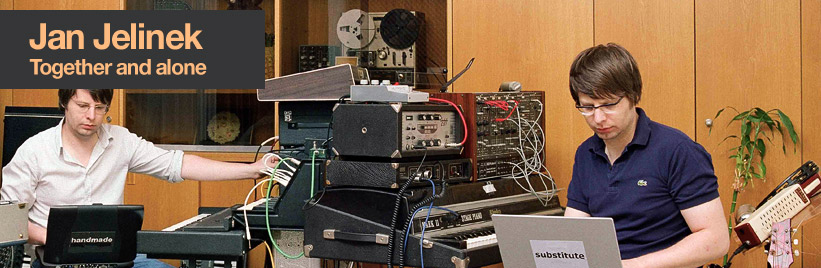
Once the definitive solitary electronic producer, over the last few years Jan Jelinek has re-prioritised, embracing decades-old ideas to force his music in new directions. In short, he’s been jamming with other people. He’s even gone sequencer-less, one of a sprinkling of laptoppers eschewing the programmatic for new directions after recognizing the limitations of MIDI, quantization and musical precision.
This is a complete turnaround from the music Jelinek is most known for. Loop-Finding-Jazz-Records (~scape, 2001) is perhaps the archetypal solo bedroom production—eight tracks of delicate funk made wholly from manipulated samples of old jazz records. His dance productions as Farben on Klang Elektronik became the signature sound of the early ‘00s clicks and cuts movement, the genre that introduced clubland to the spectacle of the solitary musician staring intently at a laptop screen.
“I always had the impression I failed with that,” confesses Jelinek. “When I was producing the music I always thought okay, this is dance music in a way, but when I was playing live, in the beginning very often at peak time in clubs, I failed. Well, not always. Sometimes it was really good as well”.
On record, however, the results have endured as classics. A good summation of Farben is Textstar (Klang, 2002), a compilation of 12-inches full of rolling pulses, pop undertones and clipped percussion. I ask Jelinek whether he has any plans to revive the Farben moniker and make dance music again. "Phhhh. I'm not really interested in that now," he says. “Eight or nine years ago there was this peak for electronic music, especially for clicks and cuts and laptop performances. I think during that short period in club music a big space opened for experimental music. But now it’s gone back to very basic kinds of productions.”
The sampling matters: A bluffer’s guide to Jan Jelinek
by Janet Leyton-Grant
Farben - Live At The Sahara Tahoe, 1973 (Featuring The Dramatics, Klang, 1999)
Big bass drives this danceable track, with layered, classic dub pongs and pings. Jelinek fakes a 30-year career and is his own one-man backing band, The Dramatics. Appears later on the Textstar compilation.
Gramm - Siemens.Bioport (Staedtizism, ~scape, 2000)
Bass heavy, warm track with delicate melodies produced under Jelinek’s lesser known Gramm moniker. Taken from on the album Personal Rock (Source Records, 1999)
Farben – Silikon (Beautone, Klang, 2000)
Static-filled, pulsing, driving loops and skipping rhythms—a Farben classic.
Jan Jelinek – Tendency (Tendency EP, ~scape, 2000)
Brisk bass with crackling loop and woody rhythm. Warm dub textures. Appears later on Loop Finding Jazz Records.
Farben - Love To Love You Baby (Farben Says: Don't Fight Phrases, Klang, 2002)
Soft, squelchy grooves, gentle beats and melody with slow woodblock percussion. Also included on the Textstar comp.
Auch - Tomorrow Goodbye - Farben Remix (Remix Tomorrow Goodbye, Force Inc, 2002)
Staticy, poppy remix that featured on Michael Mayer’s Immer (Kompakt, 2002)
Jan Jelinek Avec The Exposures - There are Other Words (They Have Not Told You Of) (La Nouvelle Pauvreté ~scape, 2003)
Jelinek once again stands in as his own fake backing band, The New Exposures. Mournful vocals, steely guitars and a drifting pace mark this out as an early precursor to Jelinek’s move toward a real band configuration.
Triosk Meets Jan Jelinek - Vibes/Pulse (1+3+1, ~scape, 2003)
‘Vibes/Pulse’ is a stand-out from Jelinek’s co-operation with Australian post-jazzists Triosk. Jelinek’s loops meet the wider dynamics of a live band.
Jan Jelinek - Universal Band Silhouette (Kosmischer Pitch, ~scape, 2005)
With thrumming guitar rhythms and spacey sounds, ‘Universal Band Silhouette’ is a definitive move to a new sensibility.
Jan Jelinek - A Concept For Television (Tierbeobachtungen, ~scape, 2006)
A noisy, droning structure reflects Jelinek’s shift toward the sounds of psychadelia and the influence of New York bands like Black Dice and The No Neck Blues Band: “I think they have a really fresh input because they’re influenced by German techno, but they’re also influenced by American alternative music,” says Jelinek." “And anyway I was a bit disappointed in the ‘scene’,” he adds. “For a while I thought that kind of music was interesting, but when I was involved in that context, I realized it was part of an entertainment industry. I was very frustrated after doing it for two or three years.”
In retrospect, Jelinek speculates that his laptop period was a reaction to years of going to rock concerts and playing bass in a band. With a background in funk rather than dance, Jelinek’s plunge into club culture was very much about experimenting with the techniques of novel form, especially such a functionalist one. It was also about creative freedom: “At that time I was really happy to produce music on my own, not to have compromises with other musicians,” he explains. “I was happy just to go to laptop performances because at rock shows I was always frustrated that people insisted on watching the stage, focusing on the performance aspect, and I was just focused on the music.”
It was an approach to music that was about to change. An early sign was 1+3+1 (~scape, 2003), an album of improv sessions which combined the delicate pulses and static of Jelinek’s loops with experimental jazz from Australian outfit Triosk. “I also remember I saw the No Neck Blues Band at the Volksbuhne,” he adds, “which musically was not really interesting, but it was like a theatre performance and that’s what I liked about it.”
A meeting with American producer David Grubbs, a founding member of ‘80s punk band Squirrel Bait, also planted seeds of doubt in the merits of a sound-only approach. “We were at a festival in Oslo, and there was a jazz duo, a drummer and an organ player. And I realized that David has a totally different point of view when watching live performances. He’s more focused on the social aspect, how the people are reacting to each other,” says Jelinek. “And that’s when I realized what this could be—even if the music is bad, the show can be good if there are interesting social or interactive things on the stage.”
The 180-degree shift came in the form of the album Kosmischer Pitch (~scape, 2005), a homage to the psychedelia and collectivism of 70’s krautrock, supported with a fully-fledged live band and tour. Hanno Leichtmann on drums, Andrew Pekler on heavily distorted guitar and Jelinek producing his unmistakable loops from effects boxes and a mixer eventually became Groupshow, and the band now performs improvised sets sporadically in Berlin and elsewhere, pursuing their own particular version of ‘social improvisation’.
Of course improvisation is not the safest or most reliable method of creating music, and when I bring up Groupshow’s recent performance at Maria, Jelinek winces. “It was bad. A bad show. We were more or less improvising the whole time, and I couldn’t hear.” I console him by telling him I thought last year’s performance at the Ballhaus was rather good. “Yeah,” says Jelinek skeptically. “Probably.” Then he laughs. “Probably it was better. We haven’t been very lucky playing in Berlin so far. We’ve thought about making shows which are not shows, just sessions open to the public, to invite people to the studio. But then that’s a very hippy-esque thing…”
Behind the Groupshow project is a fully-fledged musical philosophy of the collective dynamic taking precedence over the sound, an approach with roots in the proto-Fluxus ideas of La Monte Young, the commune-dwelling collectivism of the kosmische movement, or the '70s direction of Cornelius Cardew and The Scratch Orchestra. Jelinek explains: “We decided as a trio to not to have something like a repertoire and to work against it. But it’s very hard to because you always have to avoid tricks and habits, and that means the quality of the music not really good. But we don’t care about that—it’s more about this social aspect.”
A Groupshow studio album is in the works, but you might not like it, warns Jelinek. “It’s not easy music. People who like my old stuff will be even more disappointed than they were with the Tierbeobachtungen album. It’s not easy listening. A lot of harsh noisy stuff.”
Like Kosmicher Pitch, Tierbeobachtungen (~scape, 2006) was a collage of oddly meandering, kosmische influenced, loopy improvisation that rejected the sleekness of Jelinek’s earlier work. “The album was produced more or less in two or three days. It was like a live album. Actually thirty percent of the album I made in just a day in an improvised session.”
“When dance music started, there was an innovative aspect to it. But it’s like rock or pop music now—it’s repeating itself.”
Tierbeobachtungen got a good critical reception for the most part, but whether or not fans were convinced, it led Jelinek to put together a unique event: its record release party in the form of a concert of live remixing. Bored with the standard release party format, Jelinek invited musicians such as Robert Lippok, Pole, Bretschneider and Thomas Fehlmann to improvise their own takes on Tierbeobachtungen in ten-minute slots. The result was a success both socially and musically—the who’s who of post-laptronica who filled the tiny club were flush with enthusiasm for both the performances and the party. Pleased with the results, Jelinek recently decided to release the recordings as a live remix album, HUB.
For techno true believers, it might be tempting to dismiss Jelinek’s new emphasis on performance, improvisation and social music as a step backwards, a revival of past ideas even, but for Jelinek, the motivation has always been about creative risk-taking and a disdain for the ‘safe’ rather than fitting into a well-defined musical camp. His latest project kicks off in a completely different direction altogether. “I’ve actually finished a new solo album, but it won’t be released under my own name. The plan is to do something like a fake reissue,” he enthuses. “I produced the whole album with only three vintage bass synthesizers with no sequencer. The pieces are very short—only one and a half minutes or two minutes. It’s very basic and a bit cheesy. Do you know Raymond Scott? It’s a bit influenced by that.”
As the interview winds up, Jelinek also confesses he hasn’t quite shaken off the lure of the sequencer completely either: “I still like the idea of doing this kind of anti-music, programming music, in that it doesn’t have anything to do with the traditional parameters of music like virtuosity. It’s like working with Photoshop or something. Right now I’m preparing something for video artist Karl Kliem where I’m producing something only with a sequencer. I’m actually enjoying working with a sequencer again after two years of not touching it.?
|
|
|
|
|
|
Published / Thursday, 20 March 2008
12 Comments
|
|
|
|
|
 |
 |

Features
|
|
|