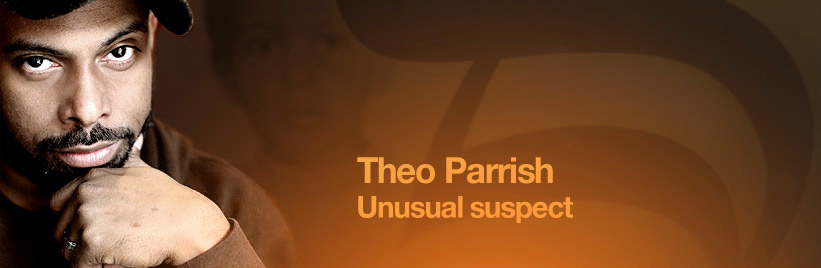
Theo Parrish: Unusual suspect
People like to think a lot of things about Theo Parrish, including the Detroit Police Department. Todd L. Burns tracks down the legendary DJ/producer to find out what’s what.
People make a lot of assumptions about Theo Parrish. The Detroit-based DJ and producer might be known for his deeper-than-deep house records, but don’t expect him to spin purist DJ sets – Parrish is just as likely to play vintage disco or soul ballads as anything house-related. Then there’s the assumption that Parrish is uncompromising and anti-commercial (perhaps this one stems from the rarity of his records), but this is a myth of sorts, too: the real Theo is not averse to his lending name to the odd sneaker advertisement, a recent move which led scores of naysayers to call him a sell-out. Then there was that infamous interview with the BBC – if you’ve got any lazy assumptions to make about Theo Parrish, Detroit and race, watch out.
But unlike the mysterious Moodymann with whom he has often worked, Parrish is happy to talk about these assumptions. Eager to explain the Adidas deal. Eager to excoriate journalists for buying into genre tags. Eager to relate what it’s like to live in the suburbs of Detroit.
In fact, over the course of our half-hour interview, I barely get a word in edge-wise. There’s no chance to ask about his beginnings as a teenager in Chicago, and how he learned how to DJ and produce tracks by watching people like Larry Heard and Lil’ Louis. No chance to inquire about his first years in Detroit spent cleaning up the KMS studios for Ron Trent, so that he could spend his off-hours in there making tracks for free. Or even ask him why he leans so hard on the EQ when he DJs, transforming recognizable tunes into strange and wondrous new "versions".
What he does talk about—the effort to keep vinyl alive, why his new CD will frustrate file-sharers, and what he means by sound sculptures—is revealing, and puts a little bit of knowledge in the place of a lot of this secondhand information floating around. It’s easy to make assumptions, but they inevitably lead you down the wrong path – just ask the Detroit Police department.
You recently made a short film about your music and Detroit that was sponsored by Adidas. I think it's a really beautiful piece of art. I was wondering how it came about.
Basically, I'm very skeptical about all these so-called technological advances. It seems like the Western world has an addiction to them. There's this idea that we should use technology to make things more convenient in every aspect of our lives. But I've found in artistic situations, it doesn't do much but shortcut certain critical processes. It makes creators kind of lazy.
As a result, you get people who call themselves artists that really haven't learned some of the major lessons of construction in those traditional forms. And with traditional forms you're dealing with hands-on, hard-learned lessons, so those kinds of shortcuts like Fruity Loops, Acid, Serato, Final Scratch and even MySpace too—all of these different things, they make me kind of skeptical of the folks that use them.
My wife, however, she's like, "You need to get on MySpace." [laughs] And, you know, I'd already let my website go to shit, you know, but I was still skeptical. But MySpace doesn't cost anything and she said that I might get more responses there. I was like, "Okay, I think it's bullshit, but okay, whatever.”
So, anyway, it turns out that this thing came up on MySpace. Somebody messaged me and asked me how I would feel about a film. So, weary as always, I said "Yeah, right, a film, okay, sure. Send me a proposal." They sent a proposal back. Turns out that they wanted to meet with me while I was in London for the Plastic People residency. They were an advertising firm called Amsterdam 180 that handles Adidas as one of their clients.
They said, you know, "We want to make a film about you." So I said, "Do I have to do some acting bullshit or get a leaf tattoo or anything like that?" They said, “No, just do what you do.” I figured I was already wearing their brand for years because of the comfort…so I thought about the best way to tie the city of Detroit into producing a song that would make it visually interesting, considered the places and additional people I wanted to use, and then came up with a figure to make it happen. And so they came to Detroit with a film crew, followed me around, and filmed the process.
"Music should be more than a job. It should be a passion. It should be something that you don't even see as work."
Did you worry about Adidas?
Of course! That's corporate culture. It's very rare that an independent artist is approached to do something corporate without some sort of ownership thing. But the bottom line was: I'm not owned in any way. That's what I was most concerned about protecting. Luckily everybody there, in all of the companies subcontracted by Amsterdam 180 that I was working with, was pretty honest, straightforward, and as professional as could be expected under the circumstances. The fact that it was a movie, a documentary, not a music video, but still a commercial made it a challenge for everyone involved to understand all the artistic priorities and still make it work for such a well-known client like Adidas. It just took a little wrangling. But mostly it was just patience to get everything the way it needed to go. Before all of that I was super-skeptical. [laughs]
The song that was in the commercial was from the new album, right?
Nah. That song is called ‘There's Something About Detroit.’ It's not on the album, but it might see release sometime in the summer.
There goes my perfect segue. I wanted to talk about Sound Sculptures, Vol. 1 bit. The vinyl version is a bit old now and now it's being released in CD format now for the first time, right?
Right, and wrong…as rare as music is on vinyl, if someone says a record is old, they are really calling it stale, but I don't think that's what you mean. If you mean it came out late last year on vinyl, yes, but that doesn't qualify as even a bit old to me. Now, if it dropped a decade ago, then it would be a bit old. So, that's a recent one. I just dropped the CD two-and-a-half weeks ago or something like that.
How is the CD different? When you went in to make it, how were you approaching it?
I ended up completing about forty songs over the course of two-and-a-half years and so, in mixing those songs, making different versions and figuring out which ones can form a cohesive piece, I eventually figured out which ones I wanted to do for the vinyl and I figured out which ones I wanted to do for the CD. The goal, in the end, was that I wanted the whole album to play as one piece. So the track IDs are intuitive. That means that if you try to download this album, it's going to be hell to try to get all of the songs starting from the beginning. I wanted to make it a little difficult for these CD Jockeys I hear too. So if you pick up the CD, there's a little surprise. It's been kind of fun to see who picks up on that surprise. Not many have yet. One distributor did so far and a few of my buddies have picked up on it. But most people haven't…or they know that's part of how I get down. [laughs] I'll probably release some CD numbers sans surprise in the future, but in much lower numbers.
I really appreciate the idea of messing with people who are trying to use these shortcuts. Or are trying to make it too easy.
Yeah! You gotta shake it up if you feel like there is something wrong, you know? I don't think there's anything wrong with technology. I don't think there's anything wrong with making your life more convenient. I think there is something wrong with taking the sacrificial part out of making art. Art is not supposed to be easy. You should have to make difficult decisions, like, "Okay, do I kick it with my friends or do I stay at home and chop this beat up?" "Do I quit my job and express myself with the hope of making ends meet?" "Do I make something everybody can play easily or do I throw a middle finger up to all the bland BS that's getting on my nerves?"
It's a job, if you want to be good at it.
Music should be more than a job. It should be a passion. It should be something that you don't even see as work. Eventually, yeah, some parts become work when you're not in the mood, or when your method of creation isn't up to speed with how you actually function in the world, or if your physical setup doesn't mesh with your lifestyle. But when you can create through those uncomfortable periods, when that time flies past, you know that's not work.
You mentioned art briefly earlier and I wanted to talk about that. You went to art school in Kansas City. You were studying sculpture there for a while and I was wondering how that plays into your work.
Well, if you think about it, sound behaves a lot like sculpture except there's a time limit. Look at that sculpture right there behind you. You look at it and there's a front, a back, an up, a down, around and through. So you're talking about volume. You're talking about spatial relationships.
The thing about sound is that there is a beginning and there is usually an end, there's a certain amount of space that it takes up, but the big difference is that all of that is merely alluded to. It's not something that's concretely in front of you. It's fluid. You may hear a snare, but the way that it's presented and the textures that it has, you can bring certain mental images to it. If you're listening. If you're listening.
A lot of times you'll put something on and it's just another track, but if you're listening to it you can hear a lot of the nuances that are in there and really start to understand…start to really get your head around it…
Repetition kind of sets a certain mass in a song. That's a constant, that's something you can 'see' all the time. Then there's little bits that come in and out and these changes that kinda shift on that pivot. If you think of it visually, sometimes you're dealing with almost a mobile-like thing. This is where I go in my head sometimes. Mobile means shifting, spinning, all kinds of stuff.
If you look at it, it could almost be like sculpting air. It's like you have all of these shapes…but you have to rely on a structure, but then again you really don't have to. So your structure tends to be your time limit – how long your recording is from beginning to end. Anything that happens in that amount of time is on you. Totally up to your creativity.
Sound sculptures: Top 5 Theo Parrish jams
by Thomas Cox
1. Theo Parrish - Musical Metaphors (Sound Signature, 1997)
The very first Sound Signature 12-inch is nothing short of classic. From the long, drawn out, bottom heavy ‘Carpet People Don't Drink Steak Soda’ to the ridiculously loopy and filtered ‘JB's Edit’, these are some of Theo's most raw productions. Experimental and soulful at the same time, for pure visceral dancefloor reaction these cuts are hard to top.
2. Theo Parrish - Solitary Flight (Sound Signature, 2002)
‘Solitary Flight’ teases you through the intro with mechanical drums that grind underneath quirky atmospherics, never preparing you for the aching beauty that is revealed when the piano and strings drop. It's one of those hands in the air, shouting in ecstasy moments, even if you're just rocking it on your iPod walking down the street. The definition of deep!
3. Theo Parrish - Sound Sculptures Volume 1 (Sound Signature, 2007)
The nod goes to the CD version of this album which compiles all the killer tracks from the vinyl (like the Marvin sampling ‘The Rink’, ‘Soul Control’, and the Omar-S collaboration ‘Synthetic Flemm’) and more than doubles the tracklist with a ton of exclusive jams too. ‘Goin Downstairs’ has been a highlight from recent 3 Chairs sets while guests such as Craig Huckaby and Amp Fiddler round out an essential release. Let's hope some of these jams see the light of day on wax soon.
4. GQ – Lies - Theo Parrish Edit (Ugly Edits, 2004)
Part of his infamous Ugly Edits series, ‘Lies’ sees Theo chopping up an album cut from the soulful disco group GQ and turning it into a melancholy party anthem. Looping the vocals for maximum hypnotic effect, the groove only subsides a bit when it breaks down to just the bassline and the drums halfway through, then the synth strings and vocals come back to finish the job. This edit was used (but not credited) on James Murphy & Pat Mahoney's recent FabricLive mix which is an easy way to get it, as the Ugly Edits are notoriously difficult and expensive to track down.
5. Theo Parrish - Twin Cities EP (Harmonie Park, 2004)
Rick Wade's label released this essential EP in 2004 though white labels had been doing damage on dancefloors for almost a year prior. ‘Twin Cities’ refers to the two towns whose music most influenced Theo, Chicago and Detroit, and he uses this song to pay homage to both with tracky drum patterns and dirty synthesizers. Flip it over for ‘Dance Sing’, a sweet extended trance-inducing disco cut-up. I'm fascinated by how you use certain structures and then tweak them a little bit: house, jazz, acid.
The thing with that is having a thorough understanding of the definition of those terms and then, at some point, throwing them away, totally disregarding them. You know, all of those are just marketing terms to describe an experience. So when someone says “jazz”, is Jay-Z jazz? I would say no. Is J Dilla jazz? I would say yeah. Combined, are they jazz? Probably not, but I don't know. But you can go through every single musician and apply something. You could say that Led Zeppelin is rock. But you could also find examples of music they did and make them jazz. Either way, all of those terms really don't apply anymore. They're antiquated terms that try to describe what's happened in past production cycles.
You know, there's like a ten-year production cycle that repeats, and this last cycle was flooded with so many different influences with roots stemming from the Midwest. Some songs were well executed and very original, but many were songs that came from biters, usually from other regions, trying to cash in on other's originality.
There are so many people that were into other things when “house” music was house music that I look at them and think, you're fraudulent! You barely understand the concept. Your song may be 4/4 and 120 bpm but that doesn't make it funky. Experiencing people can make you funky. The concept is not anything that you can go and learn online, you can't go on the Deep House page, download some Ron Hardy and Frankie Knuckle mixes and all of a sudden become a house expert. Face it – you weren't there.
First of all, it's a silly thing to try to do anyway. Second, it was really never about the "house" of it all. It was just a term to conveniently describe a place it was heard, then a lifestyle. The term was secondary, after the fact, beside the point. If someone in their 20's tries to come and tell you about the conception of house, that's something that somebody 25 years older than them probably really experienced and was talking about. You're regurgitating, you're not talking about anything current. Some people just want their “house” award, recognition for being the housiest one of all.
What's funny about most of that is that these biters wouldn't be able to steal and these 20-and 25-year old “house purists” wouldn't feel so haughty if it weren't for technology making it easy to claim an experience they otherwise couldn't. Hell, there are plenty of amazing people playing now. Go experience them. Get some floor time. That's really what it's about – getting out and going to the nearest place where there is good music, a good atmosphere and enjoying yourself. Keep your blend critiques and enjoy some people first. Then decide if it works for you. Then ask what's wrong. Then decide: What's your take on what's going on? What do you want to call it?
So what do you want to call your music?
I'm gonna call it my music. I'm going to call it sound sculptures, because that's where I'm at now. Tempo is irrelevant – whether or not the foot is on the one, the two, the three is irrelevant. It's about each specific song making sense to me. It's about those songs conveying specific ideas and specific feelings. And if someone picks up on those things and feels them? God bless 'em. Human communication is still functional, and we all haven't turned into robots yet.
You mentioned your music now. Do you listen to the music that you've done in the past?
Sometimes. There's a lot of times that you make something and you're not ready to play it yet as a selector. Because you might be ahead of yourself in production than where you are selector-wise. It depends. Some of the stuff that I did, I can't even hear it anymore. I can't hear 'Lake Shore Drive' anymore.
Really?
A year ago I was into it. The year before that, I couldn't stand it. It may come back, it might not, you know?
I wanted to ask about distribution in America. It's hard to get your records here.
Yeah, man. It's a mess. We've had a lot of major closures in the distribution network, particularly with Watts, Unique and Syntax. Those were pretty strong supporters of vinyl, but I'm confident right now that my network is pretty good at getting it out. Specifically where, though, is what I get concerned about. I'm considering reaching out to shops directly if they're having a problem getting Sound Signature product because I am realizing that the majority of the money that a distributor is making over here, they shoot right overseas. I don't blame them. But there's a big problem if we don't feed the roots.
It's funny, you always talk about digging and the sacrifice that goes into it. I didn't know that I was going to have go digging for you too.
That's the thing. Initially there was so much stuff out there in terms of other labels that anything you wanted to look for, you had to dig for anyway. Now I suspect it might get easier to find the stuff just because a lot of labels have fallen off, a lot of distributors have fallen off, a lot of DJs got lazy.
You want to understand why the labels are failing? Dedicate yourself to it. You say you want to play vinyl? Then play it. Quit crying about your back, quit crying about how rare everything is. I never used to hear all this crying and convenience talk. If you can't find the records you want, then you simply aren't looking hard enough, and you shouldn't be playing until you have enough records.
If your records are too rare to risk bringing and sharing with people, then guess what? You're a collector, not a selector. If your back hurts, hit the gym, hire a record bag boy or retire. But if you have a record label, you've got to manufacture vinyl. You can't just make money off of something essential that you're not going to put yourself back into. You've gotta support that industry. There are a whole lot of people who get paid that you're dealing with that are helping put things into the physical universe. If you make things that actually exist, then you can employ people. It's very simple. But if you get lazy, the only person that's gonna eat is Steve Jobs.
Steve Jobs is getting paid. So, basically, everybody is giving their money to him and wondering why their industry is suffering. Because you're selling it out, you know? Put your money back into pressing plants. Distributors won't close, stores won't close, pressing plants won't close. If you're cool with it being a dollar dream and giving it away, I think that's silly for future generations. There's going to be no more pure artists.
I mean, listen, the majors are about to be over. They're a mess. They're on the verge of collapse, so all that's going to be left is independent music. If we're teaching children now that music is supposed to be free, what do you think is going to happen ten years from now? No one is going to be motivated to do it anymore. We're going to go, "Oh, remember in the late 20th century and the early 21st when they're used to be music made by people?" That's what we're going to be dealing with. Right now, we're handing it all over to the robots. We're handing over to them and expecting to make the exact same profit. Not going to happen. You have to put your ass into it, if you want to get anything out of it.
"Steve Jobs is getting paid. So, basically, everybody is giving their money to him and wondering why their industry is suffering.”
On a lighter note…
[laughter]…
I wanted to ask about the end of 'Soul Control' where that Stars Wars 'Imperial Theme' comes in. It's a serious song, you know, but I can't help laughing when I hear it.
Well, it's simple, man. I was working with a new vocalist, Alena Waters, and we were just clowning and thinking about that bassline, how it's a really sick bassline. [sings bassline] And around that time Bush was lying about the troops going in and, at the same time, I was being messed around with by the cops because I had just moved about a mile from Detroit.
Basically, if you move just a mile from Detroit, you are in the suburbs. Make no mistake. And typically, in the suburbs, there are no black people. So out there in this subdivision, I'm the scariest dude in the neighborhood. Me being the scariest dude in the neighborhood is okay because the chance of my house getting broken into drops, but it also means that it's difficult to go drive around. The first two years, I was getting pulled over by the cops almost every week for something.
What?
Harassment, man. "You didn't put on your left turn signal at 5 a.m. in the morning." It was ridiculous. So he's busy running my tags, asking me if I own the car, that kind of stuff. Asking me if I live around there. "Yes, officer, I live right behind you in that house that the lights in your car are flashing off of." And these lights were waking up my elderly-ass prejudiced neighbors, which definitely gave them something to talk about. "That new drug dealer that moved in to the neighborhood was getting arrested last night!" [laughs] No. That musician dude is getting harassed again because you all haven't seen black people around here in 30 years, and back then they were serving you ham sandwiches and lemonade on silver trays and shit.
[laughs] Or they're pulling over my wife because she has a headwrap and a plastic cup in her hand. "Why am I being pulled over?" "We suspect you have an alcoholic beverage in that cup Ma'am..." "It's 97 degrees out here—it's iced tea. Here, you should taste it. It might refresh you. The heat is definitely affecting your judgment." "No thanks, you're free to go. Be careful."
When she was pregnant, I went on a late night Taco Bell run for her. I made it all the way to my house, and have the front door keys in my hand, the Taco Bell in the other, and a cop car that had been following my truck for three miles shines the light on me and asks for my ID and if I live here. I'm thinking, What was your first clue? I have keys in my hand and tacos in the other. Does this look like a breaking and entering? Wow, you're never gonna make it to detective that way. I ask him for an explanation and he gives me some bullshit about my tags. (Then why wasn't I stopped while still in the vehicle?) I get my license back and go inside, glad that the tacos aren't cold. I mean, I guess I'd rather choose that than have to shoot some desperate cat trying to get in my window. And that's the reality of life in America. That's life in America.
Damn, I can see why you put that in now.
It's funny, because I didn't even talk to Alena about that stuff. She didn't even know what I was going through with that, but it just came out. She just heard the track, threw down on it and bam. There it was. That was one of my newer experiments with some of the analogue keyboards. I started talking with my man Omar and I was just kind of amazed at how much power these things still have. So he lent me his MS-20 and that's what I did some of that on. I gotta give a shout to Omar for that.
This is Omar-S, right?
Yeah.
I'm sure you've heard his new 12-inch, 'Psychotic Photosynthesis'.
Ignorant. That shit is ridiculous. There's only a few people in Detroit…anywhere, really, that see that there's room to put out things or ideas that haven't been explored yet. He's doing that. He's also reaching out to some of these younger artists. He put this thing out, 'Plastic Ambash' by Kyle Hall. It's going left and right, timing is all shifting around. I'm still learning how to play it! It's an amazing, wild-ass record. But no one is making anything like it. You listen to it at first and you go, "What the fuck is that bullshit?" Then you listen to it again and you realize that he's on some next shit. And then you find out that the dude is just 17 years old? Crazy.
Last question: what are you doing for fun these days?
For fun? Outside of music, I do a couple of things. I play Soul Caliber III with my wife at 10 p.m., because that's when my son's asleep. I'm also talking on the phone with Omar about those damn cars. Cracking jokes with Marcellus. Every once and awhile somebody interesting comes in town to rock a set, I'll check that out. Playing with my son brings me the most fun—a lot of joy. Hanging out with him, that's icing on the cake. That's about it.
| | |