RA
RA Japan
Global
Local
Music
Interact
Search RA
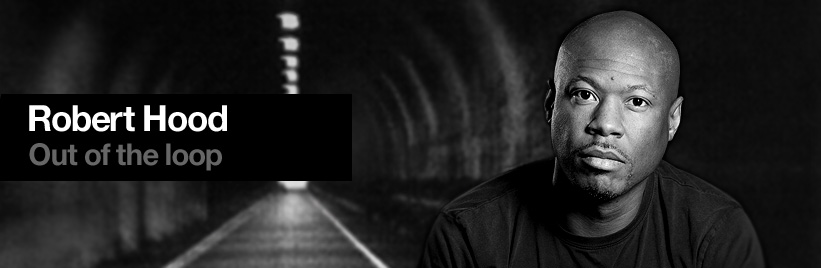
Robert Hood: Out of the loop

Lee Smith catches up with the man who invented minimal techno: Detroit pioneer Robert Hood.

The first time I ever heard Robert Hood play was at the inaugural Axis Records party at Lost in London, sometime in the winter of 1995. It was his debut live set, and with the crowd in front of him pretty much baying for a blast of Millsian fury, he'd rolled up in a waistcoat, a bow tie, and what looked like some kind of straw boater hat. He proceeded to largely baffle the boshing hordes with a set of scratchy waltz samples, lonely and beatless analogue whines, and unresolved atonal organ whirrs, punctuated by long bouts of silence as he loaded up each individual DAT tape. To my virginal ears, there was definitely something deeply fascinating hidden within the angular obfuscation of that strange, undanceable set - I just couldn't quite work out what. It seemed like, more than anything, he was pretty much oblivious to his immediate environment. It was as if he was entirely in control of what he was doing, but didn't know, and didn't really care, what was actually going on around him.

Thirteen years later, and Hood's sinewy, roughly-hewn coagulations of bassline, kickdrum, and brutally compressed groove are now widely recognised as the first foundations of what is now commonly referred to as minimal techno. And not before time, he's also achieving the wider recognition he deserves, thanks largely to his blisteringly funky contribution to the Fabric mix CD series. "Yeah, the interviews have quadrupled at least. I've had to get up really early to do them," says Hood in his London hotel, where he's resting up before his appearance at Split. Surprisingly, given his status, Hood holds a regular day job. "I can't remember it being like this at any time in my career. But I've been fortunate to be asked some real interesting questions, much more so than the usual questions I'm used to."

It's easily believable - up until very recently, an online search for Robert Hood interviews threw up next to nothing, save for a few brief profiles in American local newspapers. Unlike his early Underground Resistance cohorts Jeff Mills and Mike Banks, however, this detachment from the media, and by extension "the scene" at large, isn't part of some baffling cod-astrophysical mantra, nor is it an attempt at inverted Detroit myth-making. More humbly, it's Robert Hood simply doing his thing, and doing it on his own. Indeed, it's this singular, strangely isolated sense of self-containment that many believe is the cause for his much speculated-upon fallouts with the UR camp in the early 90s.

 A bluffer's guide to Robert Hood
Minimal nation: A bluffer's guide to Robert Hood
by Lee Smith


1. Robert Hood - Internal Empire (Tresor, 1994)
The one that started it all - Hood's previous dabblings had hinted at his penchant for brittle, boiled-to-the-bone starkness, but this was truly the first techno record that deserved to be called 'minimal'. Check the track 'Minus' to hear just how inspirational this album has gone on to become.

2. Robert Hood - Moveable Parts Chapter 1 (M-Plant, 1995)
Icy, impossibly sharp shards of minimal brutalism in classic Robert Hood style. Fierce as hell, but also laced with the kind of abstract deepness that at the time, made it sound like nothing else on earth.

3. Missing Channel - Submerged (Hardwax, 1996)
'Gold' is the one here - a fuller, more propulsive and accessible outing than much of Hood's work up until this point, but no less searing. Even today, the instantly recognisable lead synth still cuts straight through any set it's dropped in like a white-hot steel blade.

4. Turner - When Will We Leave - Robert Hood Remix (Ladomat 2000, 2005)
As a remixer, it's a toss up between this and Hood's version of Dave Clarke's 'Wisdom To The Wise', but the elegant arches, distant vocals and simmering beauty of this sparkling revision of electro-pop sweetheart Turner still has people scrabbling to find out what it is whenever it's played.

5. Robert Hood - Nighttime World Vol. 1 (Cheap, 1995)
Hood surprised the techno world when this album came out in 1996, with many expecting a thumping collection of dancefloor bangers instead of eight tracks of brooding, complex jazz and plaintive electronics. 13 years later, and it's revered as the classic it always was.


"I'm not much interested in talking about what happened with that now," he says, when I offer him the chance to put the internet rumours straight. "All I can say is that it was a situation that didn't have to be. People just have to have respect for each other, and in 2008, I have nothing but admiration, respect and love for Mike and Jeff. Whatever happened in the past, I just let it go."

More illuminatingly, he goes on to talk about his introduction to the UR camp, and his early forays into the stark, brutally reduced sound that eventually made his name. "I met Mike Banks and Jeff through Mike Clark in Detroit, and all I had was a Roland TR 505. Right off the bat, Mike [Banks] was interested in my drum programming. I was forced to be unusual in the way I did things. I had to squeeze blood from that drum machine."

So, did minimal techno - as evidenced by classics like Moveable Parts, Internal Empire, and Minimal Nation, all of which were released in 1993/94 - come about by accident or design, then? He pauses for a while.

"I would say it was by design," he eventually decides. "I had minimal ideas before I even learned how to turn on a drum machine. Around '92, everyone was just grabbing onto technology, everyone was big on tone generators. Rave was everything in techno then, you know, the gabba sound and stuff. I wanted a more humanistic approach. So I just focussed on what felt good to Robert, and not what the latest trends were. I knew it was the chordy, organistic, really stripped down minimal sound that was natural for me, so I embraced it and went for it."

It is this penchant for not following the pack that endears Hood the most to his fans, so I ask him the difficult question: How does he feel about the hordes of minimal copyists that have ended up following, often half-heartedly at best, in his wake? "That's always gonna happen," he admits, without any discernible touch of bitterness or disappointment in his voice. "People jump on a trend, they develop a name, they blow up huge, they come and go. It's because they are not connected to the artform. Whether it's techno or house or minimal, they use it as a product, not as an artform, so there's no longevity in it. My thing is to identify with your profile, tap into your musical roots, pay attention and don't forget it - but also, look forward, and don't dwell on the past. Then you'll have longevity. Things are always gonna come in cycles, everyone's gonna have their turn to tell the story. And depending on how you tell it, that will determine how long you last in this game."

He's also determined to stick to his guns as a DJ. While just about everyone else - including his once famously pro-vinyl mentor, Jeff Mills - has moved over to CD, Serato, and digital variants thereof, Robert still shows up to gigs with a bag full of vinyl, a fact made fairly apparent by some of the precariously unstable track transitions on Fabric 39.

"That's just how I feel, man," he explains. "If it ain't broke, don't fix it. That's the way I work. We been shifting back and forth with different technologies, with different ways of presenting house and techno, which is great - but I am looking for something that works for me. I don't wanna grab the latest technology because everyone else is. I think we got too many of us following behind each other, and nobody's prepared to be a vanguard and really stick to their guns, and be brave. People say that those who don't jump on technology are afraid of being left behind. I think the ones who jump on all the latest technology are the ones who are afraid of being left behind. There is no Pro Tools, there is no Serato, there is no compact disc that can outdate my form of music. The way I present it is timeless. It's in my heart, and it's in my hands. It's not in technology."

All of which inescapably brings to mind minimal techno's other most prominent, and certainly most well-known ambassador - Richie Hawtin. How does Robert feel about Hawtin's phenomenal popularity, and his unambiguous evangelisation of new technologies in electronic music?

"Well, ever since I've known him, that's what Richie's always been about," Robert ponders. "When you're just doing that, and not jumping on or following others, you're just being yourself. I cannot kick that. I applaud that. The way Richie has presented minimalism over the years has been inspiring - to me. I think he is one of the few that are true masters of minimalism. Rich and I sat down a little over a year ago, and spoke about minimalism, about ideas, about colours, about getting away from the typical, about what everyone thinks they see or know. He's dead on point. But at the same time, he's being Richie, he's being Plastikman, but that's what I'm saying - if you're about technology and reaching forward constantly, then that's what you're about, and you're being true to yourself."

"My sound, I won't say it's dark or sinister, but maybe more internal and cerebral than what you might expect."


I wonder who Robert Hood thinks the other 'handful' of minimal masters actually are? By his own admission, he doesn't follow trends; his Fabric CD is largely made up of his own material, alongside uptempo bangers that have more in common with the unbridled techno stomp of the mid to late '90s than with the mid-paced, sonically conservative sound that fills minimal clubs today. He also now lives in a remote Alabama village, where he "rides a tractor to mow the lawn" and "makes sure I have my groceries before 6 o'clock, because the whole town shuts up." Not exactly in the thick of it, then. Which techno artists have genuinely inspired him?

"Mark Broom, Dan Bell, Robert Armani, DJ Skull, Jeff Mills, Steve Rachmad..." he stumbles a little. "Oh, and Magda." I express a little surprise - is Robert into 'that' kind of minimal? "It's not my style, but I have to say, I heard that guy's first few records, and he is really onto something. He is true to himself. You know, I'm all like Robert Hood from Detroit, and he is like Magda, Germany. He is being true to himself, and he is making some really interesting material."

Shamefully, I can't bring myself to tell Robert that Magda is in fact a woman, who grew up in his hometown of Detroit. Maybe out of respect, maybe out of politeness, I don't know. In a way, it's akin to meeting the Dalai Lama and correcting him for forgetting your name - there simply doesn't seem much point.

But then, maybe that is the point. Detroit techno has always sold itself on its outsider status, and often parades its disregard for almost anything outside its own insular sphere. And who could be more of an outsider than a former Detroiter, who now lives quietly in Alabama, has a regular day job, and just happened to create possibly the most widespread variant of techno in its twenty year lifespan? And what kind of music could be more "outsider" than Hood's angular, unsettling, yet strangely engaging strain of stripped back techno? Perhaps being detached from the fripperies of Europe's well-established scene is exactly what is needed to create truly breathtaking minimal music.

"I compare my music to Detroit's skyline," explains Robert, when I ask him if he believes Detroit is still a potent force in techno. "It has this sort of grey haze. Even when the sun is out, it's just grey. To me, that was reflective of the city's attitude, the city's politics, its soul. Downtown had these grey buildings, and they would stand still as if they were in a museum. My sound, and in particular my 'Grey Area' sound, is reflective of that - I won't say it's dark or sinister, but maybe more internal and cerebral than what you might expect. Or maybe what some of the people from Fabric might expect!"

Internal, introspective, inward-looking - all of these terms are apt when it comes to describing Robert Hood's music. But in an age where the latest minimal promos are zipped from mixing desk to inbox to obscurity in a matter of days and weeks, Robert Hood's detached timelessness is, paradoxically, a force to be reckoned with. He's an outsider looking in, an almost alien presence who connects on his own terms, in his own unique way. And ultimately, that may just make him the perfect embodiment of everything techno is supposed to be about.

Words / Lee Smith
Published / Friday, 11 April 2008

comment 59 Comments


Share this article
Facebook
Twitter
Google Plus
Pinterest


Features


Other features
Steve McConville heads to Austria to check out rave in the mountains Snowbombing. Falling over = mandatory.
Philipp Cerfontaine catches up with Sascha Funke at Kompakt Records in Cologne.
RA staff look back at the week that was in Miami during the Winter Music Conference.


About  
Staff  
Mobile (beta)  
Submit event  
Copyright © 2013 Resident Advisor Ltd.
All rights reserved. Terms & Privacy.