Scion presents Breaking Through - Submit an artist today
RA: Resident Advisor Global
News
Features
The Feed
RA Newsletter
Local
Event listingsSubmit an event
Club Tickets
Party photos
Clubs bars and venues
Music
Music reviews
DJ PagesDJ Charts - Top 10s
Record labels
RA Podcast
Interact
My RA
Inbox
RA ForumsLatest forum topics
Competitions
Search RA
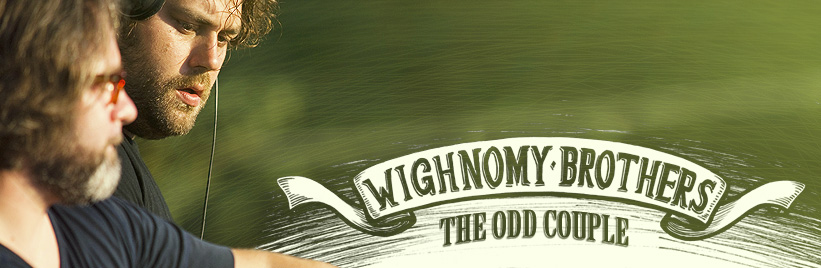
Wighnomy Brothers: The odd couple

Robag Wruhme is the music maker and Soren Bodner is... the sleepy one? RA's Richard Brophy calls up Wruhme at his Jena home to find out what makes the duo nervous, who's really producing the Wighnomy Brothers material and why his back is hurting.

"Do you like dogs?" asks Robag Wruhme, one-half of the Wighnomy Brothers, as he gets ready for another weekend of non-stop, city-to-city, club-to-club action. We're talking about canines and in particular Dobermen, because that's what Apolda, the small East German town that the Wighnomys come from, is best known for. "Don't worry, we don't have the same temper as them. Actually we're totally the opposite."

Like the left-of-centre techno and house that has flowed from the Wruhme/Wighnomy studio since the start of this decade, its author is quirky and offbeat, the polar opposite of a po-faced techno perfectionist and much more friendly than a fang-bearing Doberman. Unsurprisingly, our conversation doesn't take the form of a standard interview. When I ask questions, Robag is prone to answering, drifting off to a related topic and eventually coming back to expound further before finally reaching a conclusion—much in the same way that he arranges a track, or twists and turns his way through a six-hour set.

on the decks
However, for one topic, some clarity is needed: Given that their releases and remixes are issued under a bewildering array of permutations and combinations of Wruhme and Wighnomy, it's time for Robag (real name Gabor Schablizki) to explain the relationship that he has with his partner, Soren Bodner.

"We're really a DJ duo, but yes, sometimes, it's hard to distinguish between us and to see who does what," Robag explains. "Soren produces too, but he keeps it to himself—I have yet to hear his music. We have tried to work together in the studio: We tried it four times, but each time, after about 10 minutes, he just fell asleep. I started producing in 1996 and make all the music. I also did the new mix CD on my own, but we have been DJing together for 17 years. I think it's better that I produce on my own because it's hard to make electronic music as a duo: everyone has their own rules and opinions and that can make working together difficult. Also, because we are on the road every weekend, sometimes playing three gigs, we don't see each other during the week. We both have our own interests outside music and it's better that we're not hanging out of each other's pockets."

While Robag bemoans the fact that their busy schedule leaves little time for a private life, he still feels extremely fortunate and proud about what the brothers have achieved. It's a world apart from their formative years, living during the final, particularly bleak days of the East German communist regime. At that time, it was difficult to acquire music from the West, and any attempts to do so would have been viewed as clandestine behaviour. Undeterred, Robag recalls recording a Depeche Mode concert in Berlin that was broadcast on West German radio while he was staying with his grandparents.

"This was the way of getting into music back then: If the communist system had continued, this whole club culture would not have existed, it would not have been possible, nor could we enjoy such an incredible life, it has been unbelievable for us," he claims, his words starting to drift off into a reverie. When the regime fell, Robag and Soren felt like they had been given the keys to a kingdom of untold riches. "Just as the change was happening we were getting into music," Robag says. "When I was younger I listened to Front 242, KMFDM and Depeche Mode, but it was really difficult to buy music. We had no contacts in the West, so we had no real idea about what was going on. Once the Wall came down, we were in paradise, we spent every penny we had on records."

"There are too many people making boring music."


Once they discovered what was going on, they moved from Apolda—"a provincial town with 25,000 inhabitants, we got out fast"—to Jena, "a big university town with a lot of history." There, the Wighnomys set up their label, Freude Am Tanzen, in 1998, as an outlet for some of Robag's earliest material. Initially inspired by Warp acts like Autechre and the deep house that emanated from the US and the UK during the late '90s, the Wighnomys' progression into stripped back, distended rhythms dovetailed with the emergence of the new wave of minimalism from Germany.

But while he acknowledges that it helped them to come to international prominence, Robag has mixed feelings about the minimal sound. "The minimal boom suited us hugely, but what has come of it is another issue," he believes. "We got loads of the attention and since German music got more popular, 80% of our gigs are outside Germany, most of them in Europe. It used to be really hard to sell music from Germany abroad and with the exception of the few big names, few German DJs used to play abroad," he notes. "But at some stage, this music just exploded."

The minimal backlash is now in full swing, but Robag isn't quick to criticise the form. Instead, he feels that it's the processes used to create the form that are to blame. "The possibility to create music is so much easier—you don't even need a sampler anymore, and this has consequences. As it has become so easy, this means there are too many people making boring music. The problem is this constant re-use of sounds and the same FX, this is what is really uninteresting. We try to keep our music as authentic as possible, but there are too many people copying the same sounds when instead they should be keeping it simple. Unfortunately, it's the same problem in every genre."

Robag believes that this development has had a negative effect on the industry and even on their own DJing: "This overkill of music making meant that the production of vinyl went into overdrive and the consumer was being presented with more releases than ever," he says. "People were going into record shops and were being given 50 records to listen to instead of ten records and were still only buying three." The knock-on effect is that, increasingly, labels are finding it harder to make ends meet, especially the newer ones. "Thankfully, [Freude Am Tanzen] has been around for a while and we have built up a fanbase that follows us from deep house to rougher sounds to something else again," he says.

Despite his worries about the format, Robag is still dedicated to vinyl. "I'm still a huge fan, physically it's not good for me to be carrying around big record boxes, but I am 100% committed to it. It won't totally disappear," Robag predicts. Those big record boxes, clearly, are why it's as DJs that the Wighnomys excel, a place where their many sounds are united, from their deep house past to the rumbling, tearing bass of Wruhme's remix of Tanzmann's "Bulldozer" and the Brothers' clicky take on Slam's dreamy "This World" to Robag's disjointed, spiky rhythms of "Stekkruben" on Vakant and the Wighnomys' blissed dub out "Wurz & Blosse" on Speicher.

"We were so nervous the first time we played Fabric that we threw up."


Robag and Soren have gained a reputation as party DJs, but it's not just due to their diverse selection or interaction with the audience—they are known to celebrate as much as those who come to hear them play. So is their fondness for a tipple overstated or accurate? Robag says it's purely functional. They indulge to calm their nerves. "Our first major gig, it was for Kompakt in Cologne, we were so excited that we had to have a drink, and we also found out that the more we drink, the better we mix," he laughs. "Neither of us take drugs and we didn't used to drink, but that night we had a few vodkas and we felt a bit easier and we could get into the music. We were so nervous before the first time we played Fabric that we threw up, so a few drinks calmed us down," Robag adds. "The crowds we play to aren't sober and we don't want to have complete control either. I'm not a huge fan of clean, flawless sets, I'd rather four hours of drink-fuelled mayhem."

on the decks
Despite this tendency to get messy behind the decks, the brothers' new mix CD, Metawuffmischfelge is the opposite of on-the-fly mixing and alcohol-blurred selection. From the opening segment that pits Lisa Gerrard's paganistic vocals with the air-raid-siren-in-slow-motion sounds of False's "Fed on Youth" to the way that the melancholic woodwind hooks of Agoria's "Les Violins Ivres" bleed into the bugged-out vocal samples of Beckett & Taylor's "Let's Smash Up Our Love," through the jazzy house keys of Trentemøller & DJ Tom's "An Evening with Bobi Bros" before the mournful electro of Machiste's "Mosca Via" provides an unexpected outro, the mix hints at the diversity that fuels the Wighnomy's set, but is also refined in both its arrangement and execution.

Before he started working on it, though, Robag had serious reservations about the project. "When we play out, we are totally in the music and you can't recreate a night out at home on your decks during the week," he says. Instead, he decided to adopt a different approach, striving to create a perfect, seamless blend of many elements. "I wanted to make a CD that you can listen to anywhere: I could have chosen to do something with less melodies or more freaky, but it was very important to have many different features, that the listener could go back and listen to these sound collages and discern nuances again and again."

It's time for Robag to get going, to prepare for another long weekend spent playing in clubs around Europe with Soren. Before he goes, there is one thing that I need him to explain. The Wruhme/Wighnomy catalogue is littered with unpronounceable titles—Wuzzelbud KK, "Guppipeitsche," the title of the new mix CD—so is his stage name derived from an obscure linguistic deviation? German is a guttural language and it wasn't easy for me to speak to him in his native tongue, but "Robag Wruhme" sounds like something a heavy smoker would cough up after a night on the tiles. "Well, Robag is Gabor backwards: I use it because Gabor is a very common name in Germany and 'Wruhme' is our local dialect for 'Warum', the German for 'why', so I thought why not use it?"


Photo credits: Merlijn Hoek
Published / Wed, 03 Sep 2008

comment 19 Comments


Features


Other recent features
DJ Bone: True to da rootsSebo K: Safety firstBreaking through: Sleigh Bells

About  
RSS feeds  
Get involved  
Submit event  
Copyright © 2009 Resident Advisor Ltd.
All rights reserved. Terms & Privacy.