RA: Resident Advisor Global
News
Features
The Feed
RA Newsletter
Local
Event listingsSubmit an eventMiami WMC
Club Tickets
Party photos
Clubs bars and venues
Music
Music reviews
DJ PagesDJ Charts
Record labels
RA Podcast
Interact
My RA
Inbox
ForumsLatest forum topics
Competitions
Search RA
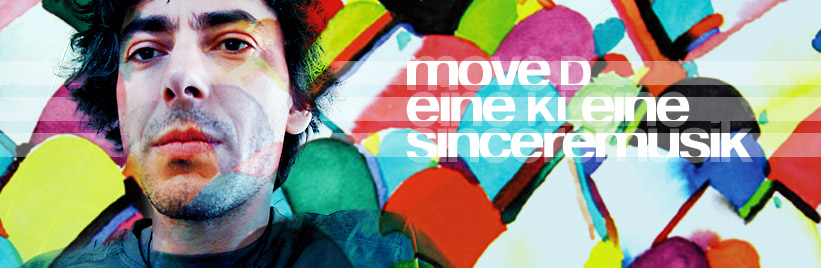
Move D: Eine Kleine Sinceremusik

Sincerity, flow and Uwe Schmidt: RA's Peter Chambers catches up with David Moufang to tell us why he might just be the deepest of them all.

Ask me about Move D, and it's difficult to compose a response. Is Move D an under-recognised innovator, or a veteran who's just been plugging away until synchronicity draws his style into the spotlight? Both are parts of the story, but neither captures what David Moufang is really like, what makes him tick or what ticks him off. In conversation, D is mostly reflective, but it's more the reflection of a steely surface, one that repels as much illumination as it returns. And then there's the moment where metal sparks on metal and everything is illuminated: "What I hate is musical parody."

I'd been asking questions about depth, something that seemed crucially important, given an artist whose tracks glide between "deep house," "deep techno" and "deep listening music." Indeed, it's D's "deepness" (real and perceived) that's won him new fans and accolades since the re-release of Kunststoff on City Centre Offices, an album I was not alone in loving for its interplay of gravity and levity.

"The term depth could maybe also be replaced by sincerity," D offers. "I definitely prefer sincere music over just entertaining music most of the time. I was coming back from Italy the other day," he elaborates, "when I heard Monty Python's 'Bright Side of Life' on the radio. This is pure comedy or parody and all this, and I thought it was really funny, and musical too—but in general it is not what I'm looking for in music. I'm looking for sincerity." Surely everybody who sincerely likes music likes "sincere music"—but why is D seeking out sincerity as an ideal in others' work, and his own? And why define it a stand against parody?

Move D
Move D takes to the keys
Parody is a word with a relation to real. It's "realness" turned upside down, on all fours, pants around ankles. You parody something to make it seem ridiculous, because it takes itself too seriously. Talk to D and you realise that there's a typically—perhaps stereotypically—German high-minded seriousness about Moufang and his work. It's a seriousness that, perhaps, makes him extremely vulnerable to parody. Maybe that's why it bugs him so much?

I think straight away of the character Bertie the Bolt, who appears in the liner notes of Nonplace's Difficult Easy Listening compilation to guide the perplexed with a cartoon and a caption that reads: "Just quality shit that is way up its own arse but, hey, we're German, please forgive us." But then, of course, Burnt Friedman is also German, and as serious a producer as Move D. And so is Burnt's sometime collaborator Uwe Schmidt (of Señor Coconut fame), who Move D singles out as an artist guilty of the kind of musical pisstake that really pisses him off.


"I totally appreciate Schmidt as a musician and a producer too, and he has done some mighty stuff which is nothing like parody, but there are tracks or even albums that are coming from this parody angle—and these are the ones I don't like as much as the serious ones." I point out that, in interviews, Schmidt has been at pains to emphasise that Señor Coconut was never in any way ironic. Señor Schmidt really meant it, as much as D does. "No, I don't mean Señor Coconut so much," D clarifies. "I was thinking of the one he did on Rather Interesting using clip art you can find on the internet for making artworks. He was kind of turning that into music, using cheesy samples." So to any of you planning on sending Move D a Weird al Yankovic DVD as a Christmas "thank you" for a great year's worth of music, think again. Music is serious. Next question.

"Music deserves more space for your own interpretation and imagination."


Sincerity isn't the answer in its entirety—not to the question of D, nor the question of deep. Earlier this year, in answer to another friend's question about music in 2008, I formulated a three-pronged defence against complacency, insipidity and redundancy. It said: "1) go deep; 2) develop a style; 3) make an emotional connection," and I offered Move D's collaborative work with Benjamin Brunn as a project I thought sharply exemplary of each. The greatness of their album from this year, Songs from the Beehive, is the way it builds its own soundworld, one that's full of spaces that expand and modulate with each exploration.

The fact that I'm still discovering new spaces in it months later seems a vindication of this, especially in an era when listening and reviewing is so much about giving a gloss on the froth, just in order to keep from drowning in the datasea. How many records that owned you on Monday were forgotten by Friday? How many times did you fail to identify your "favourite record" when shuffle brought it forth and a friend asked, "This is alright, what's this?" Beehive is unlike this: if it's not for everyone, it's because its gone deep into itself, in order to find that emotional connection, which in turn it is about the development of a style, one that's all about light and looseness, the open pursuit of space.

Art from the beehive
Five questions with Stefan Marx
Todd L. Burns chats to the man behind the artwork for Songs from the Beehive

Do you have any formal art schooling?
I studied graphic design, especially typography and theory in Hamburg.

How did you first get involved with the Smallville imprint?
Basically I got involved because I'm friends with Stella Plazonja, Julius Steinhoff and Peter Kersten. When they founded the Smallville shop in 2005, they decided to ask me for a logo drawing and a logotype. Before that I wasn't really involved in music artwork, I had just finished my very first cover for Isolée's We Are Monster.

Tell me a little bit about your working format. On the singles, it looks like you're simply using ink and paper.
I'm drawing a lot with black ink on paper, yes. But I also paint with oils and aquarelles. The Smallville 02 and Smallville 08 covers are pictures of oil canvases. The oil canvases are mostly bigger formats, they go up to 2x1.5 meters. Songs from the Beehive is an aquarelle work.

It seems like you're a very "automatic" worker, as though you don't spend a lot of time on these things. Is that true?
I spend my whole day working on these things, but you are right, I do loads, so some I do really quick. I do landscape drawings out of the train, mostly between Berlin and Hamburg, the landscapes there are so beautiful. That's where the cover to Steinhoff & Hammouda's "Tonight Will Be Fine" came from. I often try to capture things around me.

How do you approach the artwork for Smallville?
With Smallville the art is taken straight out of my studio or my books. I don't even write the musician's name on the cover. It's pure drawing or painting, mostly in black and white, printed one color black. Peter Kersten, Julius Steinhoff and I hang around in my small studio and have a look at the works and we decide together which work is right for each cover.


Key to the articulation of this open pursuit are two things: First, the album was entirely composed using Clavia's legendary Nord Modular, which allowed Brunn and D to build evolving sounds by patching, recombining digital modules together in new configurations that nonetheless show traces of their former sound-selves, as D explains. "It's kind of funny using existing patches in this way, because you can find elements of songs reappearing from the first one we did on Binemusic. There's also some bits (on Beehive) which I recognize from his solo records—you can hear the trail or the history of a sound in the unfolding sequence."

Second: Not only was Beehive composed almost entirely on the Nord Modular, it was done in realtime—and most of the tracks were done in one take. It's essentially an electronic improv album. Yes, really. "Benjamin and I just harmonise with each other very nicely," Moufang demurs, adding, when prodded, "We do one take, and usually it's somewhere in there, you know, maybe not from the very beginning, but maybe the latter half or something. That's in most cases. I remember only one track really where we kind of were looking for elements and putting them together. It just comes out of the flow in a way."

Another notable aspect of Beehive is the length of the tracks: "Radar," the album's subtlest pleasure, clocks in at more than 24 minutes. But the pursuit of recordings that suspend you in their mood for seven to ten times the length of a radio-friendly pop song isn't limited to Beehive, it's been a hallmark of D's collaborative work, especially the Raumland series with Pete Namlook. For Moufang, length is another way of generating depth, and it's been something he's been drawn to since he was a kid. "Ever since I was four, I felt that music deserves more space for your own interpretation and imagination. If someone gives me seventeen verses and/or a really strict musical pattern/chord progression then that is very likely to sound long or boring to me, whereas records like [Kraftwerk's] 'Autobahn' or [Pink Floyd's] Ummagumma never felt too long."

Repeat repeat, and music can be a space-making time machine. It can also open music up, and it's this sense of long, large and emphatically open emotional spaces that hooked D into the sound of Larry Heard, Aphex Twin, Derrick May, the KLF, Dan Curtin and Autechre. "When I started to get into producing electronic music in the early '90s I was really kinda fed up with the full descriptive images you were given by most other (vocal) genres—be it hip-hop, mainstream pop, anything... I felt that music deserved more space for your own interpretation and imagination." Moufang also finds himself railing against the "full descriptive images" of digital interfaces, both for production and for DJing. "I hate the over-visualization of music," he says. "I don't like staring at software. It's much nicer if you work with hardware, and with your hands."

Ironically, one of Move D's best DJ sets doing the rounds on the web was recorded in NYC earlier this year using Serato, which he says he only did to avoid immigration hassles. Echoing the sentiment of other pro-vinyl DJs like Michael Mayer and Theo Parrish in recent interviews, D explains that, for him, the interface severs the vital tactile relation that has existed between the DJ and her records. "That's the one thing I really hate. You can bring 20,000 songs on your hard drive no problem, but then you have to sort it into an endless list of names and letters. When I dig through my record bag it's a different relation… I think it's a stronger relation to the music and the piece."

It seems a big part of what D is insisting on here is not just the physicality and fetish qualities of records, but the way vinyl, as an instrument and a physical object, makes you move when you move it—as it's moving. That's the "move" in Move D, and it's something that keeps Moufang coming back to the groove, the place where the physical and musical motions meet: "The groove is fundamental for dancing. But also, your entire body and biorhythms are a matter of groove. It's fascinating to me how fulfilling and interesting or meditative a simple organic groove can be, even for a long while, or how bad, stiff and unfunky a 'well produced' track often sounds. Of course, there are trends and fashions, but essentially a groove is a groove and will be a groove." So there you have it. D is for deep, but his music? That's for moving to.
Published / Tue, 25 Nov 2008

comment 28 Comments


Features


Other recent features
Label of the month: NonPlus+Joris Voorn: A dedicated mindPlaying favourites: DJ Sprinkles

About  
RSS feeds  
Get involved  
Submit event  
Copyright © 2010 Resident Advisor Ltd.
All rights reserved. Terms & Privacy.